
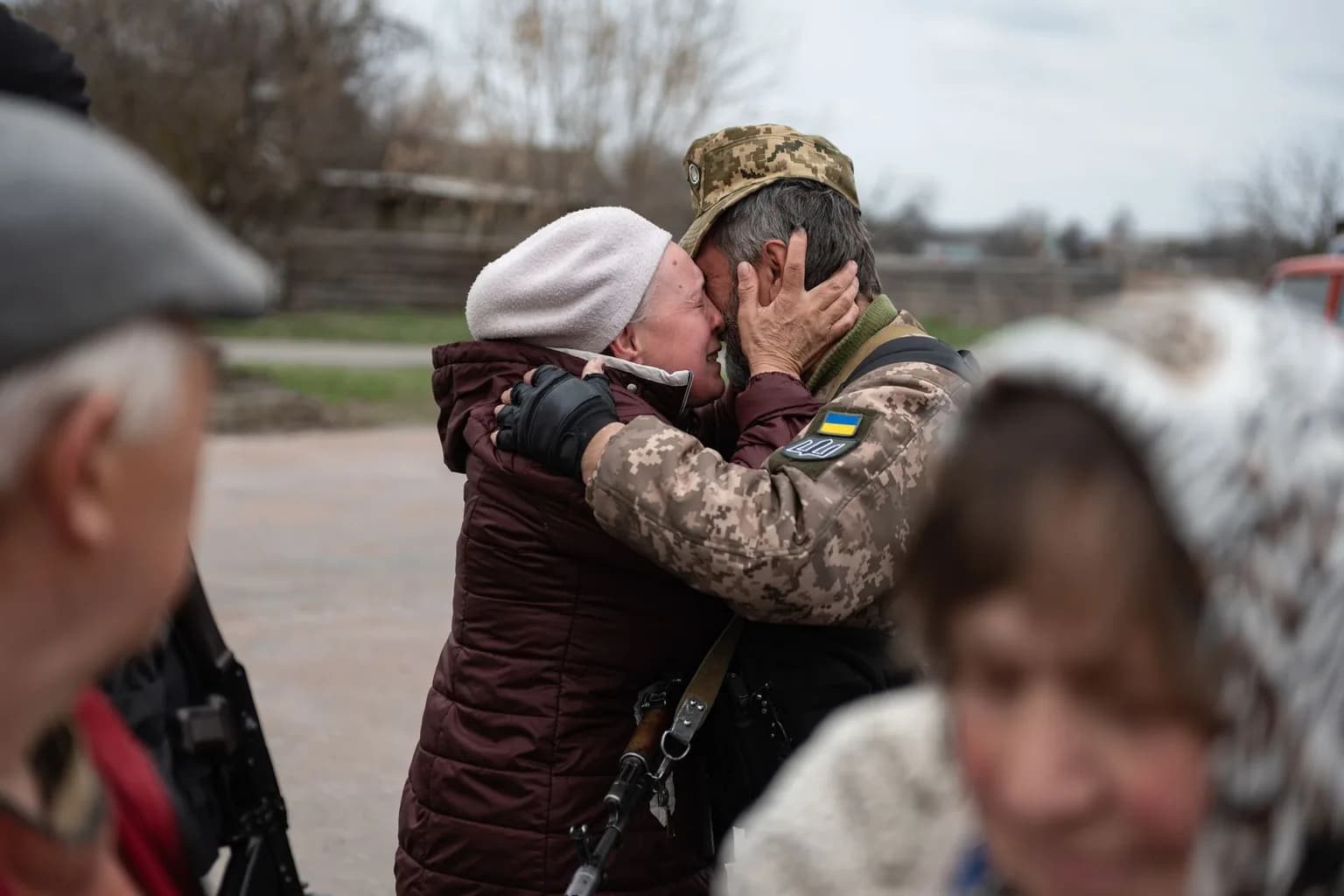
Ukraine and Russia should preserve the practical machinery that allowed civilians to leave Oleshky and use it for further evacuations wherever both sides can secure an agreement. A ceasefire of 87 hours cannot settle the wider conflict, yet it has created a route out for people who had lived under occupation and, in some cases, endured years apart from their families.
For Liza Paliy, the passage out of occupied territory carries the weight of a separation that began more than two years ago. The 19-year-old fled Oleshky with her mother and sister, while her father remained behind. “We thought at that time that it would be a month, two maximum, and we would return, but unfortunately, two years have already passed,” she said.
Her account is the human measure of this operation. Russia occupies Oleshky, a city in Ukraine’s Kherson region, and residents began reaching Ukraine on Saturday after evacuation through Belarus. The status of Paliy’s father is unknown, as are the total number of people evacuated, any reunions after arrival and the longer-term plans for those who crossed into Ukrainian-controlled territory.
The agreement was brokered by US First Lady Melania Trump. It was coordinated by Ukraine’s human rights commissioner, Dmytro Lubinets, and his Russian counterpart, Yana Lantratova. That cooperation deserves to be treated as a working humanitarian channel, with the narrow aim of moving civilians safely rather than as a substitute for resolving the occupation itself.
The ceasefire took effect at 3:00 a.m. Kyiv time on Tuesday, Oct. 27. Ukrainian and Russian military commands agreed to suspend combat aviation, drone interdiction, artillery fire and offensive manoeuvres across the Oleshky pocket and surrounding transport routes in Kherson region. Lubinets said the arrangement ran for 87 hours without recorded violations.
Such terms are necessarily limited. The strongest case for caution is that a local pause in military activity offers only a temporary opening, and the operation left major questions unresolved for the evacuees. That is true. Yet the alternative during this window was to leave vulnerable people where they were, despite an arrangement designed around their passage. The better course is to retain the ceasefire framework and apply it again when it can be verified and when civilians need a route out.
The operation was organised around those least able to make a difficult journey alone. Gathering points were set up near Oleshky’s central hospital, with priority for elderly people, people with disabilities and families with children. A humanitarian fleet of 25 buses had room for 750 passengers, supported by ambulances equipped for people with limited mobility. Lubinets said the oldest returning resident was 94 and the youngest was a baby just over one.
An official Ukrainian humanitarian delegation, led by Lubinets and accompanied by international journalists, arrived in Oleshky on Friday, Oct. 30. Civilians and accompanying officials then travelled by bus from Oleshky through Russian-occupied Crimea to Anapa, the Russian Black Sea port city, before taking charter flights to Gomel, Belarus.
Four aircraft carrying the evacuees landed in Gomel on Saturday, Oct. 31. Davyd Arakhamia, a Ukrainian parliamentary faction leader, said the passengers would be on Ukrainian territory “within hours.” They subsequently crossed the Ukrainian border in the Chernihiv region, President Volodymyr Zelensky said. “As of now, Ukrainian citizens from Oleshky have crossed the Ukrainian border in the Chernihiv region. All of them will receive the assistance they need.”
At their arrival, Ukrainian officials held posters reading “you are not alone” and “we embrace with our hearts.” An elderly woman leaving a bus said the residents had “escaped from hell.” Those scenes explain why the mechanics matter: buses, ambulances, agreed routes and a pause in fire can determine whether a civilian has any realistic way to leave.
We should resist two errors. One would be to inflate a local humanitarian arrangement into a solution to the war. The other would be to dismiss it because it is narrow. The ceasefire’s value lies in its limited purpose, which is to get people safely across territory that had kept them apart from Ukrainian-controlled land.
The next step should be to keep this channel available, with the same focus on vulnerable residents, defined transport routes and commitments from both military commands. Ukraine, Russia and the officials who coordinated this evacuation should seek further arrangements when civilians can be moved under comparable safeguards. A temporary corridor has already brought people through. It should remain a means of doing so again.
Comments (0)