
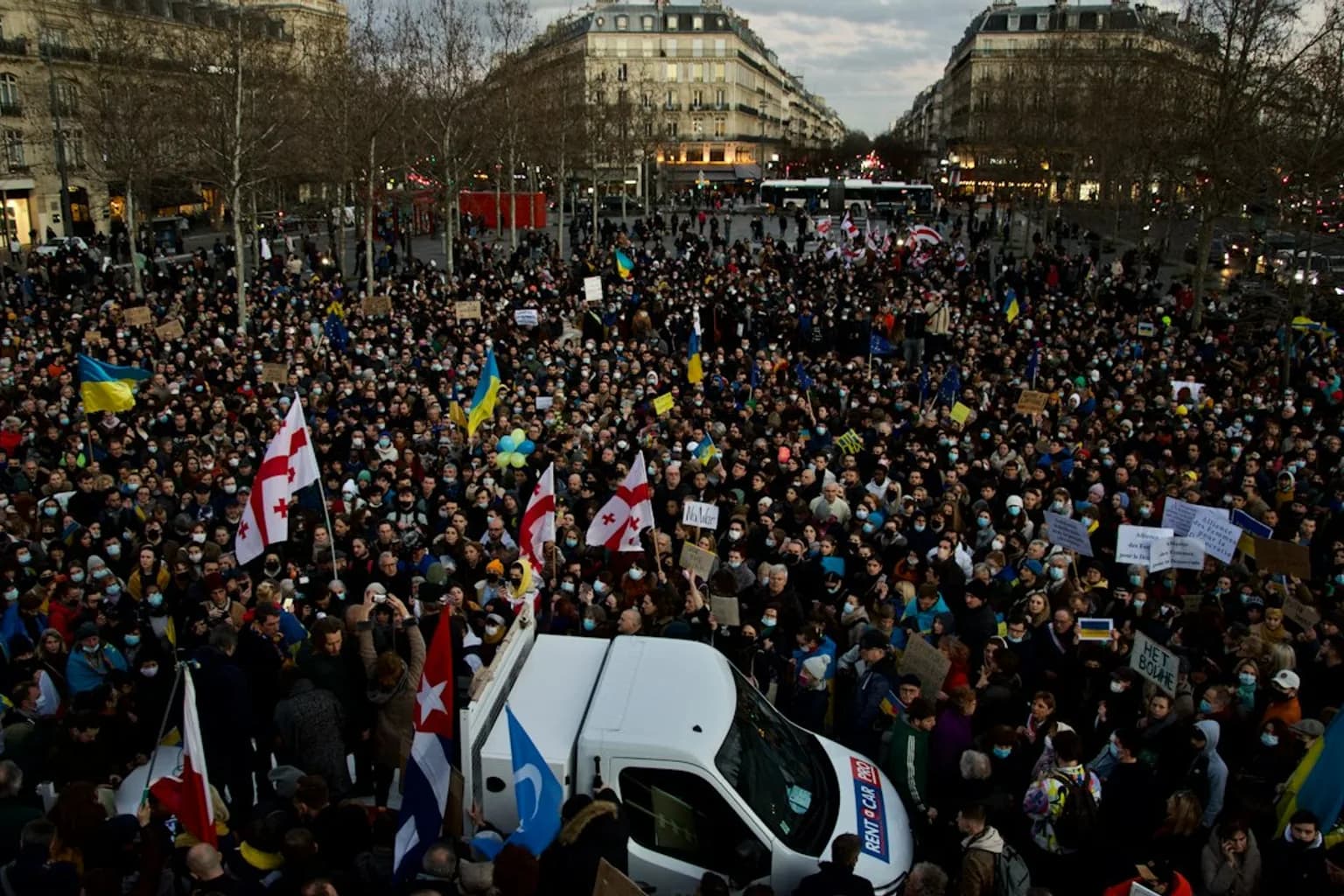
For families struggling with rising living costs and students facing neglected buildings and teacher shortages, France’s third Saturday of demonstrations kept pressure on public services and education funding.
The protests began last month with high school students opposing deteriorating school buildings, teacher shortages and a university admissions system they regarded as unfair to disadvantaged students. The movement has since widened to include anger over living costs, inequality and public services.
The first mass protests, on 17 October, drew 550,000 people and became one of the worst days of civil unrest in France’s recent history. Government estimates put turnout at 410,000 on 24 October.
On Saturday, 31 October, about 320,000 people joined rallies around France, a further fall in attendance. Laurent Nuñez, the interior minister, said about 150 planned demonstrations had passed peacefully.
For Corentin Cabreux, a 21-year-old student, the protests concern conditions in the state-run residence where he lives. “there are damp stains all along the bottom of my walls, whole sections peeling off, cockroaches everywhere, rats,” he said.
Aaron Berthier de Grandry, a 15-year-old high school student from the Paris suburb of Nogent-sur-Marne, planned to attend his third consecutive weekend of demonstrations. “When I was little, I was told young people were the future. Well, if we, as the future of France, lack resources, that means France will end up collapsing,” he said.
About 70,000 people set off peacefully in Paris from Porte de Bagnolet, near the ring road, and headed along boulevards on the south-eastern outskirts towards Porte de Charenton. Cléo Farenc, a 30-year-old gallery assistant, joined the Paris march dressed as a beheaded Marie-Antoinette.
Jérôme Rodrigues, another protester on the Paris march, said: “The French economy is doing badly no matter what happens, because today we're being run by a group of incompetents who juggle billions while families are struggling with a few cents.”
Authorities described the national situation as “generally calm” in the early afternoon. As marches dispersed, however, clashes broke out in Marseille, Paris and Lyon.
At and around Porte de Charenton, dozens of masked people dressed in black used hammers to prise up paving stones and throw them at police. The Paris police prefecture said a “hardcore of several hundred rioters” had attacked officers with projectiles.
A riot police officer in Paris was hit by a molotov cocktail, an incident Nuñez called an “attempted murder”. He had warned of a “very high risk” of public disorder and said he would not allow a repeat of earlier riots.
In Lyon, protesters threw projectiles at police, who responded with teargas. Police in Toulouse used water cannon against an unauthorised protest involving several thousand people, mostly young demonstrators.
Police made 511 arrests during the day. The total had risen to more than 560 by Saturday night.
Nuñez said 70,000 police and gendarmes, including elite units, would be deployed to contain violence at the edges of the protests. Authorities were also alert to the possibility that Halloween masks could be used to hide rioters’ identities.
Camille Guérin, a protester in Nantes, said: “We say no to the cost of living, no to the far right, yes to high school students' demands, yes to giving citizens a voice.”
The government is pressing ahead with a contested law that would make rioters liable for up to €10,000 in damage caused by themselves or groups they are deemed to belong to.
The unrest comes as public debt approaches 120% of economic output and the economy was already shrinking in the third quarter. The Chamber of Commerce estimates that losses to retailers exceed €1 billion ($1.1 billion).
Student protesters plan further high school and university blockades on Tuesday and Thursday before joining a demonstration on 5 November called by workers and trade unions, according to Sabrine Kharbach of the Union Étudiante.

Comments (0)