
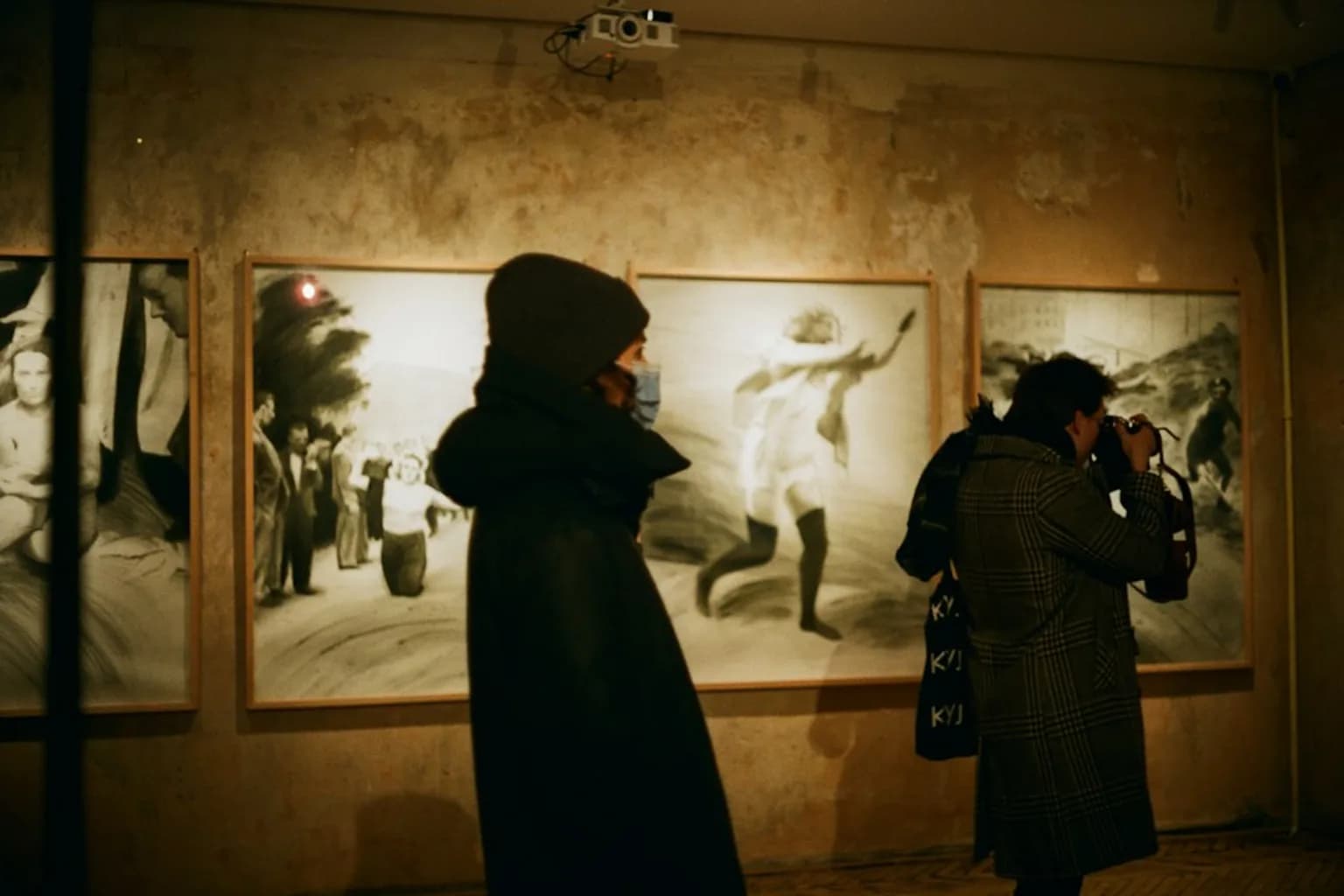
The art and literature made by Ukrainian cultural workers, including people who have since died, will shape how the war is remembered, Charlotte Higgins argues in her new book.
Russia’s full-scale invasion of Ukraine began in February 2022, disrupting cultural life and prompting artists, writers, poets and filmmakers to record the conflict’s human cost.
Higgins, The Guardian’s chief culture writer, had spent much of her career interviewing and assessing artists, authors and poets when she was drawn to Ukraine after the invasion. She wanted to understand what war does to art, and whether Ukrainian culture could flourish amid the destruction.
Her reporting trips extended across three years from the autumn of 2022. She arrived in Kyiv on 10 October, then reported on cultural workers in Kyiv, Kharkiv and Lviv as they registered the human cost of the conflict.
The result is
Ukrainian Lessons: Art in a Time of War
, published by Jonathan Cape on 20 August. The 272pp hardback is priced at £22.Among the works considered is
Civilians. Invasion (2023)
, by the Kharkiv artists Daniil Revkovskyi and Andrii Rachynskyi. Their hour-long film assembles unedited videos found online and was shown in the Ukrainian pavilion at the 2024 Venice Biennale.The people making and recording this culture have themselves been caught in the war. Marharyta Polovinko, whose drawings depicted roaming monsters, was killed in action in 2025, aged 31.
Victoria Amelina, a Ukrainian novelist and war crimes investigator, died aged 37 in July 2023 after sustaining severe injuries in a Russian missile strike.
The losses extend to the institutions that hold a country’s cultural record. At least 120 Ukrainian museums have been damaged in the conflict, according to the country’s culture ministry, including the National Art Museum of Ukraine and the National Chornobyl Museum.
On a Saturday morning in August, jet-powered Shaheds struck Ranok’s Kharkiv headquarters. The impact came about 30 metres from where 50 staff members were gathered.
The publisher’s warehouse, built 15 years ago on the site of a former bread factory, covered about 10,000 sq metres and contained 628,000 new schoolbooks. The attack destroyed 8 million books, more than 85% of Ranok’s total stock, and firefighters took a week to bring the flames under control.
Viktor Kruglov, Ranok’s co-founder and chief executive, said: “When you see what was produced with your brain, with your hands, with your imagination, spoiled by Russia, it's an awful feeling.”
Russian missiles or drones have destroyed 13 million Ukrainian books this summer, a third of all books printed in Ukraine that year. Until 2022, Russian-language titles accounted for about 70% of the Ukrainian book market. Ukrainian booksellers stopped selling Russian imports that year as commercial ties between the countries broke down.
The shift has also made room for new institutions. Oleksiy Erinchak opened the first of his Ukrainian-only Sens bookstores in 2021, then opened a second Sens site in 2024 in a huge building on Khreshchatyk, Kyiv’s grandest boulevard.
Ukrainian writing had already produced enduring popular works. Oksana Zabuzhko’s 1996 novel
Fieldwork in Ukrainian Sex
became a bestseller. Bohdana Laiuk is a Ukrainian deputy minister for culture whose work includes literature and publishing.Higgins’s book places these writers, artists, publishers and booksellers in the same larger struggle: the effort to make a record while the physical places, works and people needed to preserve it remain under attack. Her argument is that their work will endure as the memory of the war.
Comments (0)