
The Dawn That Gave Key His First Line
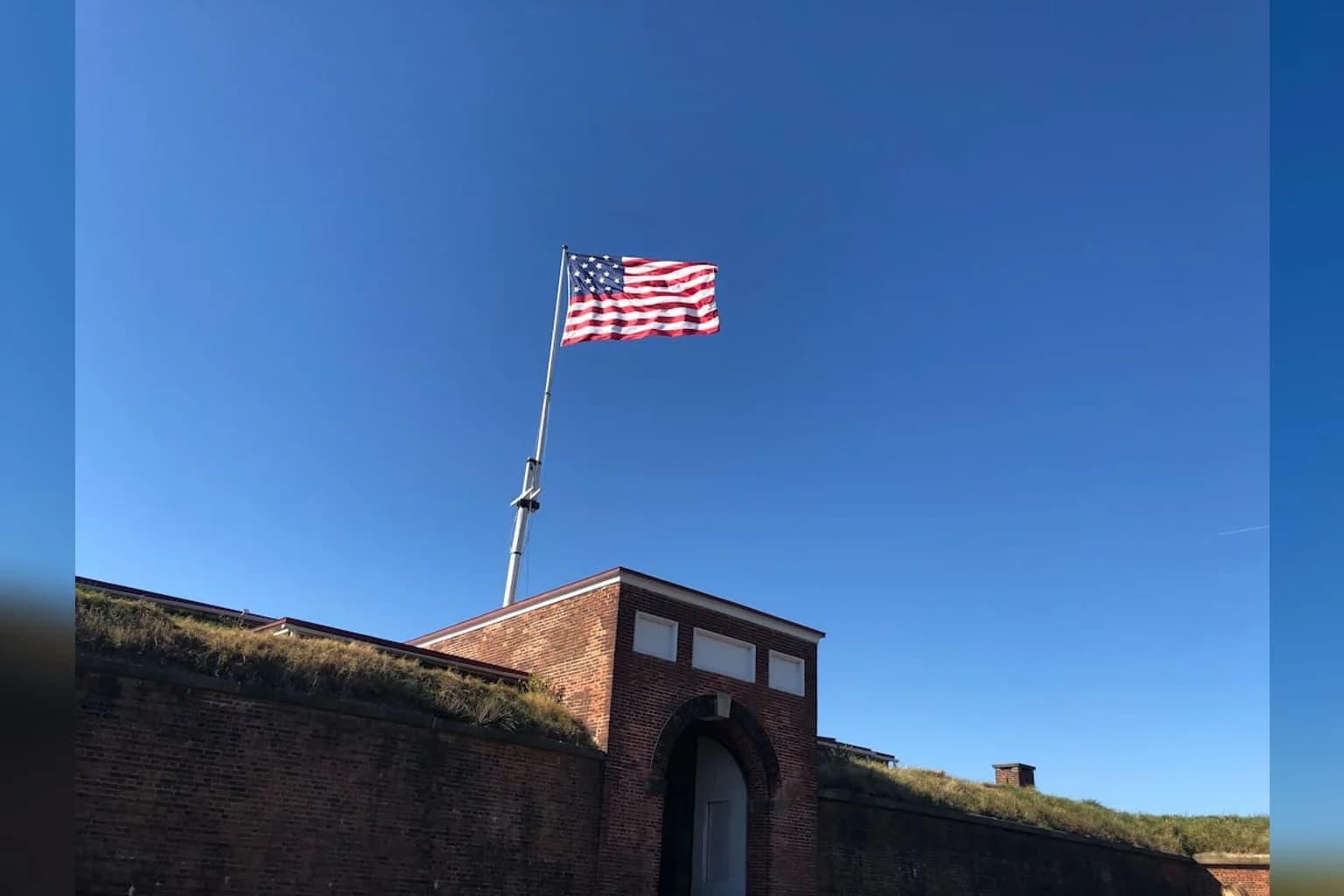
Early on September 14, 1814, Francis Scott Key looked toward Fort McHenry and saw the American flag still flying. The sight came after a British bombardment that had lasted twenty-five hours, and it gave Key the image that would lead him into words Americans still know. Britannica records that he began writing that morning, while the National Park Service identifies the flag as Fort McHenry’s large garrison flag. The National Park Service
Key saw that dawn from a constrained place. He, John Skinner, and William Beanes were under guard on an American ship during the attack, even as the fort at the center of his view endured the bombardment. According to Britannica, their presence began with an effort to secure Beanes’s release, a mission that placed the three men close enough to witness the battle and then held them there as its outcome unfolded.
That arrangement gave the morning its strange pressure: Key had come to help free another man, and instead found himself waiting through the night under guard, with Fort McHenry’s flag serving as the answer to the question the darkness had left hanging. From the deck of an American truce ship, he watched the raising of the garrison flag on September 14. The National Park Service describes the moment plainly, and its force rests in the sequence of events: a long bombardment, the arrival of dawn, and a flag still visible over the fortress.
Key began a four-stanza poem from that sight, calling it “Defence of Fort M’Henry.” The Library of Congress says the work was written on September 14 after he witnessed the British attack, and the poem would become “The Star-Spangled Banner.” The next part of the story follows the route that carried Key, Skinner, and Beanes into that guarded vantage point, where a prisoner-release mission became the setting for a dawn that entered American song.
A Prisoner-Release Mission Became a Front-Row Seat to Battle
That route began with a lawyer whose life had long been rooted in Maryland. Francis Scott Key was born in Frederick County on August 1, 1779, and moved to Annapolis in 1789 for preparatory school at St. John’s College, according to the National Park Service. He entered legal study under his uncle, Philip Barton Key, in 1796, a path that led to a prominent practice in Frederick and Washington, D.C. His career already placed him near consequential public disputes: in 1807, Key defended Justus Eric Bollman and Samuel Swartwout against treason charges connected to an alleged conspiracy designed by Aaron Burr.
That legal standing shaped the mission that carried him toward Baltimore in September 1814. The British had burned Washington, and Dr. William Beanes, a physician from Upper Marlborough, Maryland, was being held by the British. Key set out to seek Beanes’s release after securing permission to intervene from President James Madison and Commissioner General of Prisoners John Mason, Britannica recounts. The purpose was precise and personal: bring a detained American physician home.
Key had help from John Stuart Skinner, whose roles made him an especially useful companion for such a task. Skinner worked as a lawyer and publisher, and he also served as a prisoner-of-war exchange officer, the Library of Congress explains. He met Key in Baltimore on September 4, bringing experience in the machinery of wartime negotiation to Key’s authority as a lawyer.
Their partnership gave the mission its practical form. On September 5, Key and Skinner sailed under a safe-conduct flag aboard an American cartel ship, according to Britannica. A safe-conduct flag marked their purpose as negotiation, and the vessel carried them from Baltimore toward the British force holding Beanes.
Each step narrowed the distance between a legal errand and a military crisis. Key had begun with the tools he knew best: official permission, a fellow negotiator, and a voyage undertaken to secure one man’s freedom. The British fleet lay ahead, and the terms of that encounter would soon place the mission within sight of Fort McHenry.
From Baltimore to the Tonnant, Then Into Custody
That distance closed on September 7, when Key and Skinner reached the British command vessel Tonnant at the mouth of the Potomac River. The ship stood at the center of the force they had come to approach under safe conduct, and the Library of Congress identifies Admiral Alexander Cochrane as its commander. Key’s mission had brought him into the fleet to argue for a prisoner’s release; once aboard, the course of the journey came under British control.
The negotiation involved Key, Skinner, and William Beanes, and it placed all three men in a position shaped by the coming attack on Baltimore. The British allowed the Americans to proceed no farther with information gathered during their contact with the fleet. As the military operation moved forward, the three were kept under guard, a decision that turned their truce mission into a forced wait at sea. Britannica records that Key, Skinner, and Beanes spent the bombardment of Fort McHenry under guard on an American ship, close enough to witness the assault while unable to leave.
The movement between vessels makes the confinement especially clear. On September 13, according to the Library of Congress account, Key and Skinner, along with Beanes, were transferred to HMS Surprise and then returned to their own ship. That ship became their viewing point as the attack unfolded. Key was still an American lawyer traveling under a truce flag, yet the role that now defined his night was simpler and more immediate: he was a witness looking toward Fort McHenry.
From that deck, the fort remained the fixed point while the men waited through the bombardment. The setting gave Key neither the distance of a report nor the freedom of a participant on land. He had entered the British fleet to secure Beanes’s release, and the fleet’s precautions left him watching the battle from the water with the very man he had come to help. The National Park Service likewise places Key aboard an American truce ship on September 14, where he watched Fort McHenry’s large garrison flag raised after Britain’s twenty-five-hour bombardment.
That vantage point carried the mission into its final, decisive hours. Key had seen the British command vessel, passed through custody, and returned to an American ship whose deck faced the fort through the night. By the first light of morning, the question before him had narrowed to the flag over Fort McHenry, and the answer would give him the image that set the poem in motion.
Key Turned the Flag Into ‘Defence of Fort M’Henry’
With that image before him, Key began giving it language. The flag supplied the scene, and the scene supplied the question at the center of his first lines: whether it still flew over the fort at dawn. He began writing on September 14, and the words took shape as a poem rooted in what he had witnessed from the American ship. Britannica records The immediate force of the work came from its close view of a single morning, yet Key gave that morning a form built for a wider audience.
Back in Baltimore, he rewrote the poem in a hotel, turning the first draft into four stanzas titled “Defence of Fort M’Henry.” According to Britannica The four-stanza structure gave the flag a larger setting: a battle scene, a celebration of survival, and a series of claims about who belonged within the nation the poem praised. Key wrote those verses to be sung to “To Anacreon in Heaven,” also called “Anacreon in Heaven,” a popular tune by the English composer John Stafford Smith. The Library of Congress identifies the poem as a four-stanza work written for that melody.
That musical choice shaped the poem from the start. Key wrote lines meant to travel by voice, with the melody carrying his account from a witnessed event into a song others could learn and repeat. The words and tune also brought together two histories already present in the moment: an American fort under British attack, and a melody associated with an English composer and the British Anacreontic Society. Britannica notes The resulting work held its drama in the language of a song, which gave each stanza room to make its own argument about the battle and its meaning.
The third stanza makes one part of that argument impossible to miss. It includes the couplet, “No refuge could save the hireling and slave from the terror of flight or the gloom of the grave.” As the Library of Congress records the line, it places “slave” inside the poem’s vision of victory and danger. That language remains part of the text Key wrote, alongside the dawn image that first set him writing. The poem therefore carries its own legacy questions within its four stanzas, waiting behind the familiar lines that would soon begin a very different public journey.
A Printer, a Broadside, and a New Title
As the poem moved back toward Baltimore, it also began moving beyond the moment that had produced it. Key showed the verses to John Stuart Skinner on the return journey, and Skinner probably passed them to Samuel Sands, a young printer’s assistant who set the words in type and printed them within days, according to the Library of Congress. The poem entered public view without Key’s name attached, carrying instead the title “Defence of Fort M’Henry.”
That first anonymous printing gave readers a text they could hold, share, and sing. The words appeared in a broadside in 1814 under the title “Defence of Fort McHenry,” while Baltimore-area newspapers printed them with directions to use the tune “To Anacreon in Heaven,” Britannica records. The musical instruction mattered because the melody was already familiar: Key had written his four stanzas to fit “To Anacreon in Heaven,” the theme song of the British Anacreontic Society.
The poem then reached a wider local audience through the Baltimore Patriot, which published it on September 20, as Britannica notes. Each printing carried the work farther from the guarded ship, the fortress, and the hotel room where Key reshaped his draft. Readers encountered a poem with a title tied directly to Fort McHenry, then found in its printed directions a ready-made way to turn those words into a song.
Later in 1814, sheet music gave the song the title that endured: “The Star-Spangled Banner,” according to Britannica. The change shifted attention from the defense named in the original heading to the image at the center of its first stanza. From then on, the flag that Key saw at dawn would carry the song’s public name, even as the four stanzas preserved the wider and more complicated text from which that image came.
America Kept the First Verse and Carried the Whole History
That wider text remains part of the song’s record, although public performance has traditionally centered on its opening stanza. The Library of Congress notes that “The Star-Spangled Banner” traditionally includes only the first of Key’s four stanzas, the verse that follows the flag through the night and into the morning. The choice gives the anthem its familiar arc of suspense and survival, while leaving most listeners far from the language that follows.
The third stanza brings that distance into focus. It includes the couplet, “No refuge could save the hireling and slave from the terror of flight or the gloom of the grave,” as the Library of Congress records. Those words belong to the same four-stanza poem that produced the anthem’s opening verse, and they place the song within the world of its author rather than outside it.
Key’s own documented life gives that world a direct human context. He most likely purchased his first enslaved person in 1800 or 1801, and by 1820 he owned six enslaved people, according to the National Park Service. In 1816, he also helped establish the American Colonization Society. The anthem’s first verse therefore travels through American public life with the remaining stanzas still attached to its history, and with Key’s participation in slavery and colonization part of the history attached to him.
That history also includes the domestic and professional life of a man whose song became vastly more public than his name. Key married Mary Tayloe “Polly” Lloyd in 1802, and the couple eventually had eleven children. The National Park Service also records that he served as District Attorney for the District of Columbia from 1833 to 1841. His life held family, law, public office, enslavement, and the poem whose first verse became a shared ceremony.
Every performance of that first stanza carries this selective inheritance. The familiar words preserve the dawn image that gave the song its name, while the other three verses preserve a fuller document, including language that continues to shape how Americans encounter Key and the anthem he wrote.
The Witness Account Became the National Anthem
That fuller document kept moving through American life, and the song continued to gather words even after its first four stanzas had taken their familiar place. During the American Civil War, poet Oliver Wendell Holmes and sculptor Emma Stebbins each wrote additional stanzas for the song, extending a work already bound to public memory and national conflict. Holmes’s contribution took a particularly clear form in 1861, when he wrote a fifth verse to Key’s song, according to Britannica.
Those additions show how readily the anthem’s frame invited later Americans to speak through it. The original song could hold the dawn over Fort McHenry, the four-stanza poem could hold its harder language, and later verses could carry Civil War-era voices into the same musical tradition. Yet public performance settled around a narrower selection. The first stanza became the customary version, a practice that left Key’s opening scene at the center of the song while the remaining verses, along with Holmes’s and Stebbins’s additions, remained part of its larger printed and historical record.
Over the following decades, the song’s official status remained unresolved until Congress acted. On March 3, 1931, a congressional resolution designated “The Star-Spangled Banner” as the national anthem of the United States, the Library of Congress records. President Herbert Hoover signed it into law that same day, giving formal national standing to words that had begun as one witness’s response to a morning at Fort McHenry.
The designation completed a long public journey. A poem born from the view of a guarded American witness after a twenty-five-hour bombardment had become the song the country chose for its ceremonies and collective occasions. Each performance of its first stanza therefore carries several histories at once: the flag Key saw at dawn, the mission that placed him within sight of the battle, the four-stanza text that circulated under another title, and the life of the man who wrote it. The national anthem preserves that opening image in song, while the full record keeps asking listeners to hear the history around it.

Comments (0)