
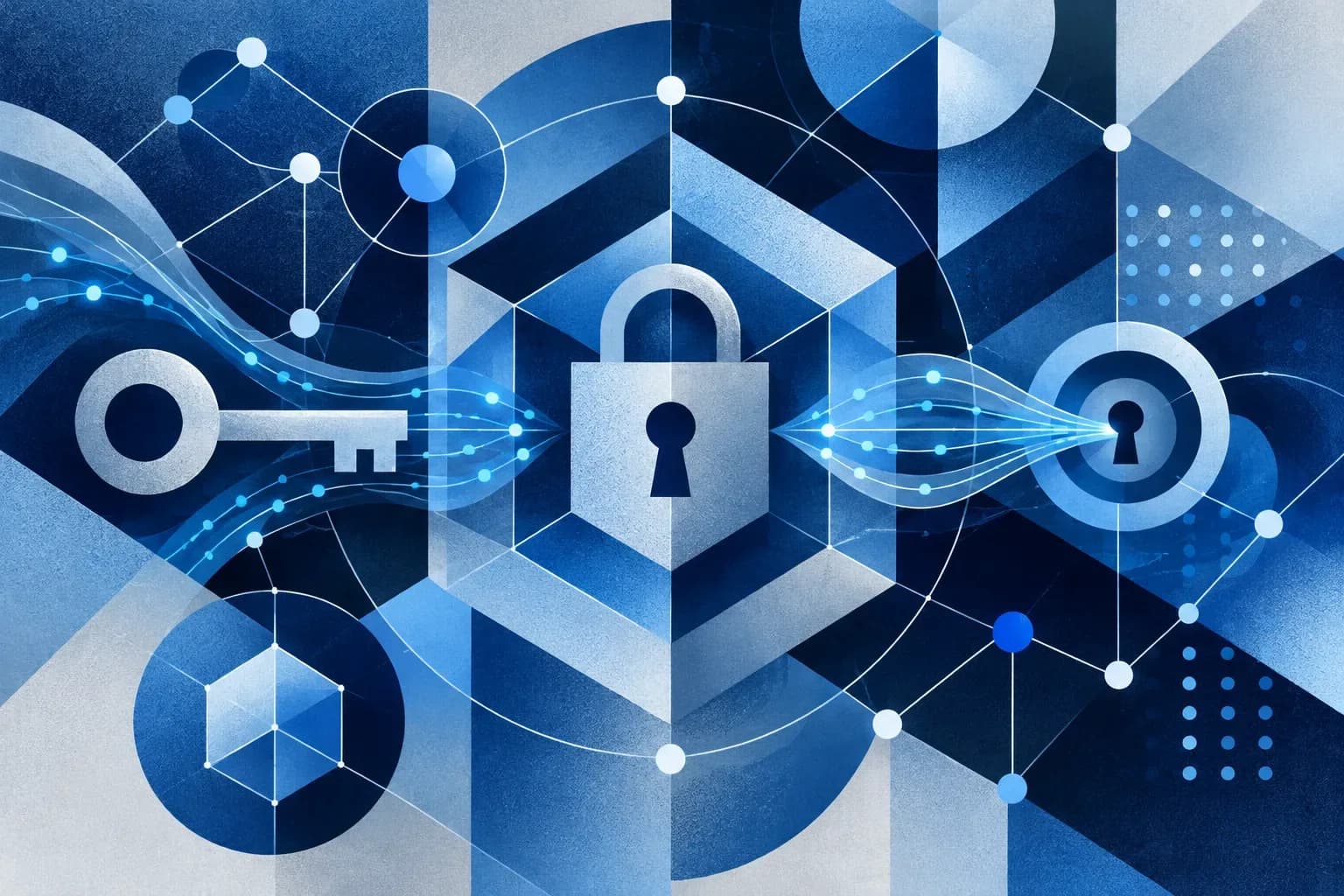
Every Secret Once Had to Travel Before the Message Did
Imagine two people who have never met trying to send a private message across a channel that anyone can watch. They can turn the message into an unreadable jumble with a cipher, using a mathematical key much as a door lock uses a physical one. Yet the real problem arrives before the first message leaves either person’s hands: both people need the same key.
Until the mid-1970s, cryptographic systems worked this way. Sender and recipient used one shared secret for both encryption and decryption, a model now called symmetric or secret-key cryptography. Britannica explains that this arrangement creates a key-distribution problem, since the participants must first exchange the very secret that will protect their later communications.
That exchange can feel manageable when two people share a secure meeting place, a trusted courier, or an established relationship. An open network changes the terms completely. The channel that carries the key can be watched, copied, or intercepted, and anyone who gains that key can read the messages it was meant to protect. The encryption may be strong; the arrangement still depends on a prior act of trust.
Scale makes the dilemma sharper. A private conversation between people who already know how to share a secret is one thing. A network built for people, organizations, and machines that may have no prior relationship has to answer a harder question every time a new connection begins: how do both sides obtain a shared secret without exposing it along the way?
For centuries, cryptography concentrated on the message itself. Ciphers apply algorithms to turn readable words into unreadable jumbles, while keys are the mathematical values that make those algorithms work. The Atlantic’s primer likens the relationship to a lock and its key, a useful image because a lock can do its job only after the right key reaches the right person. In conventional cryptosystems, that delivery required its own protected route.
This left private communication with a circular problem. People needed a secure channel to establish the secret that would secure their channel. As communication spread across systems designed for broad access rather than private handoffs, that circle became the defining obstacle. The essential question was waiting in plain sight: when the route between strangers is open to interception, where can trust begin?
The Breakthrough Was Making One Key Public
It can begin in public, with a key designed to be seen by everyone. Public-key cryptography gives each participant a pair of related mathematical keys: a public key that can circulate freely and a private key that remains with its owner. The system is also called asymmetric cryptography because the two keys have different roles, yet they work together as a pair. Public-key cryptography rests on a simple discipline: the public key can be openly distributed, while the private key must remain secret.
That arrangement changes the shape of the exchange immediately. A person can publish an encryption key in a public directory, allowing anyone to use it to scramble a message. Only the corresponding private key can turn that scrambled message back into something readable. Britannica describes the practical model plainly: anyone can encrypt for the recipient, and only the intended receiver can decrypt. The sender and recipient therefore use different keys, each doing the part it was made to do.
The image from Quanta Magazine makes the oddness of the idea easier to hold: the two keys act like complementary ingredients in invisible ink. One ingredient lets a message disappear into an unreadable form; the corresponding ingredient brings it back. The public ingredient can sit in full view, available to every stranger who wants to send a private message. Its visibility is the feature that makes the system useful. A private message no longer depends on a private handoff before the conversation can start.
That public invitation also gives the system a clear human logic. Publishing a public key says, in effect, that anyone may lock a message for this recipient. Holding the private key means that the recipient alone has the means to open what arrives. The relationship creates a practical boundary around the message even while the route carrying it remains open. Security concentrates in one closely held mathematical value rather than in a secret delivery of matching codes.
Everything therefore turns on the care given to that private half of the pair. The public key earns its value through distribution; the private key earns its value through secrecy. Together they provide the first workable shape of trust between people who may have no prior channel at all, and they do so by making openness part of the design.
The Math Works Because Reversal Is Brutal
That openness holds only because the mathematics creates a vast difference between going forward and coming back. Public-key systems rest on trapdoor functions, as Quanta Magazine explains: calculations that anyone can carry out in one direction, paired with a reverse calculation that becomes prohibitively difficult unless its holder possesses the trapdoor. The public side of the system can therefore invite the world to perform a particular operation. The private side gives its owner the rare ability to undo its result.
Large prime numbers offer the clearest picture of that bargain. Take two very large primes and multiply them together: the multiplication is straightforward. Start instead with the enormous product and try to recover the two original primes, and the task becomes computationally impractical. Scientific American’s account of the field, hosted by MIT, identifies that difficulty as the basis of RSA. In the RSA model, a user selects two large primes and publishes their product, while the security of the system rests on the difficulty of factoring that product back into its components, according to Britannica.
The force of the idea lies in its asymmetry. A calculation can be easy enough for ordinary use while its reversal demands a level of work that makes an attacker’s route effectively closed. This is the quality cryptographers seek in a one-way function, the mathematical problem from which key pairs are generated. A cipher turns messages into unreadable jumbles through an algorithm, and the key supplies the mathematical value that makes that algorithm act in a particular way, as The Atlantic describes it. The hard problem supplies the wall around that process.
That wall depends on disciplined construction and careful custody. Security assumes a properly chosen key; an easily guessable key compromises even a strong algorithm. The private key also remains the chief point of exposure in a public-key pair, since someone who learns it gains the crucial advantage the system was designed to reserve for its owner, according to Wikipedia’s overview. Nor does a difficult underlying problem guarantee every implementation forever: RSA and ElGamal have known attacks faster than a brute-force search, and a once-promising knapsack-packing approach fell after a new attack emerged. The secret math earns trust through hard problems, then keeps earning it through the continuing work of choosing, protecting, and testing every part of the system.
Britain Found the Idea and Locked It Away
Nor does a powerful idea automatically enter the world that could use it. Years before public-key cryptography became a public answer to communication across open networks, British mathematicians working for the U.K. Government Communications Headquarters had discovered its foundations between 1970 and 1974, as Quanta Magazine recounts. The timing gives the story an unusual shape: the mathematics that would eventually help strangers establish secure relationships at scale began as work held inside one of the state’s most closely guarded institutions.
That setting shaped what happened next. The British work was shared with the U.S. National Security Agency, yet it remained classified until 1997, long after the idea had acquired a public life elsewhere. Classification kept the origin story out of view, while the technology itself faced a more basic constraint. Computing capacity was limited and expensive, so neither government implemented the system, according to Quanta Magazine. The concept had arrived before the machines that could make broad use of it.
That delay matters because public-key cryptography later became associated with openness: keys distributed widely, communication crossing networks, and mathematical protections available to people who had never met. Its first chapter moved in the opposite direction. A government institution discovered the foundation, shared it within the boundaries of allied intelligence work, and kept the discovery under classification for decades.
The contrast brings the technology’s central tension into focus. Public-key cryptography creates security through an unusual division between what can circulate and what must remain tightly held. Its hidden origin carried the same division at a larger scale. The underlying idea lived behind official secrecy even as its eventual purpose would be to make communication possible among people with no private channel between them. When the concept finally entered the open, it carried years of unseen history with it, and that public rediscovery would give the problem a very different trajectory.
Diffie, Hellman, and Merkle Put the Problem in Public
Across the Atlantic, the idea was finding its way into public view through a young researcher who had started with a smaller question. In the fall of 1974, Ralph Merkle was an undergraduate looking for a subject for his quarter project when he settled on cryptography, and his eventual Puzzles Method showed how to create problems with controllable difficulty. Certicom’s account captures the crucial shape of the method: two participants could do a large amount of work to find a match, while an eavesdropper faced vastly more possibilities. In Merkle’s illustrative puzzle, the participants might work through 220, or 1,000,000, puzzles, while the eavesdropper confronted all 240 possibilities.
That imbalance gave the emerging field something it urgently needed: a way to make the cost of listening fundamentally different from the cost of participating. Merkle’s work dates to 1975 in accounts of public-key cryptography’s early development, and it helped establish the intellectual terrain on which Whitfield Diffie and Martin Hellman were working. Quanta Magazine identifies Merkle as an influence on Diffie and Hellman, who discovered the first publicly known public-key scheme in 1976. Their work placed the question of secure communication where anyone could inspect it, debate it, and build on it.
Diffie and Hellman had proposed their key-agreement scheme in 1975, then published “New Directions in Cryptography” the following year. The paper first described “public-key cryptography” in the open literature, according to a Scientific American history hosted by MIT. Its importance lay in the practical change it made imaginable. Two people could establish a shared secret across an open channel, rather than arranging a separate protected route for the secret before their conversation could begin. The old logistics of trust had met a mathematical alternative.
That alternative also changed who could take part. Secure exchange no longer belonged only to people who had already made contact through a trusted courier, a private meeting, or some other protected arrangement. A stranger on a network could enter the same process, provided the underlying computation imposed the right burden on anyone watching from the outside. The insight turned an old private dilemma into a public protocol, and the next task was to make that protocol practical enough to carry real digital life.
Three MIT Researchers Turned Hard Math Into Internet Infrastructure
That insight turned an old private dilemma into a public engineering opportunity, and a year later three researchers at MIT gave it a form people could use. Ron Rivest, Adi Shamir and Leonard Adleman developed RSA, a public-key algorithm whose name joins their initials and whose security rests on the difficulty of factoring a large number back into its prime components. Quanta Magazine describes RSA as the practical scheme that followed the Diffie-Hellman breakthrough, while Scientific American records its development at MIT. The theory of hard problems had become a system with a clear set of operations, a way for software to put public-key cryptography to work.
RSA gave the open network something especially valuable: a method that could be built into the services people were beginning to use. The algorithm remains in wide use, and it serves as a fundamental building block of the modern internet, supporting activities that include shopping and web-based email. According to Quanta Magazine, that reach grew from a simple computational asymmetry, one that let a public mathematical value do useful work while the corresponding private value remained under its owner’s control. A person sending a message could rely on mathematics to establish the protected relationship that physical proximity once supplied.
That relationship also carried a second power: identity. A private key can create a digital signature, providing mathematical proof that a message came from the holder of that key. Quanta Magazine explains that this proof extends the system from confidential communication to authentication, allowing a recipient to check who generated a message. The same key pair that protects an exchange can therefore attach a verifiable origin to it, turning a mathematical secret into a credential.
That credential became central to cryptocurrency. Cryptocurrencies such as bitcoin depend on the digital-signature capability public-key cryptography makes possible, because a signature can demonstrate control by the holder of a private key. Quanta Magazine places that capability alongside RSA’s role in everyday internet activity, revealing how far the original breakthrough traveled: hard math could guard a message, identify its sender, and support a transaction among people meeting only through a network. Each of those tasks begins with public-key machinery, even when the rest of the exchange calls for a different kind of key.
Public Keys Open the Door, Then Faster Keys Carry the Traffic
Hard math could establish identity, protect a purchase, and authorize a cryptocurrency transaction, yet it carried a practical cost: asymmetric-key algorithms require far more computation than symmetric ones. That cost shapes the way the internet actually uses public-key cryptography. Rather than asking the slower system to encrypt every piece of a long exchange, protocols give it a focused opening role, then hand the continuing conversation to faster symmetric encryption.
The handoff follows a clear division of labor. Public-key methods bring together parties who begin without an already shared secret, providing key exchange, encryption, or authentication at the start of an interaction. Symmetric cryptography then protects the larger flow of data with the same key at both ends. Public-key cryptography reference material describes these arrangements as hybrid cryptosystems, a design used because asymmetric methods can be too slow for many purposes.
That design runs through familiar names in internet security. PGP, SSH, and the SSL/TLS family combine asymmetric key exchange with symmetric-key cryptography, and public-key algorithms underpin standards that include TLS, SSH, S/MIME, and PGP. The same overview shows how the two forms of cryptography became partners rather than rivals: one creates the secure relationship, while the other makes that relationship fast enough for ordinary use.
For someone sending an email, connecting through SSH, or opening a TLS-protected service, the transition happens behind the interface. The public-key portion handles the delicate beginning, when the parties need a secure basis for communicating. Once that basis exists, symmetric encryption takes over the sustained work of carrying messages and data. The result is a system built around a simple operational bargain: expensive mathematics earns the opening trust, and efficient shared-key encryption keeps the exchange moving.
That bargain also explains why public-key cryptography became foundational infrastructure rather than a single-purpose tool. Its value lies in the moment it resolves, when an open connection gains the ingredients for a protected one. Yet the durability of that moment still rests on the hardness of the mathematical problems beneath it, and those problems now face a new kind of machine.
Quantum Computing Puts the Old Bargain Under Pressure
That new kind of machine acquired its decisive theoretical force in 1994, when mathematician Peter Shor discovered an approach that would let quantum computers efficiently reverse the trapdoor functions beneath most current public-key systems, including prime factorization, according to Quanta Magazine. The result changes the meaning of “hard” for the systems built on those functions. Their security rests on the amount of computation required to work backward from a public result to the private information behind it. A sufficiently large quantum computer would change that calculation, turning a problem designed to resist ordinary computation into one it could solve efficiently.
That pressure reaches directly into the infrastructure described earlier. RSA draws its security from factoring, while Diffie-Hellman draws it from discrete logarithms; a NIST presentation explains that Shor’s algorithm showed large quantum computers would break schemes based on both factoring and discrete logarithms. Those two problem families sit beneath widely used public-key systems, alongside elliptic-curve discrete logarithms. The practical consequence is unusually stark: the public keys, private keys, signatures, and key exchanges that make an open connection trustworthy all inherit the strength, or weakness, of the mathematical problem chosen beneath them.
The response begins with a search for problems that preserve that strength in a quantum era. Quanta Magazine identifies lattice problems as quantum-safe alternatives to current public-key systems. The name describes a new mathematical foundation rather than a small adjustment to the existing one. That distinction matters because public-key cryptography has always been a bargain between an available public key and a protected private one, with hard mathematics enforcing the boundary between them. When the underlying problem changes, the entire bargain has to move with it.
Digital trust therefore remains a living engineering choice. The old systems made strangers able to establish protected connections across open networks because certain reversals demanded overwhelming computational work. Quantum computing places those assumptions under pressure, and lattice problems point toward a successor set of assumptions. The future of trust will rest on the next hard problems that systems choose to rely on, and on the care taken to test whether they remain hard when the machines change.


Comments (0)