
Crime Crossed Lines That Police Could Not
A suspect could leave one country while the evidence, records and officers pursuing the case remained in another. That simple break in the map gave cross-border crime its advantage, and police forces needed a way to close it: through arrests and extradition procedures, identification techniques, criminal records and working contact across national lines. A history of INTERPOL’s predecessor published by the Belügyi Szemle journal describes the founding idea in those practical terms, rooted in the belief that police in different countries should cooperate to detect and curb crime that moved between them.
The problem carried a demanding implication. Every country had its own authorities, procedures and files, while a case could pass through all of them. An arrest might require one police force to locate a person, another to provide identifying information, and authorities in more than one place to manage the legal path of extradition. Records mattered because they turned a name, a description or a set of fingerprints into something an officer elsewhere could use. Direct contact mattered because records only become useful when they reach the people handling the case.
That is the central logic of international policing: national authorities remain responsible for their own work, then make that work travel through trusted connections. Shared information gives separate investigations a common reference point. Coordinated action gives that information a practical effect. The arrangement depends on a network of people and systems able to carry a request, answer a question and connect a lead in one place to an officer who can act in another.
The early ambition was therefore concrete rather than abstract. Police needed methods for recognizing people across borders, ways to follow cases through different legal systems, and channels that could make cooperation routine instead of improvised. Each need pointed toward the same larger project: build durable links among national forces without erasing the lines between them.
That project began by bringing the people who understood the problem into the same room. In April 1914, Monaco would host the first International Criminal Police Congress, a gathering that gave the scattered challenge of cross-border crime an international stage and set the next question in motion: what, exactly, could police authorities build together?
Twenty-Four Countries Came to Ask the Same Questions
Prince Albert I of Monaco issued the invitation, and lawyers and police officials from 24 countries answered it, gathering for the first International Criminal Police Congress in Monaco in April 1914. INTERPOL’s history preserves the scale of that room, yet its significance lay in the shared agenda that brought those officials together. They came to discuss cooperation in solving crimes, techniques for establishing identity and the procedures of extradition. Those subjects gave early international policing a practical shape: an investigation needed reliable information, a person needed to be identified, and a case needed a lawful route from one authority to the next.
Each part of that agenda depended on the others. A name or a record could carry an inquiry forward only when another authority could recognize and use it. An identification technique mattered when its result could travel with enough clarity to support action elsewhere. Extradition placed the legal handoff at the end of the chain, turning information shared across borders into a process that authorities could pursue together. The congress therefore treated police cooperation as daily working material: records that could be understood, identities that could be established, and channels through which an inquiry could continue.
That approach gave the meeting a larger purpose without requiring it to settle every detail at once. The officials had begun with questions that demanded common methods, and common methods would eventually require confidence in the people, procedures and information behind them. Speed would matter when a lead moved from one country to another; trust would matter when an authority acted on what it received; usable records would make both possible. By putting cooperation, identification and extradition beside one another, the Monaco congress drew the opening blueprint for a system built through national authorities working in contact with each other. The next task was to give that blueprint a form that could endure beyond the room.
Vienna Turned an Idea Into an Organization
Trust would matter when an authority acted on what it received, and in 1923 that requirement brought the conversation to Vienna. Dr Johannes Schober, President of the Vienna Police, convened the second International Criminal Police Congress there, where representatives from 20 countries gathered around the practical work of making cooperation hold together after the delegates went home. INTERPOL’s history records the meeting as a decisive next step: the questions raised in Monaco now needed a standing way to reach the right people, carry reliable details and support action across jurisdictions.
Out of that meeting came the International Criminal Police Commission, or ICPC. Its purpose gave the international effort a working shape through direct contact among police authorities, cooperation on arrests and extradition, and attention to the identifying material that could travel with a case. INTERPOL’s account of its history describes objectives that also included offices concerned with counterfeit currency, checks and passports, alongside fingerprint techniques and records. Each area dealt with a familiar point of friction when an investigation crossed a frontier: a person could use an alias, a document could appear far from its origin, and an arrest could depend on an authority elsewhere receiving information clearly enough to act.
That collection of responsibilities mattered because it turned cooperation into a routine with a recognizable destination. Direct contact shortened the path between national police services. Arrest and extradition cooperation gave that contact a practical consequence. Fingerprints and records offered common material for checking identity, while attention to currency, checks and passports placed the commission close to the documents and instruments that moved between countries with unusual ease. The ICPC therefore connected the parts of police work that a single national authority could carry out at home with the parts that required another authority’s confidence and participation.
Vienna also made clear that international policing would grow through systems people could use, rather than through occasional agreement alone. A commission could preserve relationships between meetings, give shared methods a home and keep cases moving when their leads pointed outward. Its operating purpose rested on a simple discipline: national police authorities would remain responsible for their own work, while the connections between them would make that work travel farther. Once those connections had an organization behind them, the next challenge was speed, and the network would soon find a way to give its messages a pulse.
A Radio Network Gave Cooperation a Pulse
National police authorities would remain responsible for the work in their own jurisdictions, while the commission’s task was to help those authorities reach one another when a case demanded it. That task acquired a new tempo in 1935, when the organization launched an international radio network that INTERPOL describes as the world’s first telecommunications system exclusively for criminal police authorities. The commission now had a channel built for the work it existed to support: communication among criminal police authorities across borders.
The change mattered because cooperation lives or dies in the interval between a lead emerging and someone receiving it. Meetings could establish relationships, and records could preserve a shared reference point, yet an active investigation creates a more urgent demand. An officer who has information needs a counterpart who can receive it, understand its value and act within the authority of another place. Radio gave that exchange a dedicated route. In practical terms, it turned international cooperation from a structure that could gather and organize into one that could carry a message onward while a case was still moving.
That speed also gave the network a different kind of weight. A cross-border institution gains practical influence when useful information can travel through it and reach people able to use it. Every connection depends on access: access to the channel, access to the relevant authorities and access to information clear enough to guide the next step. The radio network concentrated those elements in a single purpose-built system, one reserved for criminal police authorities rather than folded into the wider traffic of ordinary communication.
Its arrival sharpened the central question facing the commission. Building a network meant building a pathway for information, and every pathway carries choices about who can enter, who can receive and who directs its use. The organization had found a faster way to connect police work across borders; from that point, the value of the connection would rest increasingly on the control of the network itself.
The War Exposed the Network’s Deepest Vulnerability
Control of the network soon became more than a question of access, speed or procedure. Germany’s ruling Nazi authorities assumed control of the International Criminal Police Commission after deposing its president, Michael Skubl, INTERPOL’s history records. The episode gave the commission’s structure a harsh test: its channels, records and authority existed within a world of national governments, and those governments could reshape the organization when power shifted. A system built to connect police across borders therefore carried the pressures of the states around it into its own operations.
Those pressures became physical in 1941, when the ICPC headquarters moved to Berlin. From there, the headquarters remained under Nazi control through the end of World War II, according to INTERPOL’s account of its history. A headquarters concentrates practical power. It gathers the people who handle communication, the machinery that moves information and the institutional authority that tells others where to send it. Once Berlin became the centre, the commission’s network stood inside the reach of the regime that controlled the city and the organization itself.
That sequence clarified a fact embedded in every international arrangement. Cooperation relies on rules, records and reliable ways to communicate, yet it also relies on the political conditions that protect their use. The ICPC had created routes for national police authorities to meet and exchange information; wartime control showed how readily those routes could be directed by an authority with command over the institution. Its infrastructure had value precisely because it connected people and information at scale, which also made control of that infrastructure consequential.
For an organization whose purpose depended on cooperation among countries, the war exposed the difference between having a network and securing the conditions in which that network could serve its stated purpose. The commission would eventually have to carry that lesson forward: authority needs a foundation strong enough to outlast the government that happens to hold the wires, the offices and the name at a given moment.
Paris Gave the Organization a New Name and Firmer Footing
That foundation began to take shape after the war, when the headquarters moved to Paris. In the same year, INTERPOL’s history records, “INTERPOL” became the organization’s telegraphic address. The change gave the recovering organization a concise identity suited to the work ahead: an identity that could travel quickly through the channels used to connect police authorities across national boundaries. Paris also gave the headquarters a place from which that identity could acquire continuity. The organization had lived through the seizure of its offices and authority; its return created the chance to rebuild an international presence on steadier ground.
That steadier ground took on a more formal shape during the 1970s. United Nations recognition and a 1972 Headquarters Agreement with France strengthened INTERPOL’s status as an international organization. Those developments mattered because coordination depends on more than a shared intention. It also depends on a recognized place to work, relationships that can endure, and an institutional frame that member countries can use over time. The postwar organization was building each of those supports, turning recovery into something more durable than a return to its previous address.
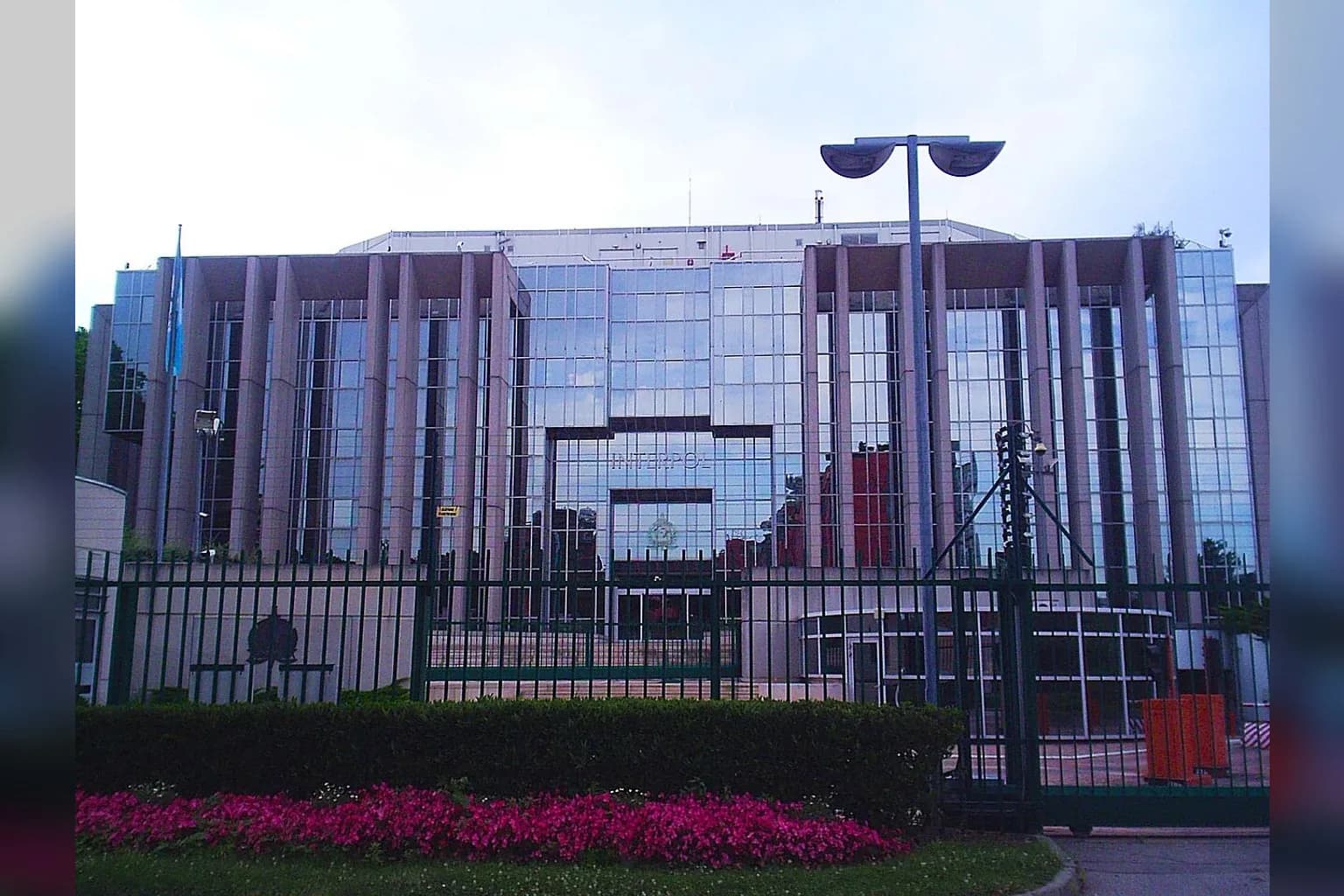
Its new footing still faced danger. In May 1986, extremist group Action Directe attacked the General Secretariat building in Saint Cloud, Paris, injuring one police officer and causing serious damage, according to INTERPOL’s account. The attack brought physical vulnerability back into view, this time at the center created to sustain international police cooperation. An organization built around communication and coordination requires rooms, equipment and people who can keep that work moving, so damage to its headquarters reaches beyond a single building.
After the attack, the General Secretariat moved to facilities constructed specifically for INTERPOL in Lyon, the organization’s history states. That move completed a long institutional arc from postwar relocation to a purpose-built base, while the name adopted in Paris and the recognition secured in the following decades supplied a stronger frame around the network. With that frame in place, INTERPOL could begin to develop the tools and operating rhythms that would make cross-border cooperation faster, broader and more immediate.
Databases, Operations Rooms and a Public Appeal Changed the Tempo
With that frame in place, INTERPOL could turn a stronger institution into faster practical coordination. In 2002, it introduced a database of DNA profiles and launched I-24/7, a secure web-based platform through which member countries could access and exchange information, according to INTERPOL’s history. Together, those tools brought two essential parts of an international case closer together: the identifying trace and the route for sharing it. The earlier network had created a channel between police authorities; I-24/7 made that channel available through a secure web-based system, while the DNA database gave investigators another form of record to search and compare.
That faster exchange also needed people ready to act on it at any hour. INTERPOL’s Command and Coordination Centre at the General Secretariat in Lyon operates 24/7, and its coverage later extended through a second operations room in Buenos Aires, opened in 2011, and a third in Singapore, opened in 2015, INTERPOL’s timeline records. The pattern is clear in the sequence: information moves through the platform, and operations rooms give the organization a continuous point of coordination around that flow. Lyon became a working hub for the system built after the move to purpose-designed facilities, while Buenos Aires and Singapore placed further operational capacity in other regions.
The system also showed how a tightly controlled police network could, in an exceptional case, reach outside its own channels. On 8 October 2007, after police channels had failed to identify a man shown in child sex abuse images on the Internet, INTERPOL issued its first public appeal for help. Members of the public identified the suspect within hours of the appeal appearing on INTERPOL’s website, and authorities arrested him 11 days later, according to INTERPOL.
That appeal changed the shape of the search without changing its purpose. A case that had moved through police channels gained a new source of recognition, and the response returned to an arrest. The lesson sits beside the databases and operations rooms: international coordination depends on secure systems and constant readiness, yet it can also draw on public participation when an investigation requires another path forward.
The Modern Organization Runs on Shared Access
That wider reach now sits inside an organization built for daily exchange among national police services. INTERPOL’s official history lists 196 member countries and 1,200 staff and officers, numbers that give the network its scale while also describing its essential character: many national authorities connected through a shared system. The organization’s work turns on making information available where it can be used, so that an officer confronting a case in one place can draw on data held and shared across a far larger field.
That is the contemporary role INTERPOL sets out most plainly. It helps police share and access data on crimes and criminals, while providing technical and operational support, according to the organization. The formula carries a practical logic. Data needs a route, a receiving authority and people equipped to act on it; support helps make each part of that route usable. Shared access therefore becomes a working habit, linking national investigations through information that can travel with greater reach than any single police service.
The work gathers around four priority areas: terrorism, cybercrime, organized crime, and financial crime and anti-corruption. INTERPOL identifies those four areas as its global focus, giving the organization a clear frame for the kinds of cases that call for coordination across jurisdictions. Each area places weight on the same capability: police in different countries need a way to locate relevant information, communicate with one another and bring their own national powers to bear. The organization supplies the connective tissue, while action remains rooted in the authorities that belong to each member country.
Its first mobile application offers a compact view of that model in the hand. In 2021, INTERPOL launched ID-Art, which provides access to its Stolen Works of Art database, and the application reached 25,000 downloads in 170 countries during its first year, INTERPOL records. The app turns a shared database into a tool that can travel widely, carrying useful information toward the people who may recognize, check or act on it. That is the durable achievement of the network: information gains force when the right people can reach it across borders.


Comments (0)