
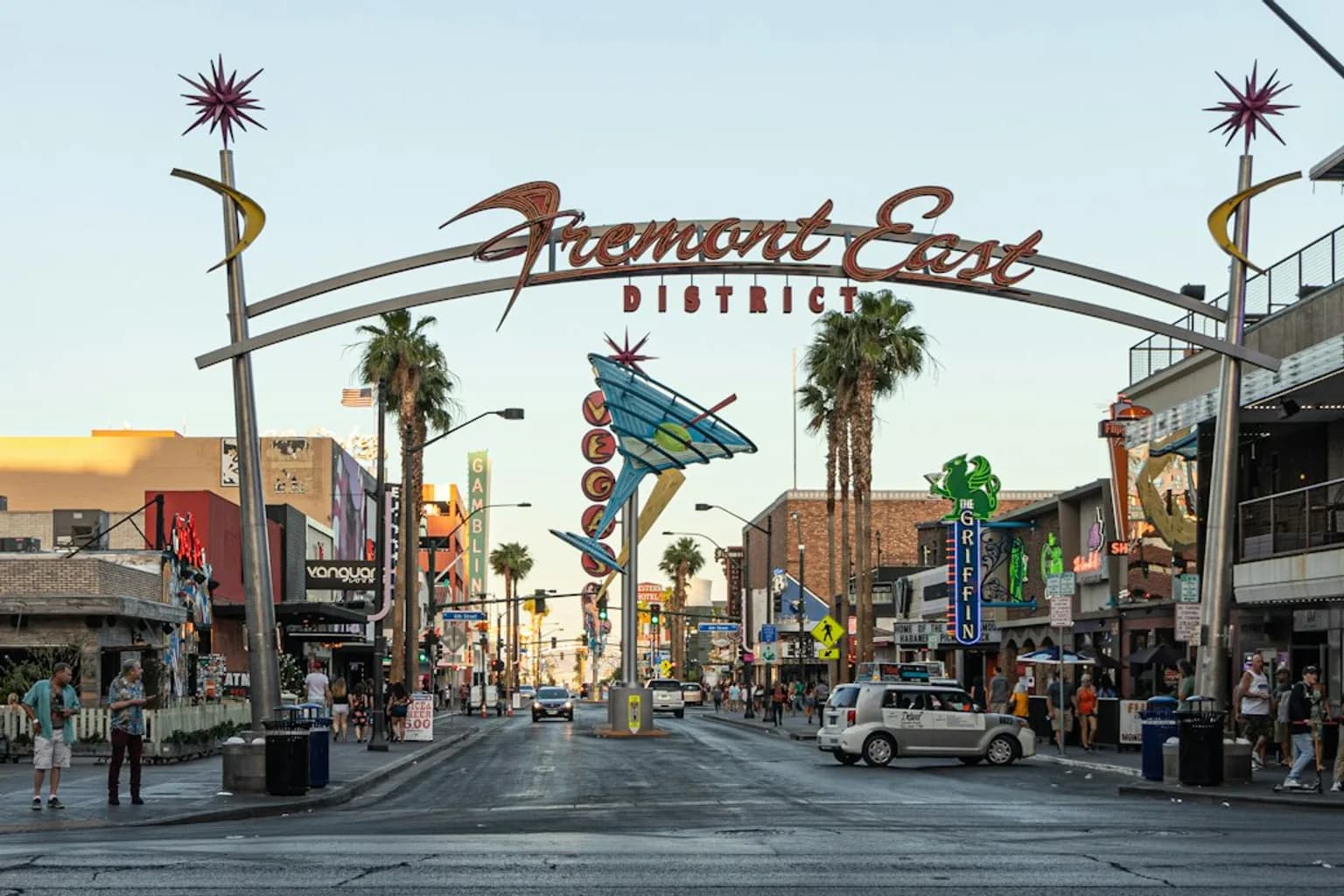
A Railroad Sale Put Las Vegas on the Map
Las Vegas began with a land sale that fit on a single page of a city’s long future. In May 1905, the Los Angeles and Salt Lake railroad company sold 110 acres, creating the settlement that would become Las Vegas; six years later, on June 1, 1911, its residents voted for incorporation, according to Casino.org. The timeline is unusually compact. A railroad company put land into circulation, a settlement took shape around it, and the new town quickly acquired the legal identity that let it act like a city.
That speed matters because Las Vegas found one of its defining businesses almost immediately. The Golden Gate, a hotel-casino at 1 Fremont Street, opened in 1906 as the city’s first casino, Casino.org reports. Its address places the idea at the center of the young settlement: gambling arrived on Fremont Street while Las Vegas itself was still taking form. The Golden Gate gave the town an early stake in an industry that could draw people in, keep them engaged, and turn a stop along a railroad line into a place with its own reason to exist.
Railroads supplied the starting point, and gambling supplied a powerful use for that starting point. The combination gave Las Vegas a practical advantage: land, access, and a business built around people choosing to spend time and money somewhere other than home. The city’s later image would become vast and theatrical, yet its first version carried the same basic logic. A visitor could arrive, find a room, enter a casino, and take part in an experience designed around chance and attention.
That early casino also reveals the shape of the story ahead. Las Vegas grew through decisions that made the city easier to reach, easier to use, and increasingly attractive to people looking for an escape, an opportunity, or both. The 110-acre sale created the physical beginning. Incorporation gave the settlement civic form. The Golden Gate showed how quickly a local business could turn that form into an appetite. From there, the question was never whether Las Vegas had a foundation. The question was how far that foundation could carry a city willing to build its future around the visitor.
1931 Gave the Desert Three Reasons to Grow
From there, that appetite grew into a wager. In 1931, that wager acquired the legal and economic conditions it needed to spread: gambling restrictions were lifted, construction began on the Hoover Dam just east of Las Vegas, and revised divorce laws allowed anyone who had lived in the city for six weeks to file for divorce, according to Casino.org. Each change drew a different kind of attention toward the same small place. The dam promised work and a larger flow of people through the region. The divorce rule gave people a reason to stay long enough to organize a major personal change. Legal gambling supplied a ready-made way to spend an evening, a paycheck, or a period of waiting.
Those forces mattered because they arrived together. A city can grow around employment, or around visitors, or around a permissive legal code. Las Vegas had all three moving at once, and each strengthened the others. People drawn by the dam found a town with entertainment. People arriving for divorce found a town whose new rules made a short residence useful. Business owners could now build around an activity that had official permission and a clear audience. The desert settlement began to offer a compact proposition: come for the practical reason that brought you here, then find a city prepared to make the stay feel larger.
The first legal gambling license made that proposition visible. In March 1931, the Northern Club became the first Las Vegas establishment to receive one, Casino.org reports. A license is an administrative detail, yet in this case it marked a change in the city’s direction. Gambling could operate in the open, as part of a local economy that was learning to serve workers, temporary residents, and visitors whose plans had suddenly become more complicated and more profitable.
That combination gave Las Vegas a durable advantage. Work created movement, divorce law created stays, and licensed gambling created a reason to gather after the day’s business had ended. The city was beginning to turn private transitions into public commerce, with hotels, tables, and nightlife ready to meet the demand. By the time a new destination began to take shape beyond the established streets, Las Vegas had already learned the basic lesson: visitors came for many reasons, and the strongest businesses gave them one more reason to remain.
The Strip Began as a New Kind of Getaway
Beyond that established street, a different kind of destination was taking shape in 1941. The Las Vegas Strip was born that year, and Thomas Hull opened El Rancho Vegas, the first casino built along it, according to Casino.org. Its location mattered because the Strip offered room for a visitor experience with its own rhythm, separate from the practical errands and short stays that had already brought people into town. A casino there could invite guests to arrive, settle in, and let the evening carry them forward.
That invitation found an audience among the men working east of the city on the Hoover Dam. Las Vegas became a favorite nightspot for the dam’s workforce, PBS reports, giving the new road a steady stream of people looking for release after long days of work. They came from a project built on schedules, machinery, and physical labor into a place designed around leisure. The distance between those two worlds gave Las Vegas its particular charge: the city sat close enough to serve the workers and far enough from the worksite to feel like an escape.
El Rancho Vegas turned that escape into a business model. The guest no longer had to treat gambling as one stop in an evening spent elsewhere. The casino could anchor the whole outing, shaping the hours around food, drink, games, and the easy promise that the night still had somewhere to go. This was the Strip’s founding logic, and it changed the scale of the city’s ambition. A railroad town had learned to profit from people passing through; now a new stretch of road offered them a reason to remain in the experience for as long as they wished.
That idea gave Las Vegas a powerful new direction. The city could build for the visitor who wanted distance from ordinary routines, then make that distance feel immediate and available every night. El Rancho Vegas stood at the beginning of that shift, with the Strip emerging as a place where the journey from workaday life to spectacle could happen in a single drive. The road had opened, and it would soon attract people who understood how much value could be created around that appetite.
Organized Crime Found a Business Ready for Scale
The road had opened, and it drew a group of operators who understood what a growing resort economy could become. During the 1940s, organized crime figures began moving to Las Vegas from Southern California, with the first wave including Guy McAfee, Tutor Scherer, Farmer Page, and Marion Hicks, according to the Mob Museum. They arrived as the city’s casinos were becoming valuable places to own, rather than simply places to visit. A casino gathered cash, crowds, rooms, food, drink, and entertainment under one roof, giving its owner a direct stake in the city’s expanding appetite for escape.
That stake was already visible at the Northern Club. By 1941, Benjamin “Bugsy” Siegel was operating the Fremont Street establishment, Casino.org records, placing him inside a business that had helped establish legal gambling as a central part of local life. The move mattered because it showed how quickly experienced operators could enter the market. Las Vegas had created the setting, and the people arriving from Southern California brought an instinct for controlling the assets that could profit from it.
Siegel’s next deal made that instinct clearer. In 1945, Siegel and Meyer Lansky, both mobsters from New York, purchased the El Cortez hotel-casino on Fremont Street, the Mob Museum reports. The purchase put major ownership in the hands of men who saw the city through the hard logic of expansion: acquire a working property, hold a position in the entertainment district, and build from a base that already had customers. Fremont Street had become a place where control of a hotel-casino meant control of an important piece of Las Vegas’s future.
Those transactions changed the character of the city’s casino business. The early destination had attracted people looking for a night away from routine; now it attracted investors and operators prepared to move quickly when a property came into view. McAfee, Scherer, Page, Hicks, Lansky, and Siegel each belonged to a wider migration that connected Las Vegas to networks beyond Nevada. Their presence turned casino ownership into a contest for the city’s most promising assets, setting the stage for a far larger wager on the edge of town.
A Single Hotel Turned Ambition Into a Building Boom
Their presence soon found its clearest expression in a single property. In 1946, Meyer Lansky and Benjamin “Bugsy” Siegel joined Los Angeles nightclub owner Billy Wilkerson to develop the Flamingo Hotel on the stretch that would become the Las Vegas Strip, according to the Mob Museum. The partnership brought together men already positioned around Las Vegas casino ownership and a nightclub owner with a stake in the next version of the city. That combination gave the project a scale and a purpose that matched the moment: a hotel could gather gambling, lodging, and the promise of a destination in one address.
For Siegel, the opening carried a price large enough to make the wager plain. The Flamingo cost $6 million to open in 1946, Casino.org reports, placing a substantial sum behind the idea that Las Vegas visitors would respond to a more ambitious casino hotel. The years that followed gave that idea its financial proof. In 1948 alone, the Flamingo produced $4 million in profit, a return that showed how much revenue a well-placed and heavily financed property could generate.
Those figures mattered beyond the Flamingo’s own doors because they made expansion easier to imagine. A casino hotel had become a visible business proposition, one that could turn a large opening cost into a large profit within the growing Las Vegas market. The Flamingo’s success then sparked a casino building boom across Las Vegas during the 1950s, the Mob Museum says. Each new project would build on the same central lesson: the city’s future rested in creating places where visitors could stay, spend, and keep moving through an experience designed around the casino.
That lesson also shifted the terms of competition. Ownership of a gambling room offered one kind of opportunity; a successful hotel-casino offered a model for building a destination at a far larger scale. The Flamingo gave Las Vegas a result that investors could see in dollars, and the boom it set off carried that result into the next decade, where casino operators would begin refining how guests were welcomed, rewarded, and encouraged to stay.
Benny Binion Made the Casino Feel Like a Service Business
Casino operators began refining how guests spent their time, their money, and their evenings. Benny Binion gave that refinement a particularly direct form when he opened the Horseshoe Casino in 1951, turning two simple decisions into a clear invitation: a player could wager without an upper limit, and drinks could arrive as part of the experience. Casino.org credits Binion as the first casino owner to offer both unlimited maximum bets and complimentary drinks to gamblers.
Those choices changed the rhythm of a visit. An unlimited bet gave high-stakes customers room to play on their own terms, while a free drink made the casino floor feel hospitable and encouraged a guest to settle in. Together, they treated gambling as the center of a longer stay, with the operator responsible for making that stay easy, generous, and enjoyable. The house still held the game, yet the customer received a reason to remain at the table and a reason to return to it.
That approach arrived as the audience for Las Vegas was growing quickly. Tourist numbers reached eight million a year by 1954, according to Casino.org, bringing casino owners a vast and recurring stream of people whose choices could shape the city’s next round of investment. The task was therefore larger than filling a gambling room for one night. Operators had to give visitors a dependable feeling of welcome, momentum, and possibility from the moment they entered.
Binion’s formula offered a practical answer. The wager provided excitement, the drink supplied comfort, and the absence of a ceiling on maximum bets signaled that the Horseshoe was prepared for whatever scale of action a customer brought through the door. In a city newly crowded with casino construction, that kind of attention turned hospitality into a competitive tool. It also prepared Las Vegas for the next refinement, when the buildings themselves would begin guiding guests toward gambling throughout the resort.
Architecture Spread Gambling Through Every Part of the Resort
The next refinement was to turn the entire building into part of the invitation. A Springer history divides the development of Las Vegas casinos into three phases, and the first, from 1945 to 1950, gave the city a powerful new template: Western-themed hotels gave way to luxurious casinos designed around a new consumption experience. The wager still sat at the center, yet the setting increasingly gave visitors reasons to remain, spend, and move from one pleasure to the next under the same roof.
That template expanded through the years from 1950 to 1966, when properties such as the Desert Inn and the Sands reached for a broader middle-class audience through entertainment. Their design carried the casino’s logic throughout the resort, according to the Springer study, connecting gambling to every activity inside rather than holding it apart in a single room. A guest could arrive for an evening’s entertainment and enter a building arranged to keep the casino close at hand. The architecture made the house’s offer feel continuous: each space led naturally toward another reason to stay.
As the resorts grew more elaborate, their physical form began to advertise the city’s ambitions before a visitor stepped inside. The Riviera Hotel rose with a nine-story tower, making it Las Vegas’s first high-rise, while the property also marked the Chicago Outfit’s first entry into the city in 1955, the Mob Museum reports. That convergence mattered because new capital and new design were pushing in the same direction. A casino now needed scale, entertainment, rooms, and an environment that could turn a visit into a longer stay.
The shift unfolded gradually rather than through a single decisive break, as the Springer account emphasizes. Yet its effect was easy to see: Las Vegas had begun to build resorts where gambling shaped the rhythm of the whole experience, and where each new development invited owners to think bigger about the money required to control one.
Labor Pension Money Fed the Next Ownership Cycle
That need for capital opened a new route into casino ownership, one that ran through the labor movement’s pension system. Teamsters President Jimmy Hoffa created the Central States Pension Fund in 1955, and Allen Glick later obtained a $63 million loan from it, according to the Mob Museum. The scale of the loan matched the scale the city had reached: resorts now demanded financing large enough to place whole properties, their payrolls, their rooms, and their gaming floors under a single owner’s control.
Glick’s casinos then acquired an operator with deep experience in the business. Frank “Lefty” Rosenthal was installed to run them, placing day-to-day casino management inside a wider web of interests that extended far beyond Las Vegas. The Argent casinos generated a skim that was divided among Mafia families in Chicago, Kansas City, Milwaukee, and Cleveland, the Mob Museum records. A visitor could encounter a polished resort as a self-contained world of rooms, tables, drinks, and entertainment. Behind that public experience, cash could travel outward through an ownership structure whose beneficiaries were spread across several cities.
The arrangement made Las Vegas valuable in a particularly direct way. A casino concentrated a huge volume of transactions in one place, every day, while the resort format gave those transactions a setting designed to keep guests present and spending. Pension-fund financing gave a buyer the means to acquire the asset; casino operations produced the flow of money; the skim created a channel from the gaming floor to organized-crime families elsewhere. Each part relied on the others, which made control of a property far more consequential than ownership of a single building.
The Stardust offered an especially clear view of how that hidden economy could work. Its slot manager, Jay Vandermark, orchestrated a scheme using manipulated scales that fleeced an estimated $7 million to $15 million between 1974 and 1976, according to the Mob Museum. The range is striking because it turns an abstract idea of skimming into a measurable loss, produced through an ordinary piece of casino machinery and sustained across years.
By then, casino ownership had become a contest over more than frontage, architecture, or the ability to attract a crowd. The decisive prize was the steady stream of money inside the resort and the power to direct it after guests had placed their bets. That power drew greater attention from people inside Las Vegas and from authorities preparing to challenge the networks around it.
Regulators and Federal Agents Made Casino Control a Public Fight
That attention soon settled on Tony Spilotro, who moved to Las Vegas in 1971 and became a clear focal point for the city’s growing struggle over who held power around its casinos. Spilotro’s orbit included the Hole in the Wall Gang, led by Frank Cullotta, and their presence gave authorities a set of people and relationships to pursue as casino money continued to attract organized-crime interest. The contest that had long unfolded through ownership, loans, and back-room control now moved into public institutions, where state officials, local police, and federal agents each had a role to play.
Governor Mike O’Callaghan strengthened the state’s side of that effort in the mid-1970s, hiring gaming regulators including Shannon Bybee, Harry Reid, and Jeff Silver. Silver joined the Gaming Control Board at 29, part of a cohort brought into a city where casino regulation had become central to public authority. The Mob Museum also records a parallel federal buildup: Joe Yablonsky arrived as FBI special agent in charge, joined by agents Emmett Michaels, Charlie Parsons, Dennis Arnoldy, and Gary Magnesen, all focused on organized crime. The Justice Department added attorneys Geoffrey Anderson and Stan Hunterton through its Organized Crime Strike Force, giving investigations a route from surveillance to prosecution.
Local law enforcement built its own capacity around the same target. Under Sheriff John McCarthy, Kent Clifford became Intelligence Bureau commander and assigned five officers to full-time work investigating Spilotro. That detail mattered because casino control depended on information as much as raids or arrests. Investigators needed to know who was speaking to whom, where money was moving, and whether the people charged with enforcing the law were protecting the investigation or exposing it.
In 1978, FBI wiretaps captured conversations indicating that Joe Blasko, a Las Vegas Metropolitan Police Department detective, was tipping Spilotro about law enforcement plans. Metro then fired Blasko and his partner, Phil Leone, according to the Mob Museum. The episode brought the conflict into sharp view: the pressure on casino-linked networks also tested the city agencies meant to contain them. By that point, Las Vegas had become a place where control of gambling was openly contested across casino floors, government offices, police departments, and federal investigations, setting the stage for a new kind of ownership to take hold.
Vegas Learned to Package Fantasy at Industrial Scale
That test of the city’s institutions unfolded as the Strip was learning a different lesson: growth depended on a system that could deliver the same charged experience again and again. From 1966 to 1976, the Strip moved into what a Springer history calls “corporate Las Vegas”, the third stage in an evolution that helped form the city’s present image. The phrase matters because it shifts the story from individual operators and contested properties toward a model with wider reach. Las Vegas had developed a way to sell escape, and corporate Las Vegas gave that promise a more durable structure.
The change came gradually. The same history describes the transformation across the city’s three major casino phases as evolutionary, with each period building on the work of the last. That steady progression shaped the 1966-to-1976 era: newly themed casinos changed the way customers encountered gambling, giving the visit a setting, a mood, and a reason to keep moving through the property. Fantasy became part of the product’s design, carried through the rooms and attractions surrounding the gaming floor.
Yet the operational logic remained consistent. The themed casinos preserved the basic spatial organization and business model of the casino, according to the Springer study. That continuity gave the new themes their power. A visitor could enter an experience that felt distinct and still find the familiar engine beneath it: gambling placed within a larger world of consumption, entertainment, and movement. The setting changed, while the casino’s ability to hold attention remained at the center of the design.
Corporate Las Vegas therefore refined a formula that earlier decades had assembled piece by piece. Ownership and financing could change hands, regulation could tighten, and the public face of the resort could take on fresh themes, yet the central promise grew more polished and repeatable with each adjustment. The city had learned how to turn fantasy into an organized experience, one that could be reproduced across increasingly ambitious properties. That lesson made scale feel like the natural next move.
The Strip Turned Size Into Its Own Attraction
That experience expanded until the resort itself became the reason to make the trip. The Mirage gave that idea a decisive new scale when it opened on the Strip in 1989 as the Strip’s first megaresort, built at a cost of $630 million, according to Casino.org. Its arrival showed where the city’s long process of refinement had led: a casino could anchor an undertaking large enough to stand as an attraction in its own right, drawing the visitor into a setting designed to hold attention across an entire stay.
That larger setting changed the terms of competition. Las Vegas had spent decades making the resort a complete environment, with gambling woven into a wider experience of rooms, entertainment and spectacle. By 2006, however, the business was playing out on a global stage, when gambling revenue in Macau first surpassed that of Las Vegas, Casino.org reports. The milestone placed the Strip inside a contest that reached far beyond Nevada, while also sharpening the value of the city’s most practiced skill: giving visitors a physical world to enter.
That skill continued to demand room. Resorts World Las Vegas opened in 2021 as a 3,500-room complex, according to Casino.org, carrying the megaresort logic into a new era. Its size belongs to a city that now has around 150 casinos overall, including 31 on the Strip, the same source says. Those figures trace the physical result of the story so far: each generation enlarged the stage, added another destination and gave the next owner a bigger machine to operate. By this point, the Strip had made scale part of the performance, preparing Las Vegas to offer visitors an experience measured in city blocks rather than a single casino floor.
Las Vegas Now Sells a City-Sized Experience
That growth gave visitors a reason to treat the entire city as part of the attraction. The resorts may provide the rooms, the tables and the spectacle, yet the larger draw now reaches far beyond any single property: PBS reports that Las Vegas attracts more visitors than the holy city of Mecca. That comparison gives the city’s scale a human dimension. Visitors arrive for an experience spread across streets, hotels, entertainment and the promise that each turn can lead somewhere larger, brighter or more extravagant than the last.
That promise has helped turn the visitor economy into urban momentum. PBS describes Las Vegas as the fastest-growing city in the United States, where tens of thousands of jobs are created each year and an average of more than a thousand prospective residents arrive every week. Each arriving resident brings another reason for the city to extend itself, and PBS says Las Vegas names 60 new streets each month. The pace gives the place a particular kind of energy: a city built to receive huge numbers of visitors also keeps making room for people who decide to stay.
That is the lasting achievement of the ownership story. Capital supplied bigger venues, regulation made control of the industry a public contest, architecture turned whole buildings into experiences, and showmanship gave each new version of Las Vegas an immediate appeal. Those layers accumulated over time, carrying the city from a compact settlement into a place where the experience begins long before a guest reaches a casino floor. Las Vegas now manufactures desire on a citywide scale, with growth itself becoming part of the show.





Comments (0)