
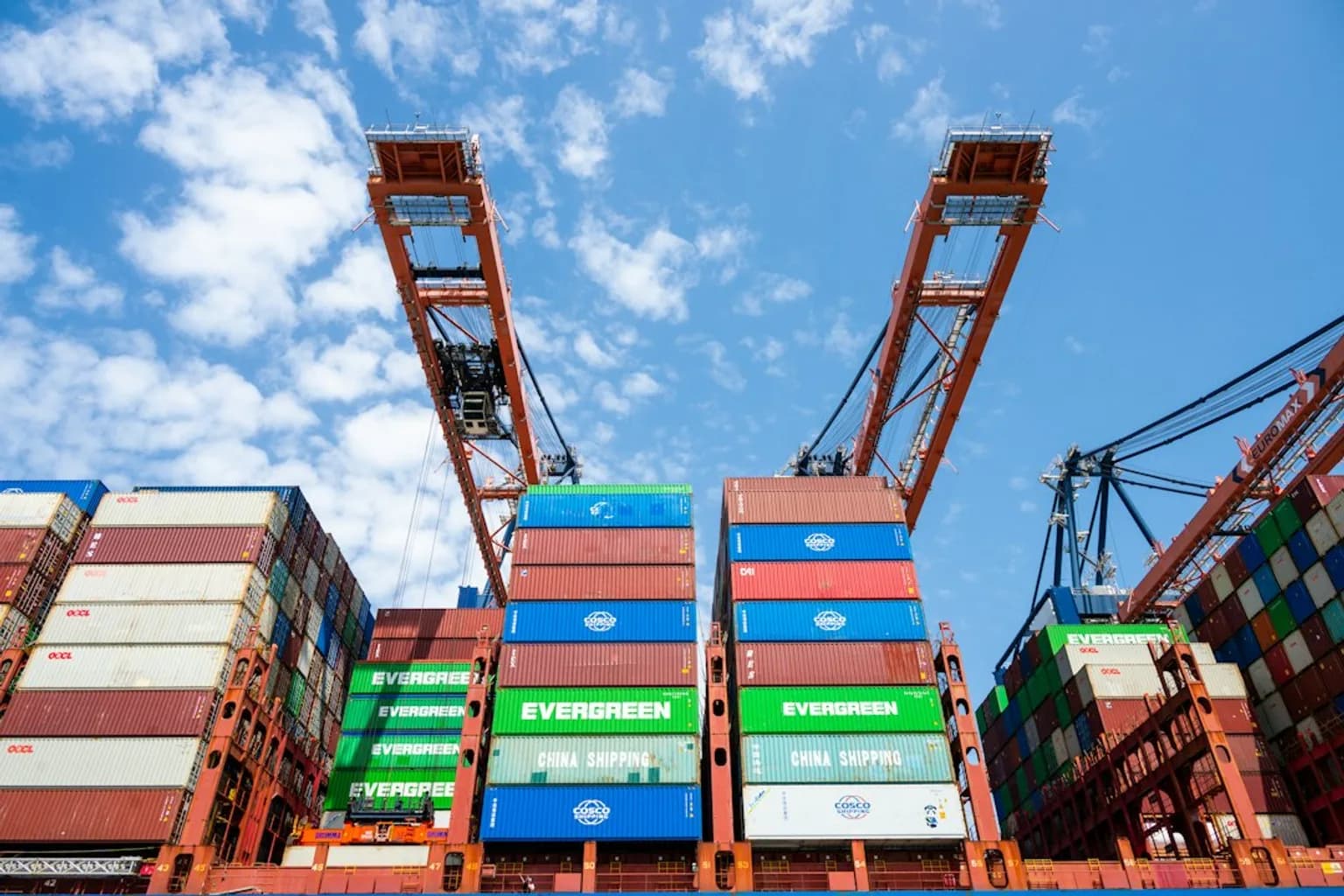
Every Journey Began With Thousands of Separate Things
In 1954, the SS Warrior carried just over 5,000 tonnes of merchandise from New York to Bremerhaven, Germany. Yet the ship’s hold contained no single, coherent cargo. It held 194,582 separate items across 1,156 shipments, each with its own destination, owner and route through the port. A journey across the Atlantic began with an immense sorting exercise on the dockside, where trade appeared as a crowd of individual objects waiting for human hands to move them.
That was the ordinary shape of breakbulk shipping. Goods arrived in crates, barrels, sacks, bales, boxes and other packages, then workers shifted them from lorries or railcars into warehouses before loading each piece into a ship’s hold. The transfer happened item by item, so a consignment passed through several teams, several spaces and several rounds of handling before a vessel could carry it away. A barrel had to be lifted, set down, stored, found again and loaded. A crate followed the same path. Multiply that routine by 194,582 items and the SS Warrior becomes a portrait of how international trade once worked: a vast system built from repeated small acts of physical labour.
Each handoff created fresh exposure. The goods themselves faced the risks of theft and damage as workers moved them between road, rail, warehouses and ships, while the repeated handling consumed time and added cost. Before standardized containers, transferring cargo between forms of transport was labor-intensive, time-consuming and costly; containers leaving ships for rail could even be opened and repacked into a boxcar. The freight kept changing its physical arrangement as it changed vehicles, and every rearrangement added another point where a journey could stall.
That friction shaped the pace of commerce long before a ship reached open water. Merchants could send goods across an ocean, yet the first challenge lay in gathering thousands of separate things, protecting them through every transfer and fitting them safely into the hold. The world already had ships, railways, roads and warehouses. What it lacked was a way to let cargo pass through all of them without beginning the handling process again at each stop.
The Harbour Was Where Global Trade Went to Wait
With every transfer demanding another set of hands, the harbour became the place where an ocean journey slowed to a crawl. In 1954, the SS Warrior spent ten days loading and unloading its cargo at the edges of an Atlantic crossing that also took ten days, according to the BBC. The ship’s passage across the water was therefore only one part of the journey. Before departure, cargo had to be sorted, found, lifted, checked and stowed; after arrival, the same work unfolded in reverse, item by item, dockside by dockside.
That rhythm governed the wider breakbulk system. Loading a ship could take as long as three weeks, while ships spent two-thirds of their productive time in port, Frontier Economics reports. A vessel earned its keep by moving between places, yet much of its working life went into standing still while its cargo was arranged around it. Every delay at the quay extended the schedules of railcars, lorries, warehouses, merchants and customers waiting farther inland. Port time spread outward through the entire chain.
The price of that waiting appeared in the cost of a shipment. In 1954, moving cargo cost around $420 (£335) a tonne, and typical delays in sorting and distributing goods by land could stretch the whole journey to three months, the BBC found. Three months gave every shipment a long corridor of uncertainty. Goods could have crossed the sea and still remain caught in the slow choreography of the port, waiting for space, labour and the next available connection.
The pressure on the waterfront was physical as well as financial. New York port averaged half a dozen serious incidents every day in 1950, according to the BBC, a measure of how much activity crowded into the process of getting individual goods on and off ships. The harbour held the world’s trade at its most exposed moment: cargo was close enough to travel, yet still dependent on repeated handling and a vast amount of time.
By the middle of the decade, the central question had become hard to ignore. How could a shipment keep moving once it reached the water’s edge, rather than surrendering days or weeks to the harbour?
Malcom McLean Had One Simple Idea: Keep the Cargo Inside the Box
One answer had been taking shape for far longer than the pressure at the harbour suggested. Railroads had experimented with various kinds of containers as early as the 19th century, and container-like systems appeared through the first half of the 20th century, as PLS Logistics records. Those experiments carried a practical promise: a load could travel as a single unit. Malcolm McLean, an American trucking entrepreneur, saw how fully that promise could reorganize the journey between land and sea.
McLean’s idea was disarmingly clear. Use the same container for road transport and shipping, so the freight stayed inside through the handoff, an insight that makes 1956 year zero for the logistics industry, according to Frontier Economics. The box would carry the cargo; trucks, ships and eventually trains would carry the box. That separation gave the journey a new logic, with the freight protected inside a standardized unit while the vehicle beneath it changed.
McLean had begun exploring ways to ship goods more efficiently during the 1950s, the Royal Museums Greenwich explains, and on 26 April 1956 the idea left the drawing board at Port Newark. A converted oil tanker called the Ideal X departed New Jersey carrying 58 metal containers, bound for Houston. Five days later, it arrived in Texas, according to the Royal Museums Greenwich.
That voyage carried a modest number of boxes, yet it established the form that modern container shipping would follow. The Ideal X showed that a trucker’s unit of cargo could cross the water intact, turning the shoreline from a place where freight had to be unpacked into a point where the box itself could continue. Modern container shipping is generally traced to that April departure, PLS Logistics notes. The next question was whether this clean idea could deliver a return large enough to reshape the business around it.
A Box Changed the Economics Before It Changed the Map
Once the box could continue across the shoreline, the savings became startlingly clear. Frontier Economics reports that containerised transport cost $0.16 per tonne, compared with a contemporary breakbulk rate of $5.83 per tonne. That difference gave shipping lines, cargo owners and ports a reason to reorganise around the new unit, because each journey now carried a far more predictable bill.
Predictability reached into the work at the dock. In 1965, dock labour moved 1.7 tonnes of cargo per hour; by 1970, the rate had risen to 30 tonnes per hour, according to Frontier Economics. The gain came through a change in what workers and equipment had to manage: a stream of uniform units rather than the varied contents within them. Freight could be counted, lifted and transferred in a common form, allowing the movement through a port to become a process that businesses could schedule with far greater confidence.
That confidence also changed the risk attached to a voyage. Insurance premiums fell to one-sixth of their pre-containerisation level, Frontier Economics found, adding another saving to the lower transport price and faster handling rate. For companies sending goods across long distances, the calculation began to shift: a shipment could leave on a system whose cost, timing and insurance were all easier to anticipate.
The first container voyage therefore pointed toward a commercial system as much as a maritime one. Cheaper movement made distant routes more practical, rapid handling kept cargo moving through the places where journeys changed direction, and lower premiums reduced the cost of uncertainty. Those benefits depended on every participant being able to handle the same box, however, which placed the next challenge in full view: the world needed to agree on what that box would be.
The Container Worked Because the World Agreed on Its Dimensions
That placed the next step in the hands of standards-makers, carriers and ports. A box could preserve its cargo from ship to train to truck only when each part of that journey recognised its fittings, its shape and the space it required. The practical promise lay in that shared recognition: freight could stay inside while the box itself changed vehicles, removing the need to unpack and repack goods at every transfer. Modern container design made the unit portable across ships, trains and trucks; common dimensions made that portability a system rather than an isolated convenience.
The United States began efforts to establish a common standard in 1958, and participants reached agreement in 1961. The path to agreement then widened: by 1968, the International Standards Organisation had settled on a global standard for container size, followed by international adoption in 1970. Those dates mark a slow conversion of a powerful idea into a common operating language. A railway, a ship operator and a trucking company could invest in equipment with confidence that the box arriving tomorrow would fit the equipment bought today.
Malcom McLean helped make that confidence possible when he released his patent on container fixings free of charge and without conditions. That decision opened the mechanism that secured a container in place to use across the industry. The standard therefore had room to travel beyond one firm’s routes and one company’s commercial interests, giving ports and carriers a reason to build around a shared format.
That format has a strikingly ordinary physical presence. The container is 8ft wide, 8ft 6in high and 40ft long, according to the BBC. Its measurements turn out to be the essential feature: fixed dimensions allow vehicles, lifting gear and storage spaces to meet the box on equal terms. Once the world had agreed on those terms, the container could begin to reshape the waterfront built to receive it.
Ports, Ships and Dock Work Had to Adapt to the New Box
That reshaping demanded a waterfront built around the container’s fixed form. American ports spent $2.3 billion on container-handling facilities between 1973 and 1989, directing money toward the specialized infrastructure required to receive, move and organize standardized freight. A port designed for this system had to treat the box as its basic unit of work. Its yards, equipment and waterfront operations therefore began to take their rhythm from a piece of steel with known dimensions and predictable handling needs.
The ships arriving at those facilities grew with the system. Average ship length rose from 180 metres in the 1960s to 275 metres in 1973, a change that made the physical expansion of container shipping visible from the shore. The largest modern container vessels can reach 400 metres, according to the same account. Each increase in scale placed fresh demands on the places that served these ships, linking the dimensions of a vessel at sea to the design of a terminal on land.
That redesign reached a workplace shaped by severe risk. In the 1950s, dock work still carried an injury rate three times higher than construction and eight times higher than manufacturing. The old docks depended on people working amid cargo in countless separate forms, and their physical toll formed part of the waterfront’s daily reality. Containerisation changed the terms of that environment by concentrating freight into a uniform unit and building handling systems around it. The shift altered where labour met cargo, how ports organized their ground, and what kind of machinery and facilities the waterfront required.
Viewed from the quayside, the container’s arrival therefore looks like an industrial redesign on a grand scale. Investment followed the box. Larger vessels followed the investment. Work on the docks entered a system organized around standardized loads and dedicated handling facilities, while the harbour itself became a far more engineered link in the movement of goods. That rebuilt waterfront would soon make the wider economic effects of the container impossible to miss.
Standardization Made Faraway Production Feel Close
That rebuilt waterfront would carry its influence far beyond the harbour, because every improvement at the quay changed the practical reach of a factory, a shop and a customer. In a subset of countries examined by one academic study, trade rose by 320% over five years after the container arrived, according to Frontier Economics. The figure captures the larger shift: once a shared system took hold, distance became easier for businesses to organise around. A producer could look across borders with a clearer sense of how goods would travel, when they could arrive and what the journey would require.
That new confidence grew alongside a striking expansion in the place trade occupied in the world economy. In the early 1960s, merchandise trade represented less than 20% of world economic output; today it stands at around 50%, the BBC reports. Containers alone do not tell the full story of that change, yet they supplied a physical system equal to its demands. Ports could equip themselves for repeatable movements, carriers could build services around common loads, and businesses could plan supply across long distances with the expectation that the route would work in the same basic way from one journey to the next.
The result is visible in the daily traffic of the modern economy. An estimated 90% of the world’s goods travel by sea, while 60% of those seaborne goods move in large steel containers, according to Maritime Executive. About $14 trillion of the world’s goods spend some portion of their journey inside one of those boxes. That scale gives the container an unusual role in ordinary life: the steel walls disappear from view long before the goods reach a shelf, a warehouse or a doorstep, yet the system behind them shapes what can be sold across great distances.
For manufacturers, the common box turned distant production into a dependable commercial option. For retailers, it created a way to draw goods from faraway suppliers into markets that could receive them with the regularity customers came to expect. The effect was psychological as much as logistical: a place on the other side of the world could enter a buying decision as a workable source of supply, because the journey between production and market had acquired a common form. The waterfront had been rebuilt around standardized loads, and that standard helped make faraway production feel close at hand.
One Ordinary Box Holds Up an Extraordinary Supply Chain
That workable source of supply rests on a remarkably simple discipline: the freight stays in one standardized unit as its journey changes vehicles. A container can come off a ship, travel by train, and finish its route by truck without anyone handling the goods inside at each transfer, a feature built into the modern system from the start. The design described by PLS Logistics turns a chain of separate handoffs into a continuous journey for the cargo, even as several kinds of transport carry it forward. Each vehicle has its own role, while the box gives the whole route a common physical language.
Human beings have always looked for ways to carry goods across distance. In 1600 B.C. Egypt, Phoenicians ferried wood, fabrics and glass toward Arabia in sacks that continued by camel-driven caravan. The Maritime Executive traces another familiar answer to the Greeks, whose amphorae carried wine, olive oil and grain aboard triremes across the Mediterranean and neighboring seas. Those vessels and containers belonged to their particular worlds, yet they served the same enduring purpose: keeping valuable goods together while a journey crossed water, land and borders.
The standardized steel container gave that old purpose a form suited to a dense transport network. Earlier modern ports still dealt in individual packages, with breakbulk freight arriving as crates, barrels, bags, boxes and other separate loads. PLS Logistics describes how those packages passed through warehouses before workers loaded them onto ships one by one. The container changes the object that the transport system handles. A crane handles the box; a train carries the box; a truck delivers the box. Inside, the shipment holds its place from the beginning of the route to the end.
That continuity is what makes an ordinary-looking object so consequential. The box gives ports, railways and road transport a repeatable way to meet one another, and repeatability gives a supply chain something solid to build around. Without the standardized container, the global supply chain would not exist, according to the Maritime Executive. Its force comes from that shared fit: countless journeys can follow a predictable sequence because the same box belongs everywhere along the way. A world of faraway production and familiar shelves rests, again and again, on freight remaining safely inside one metal box.





Comments (0)