
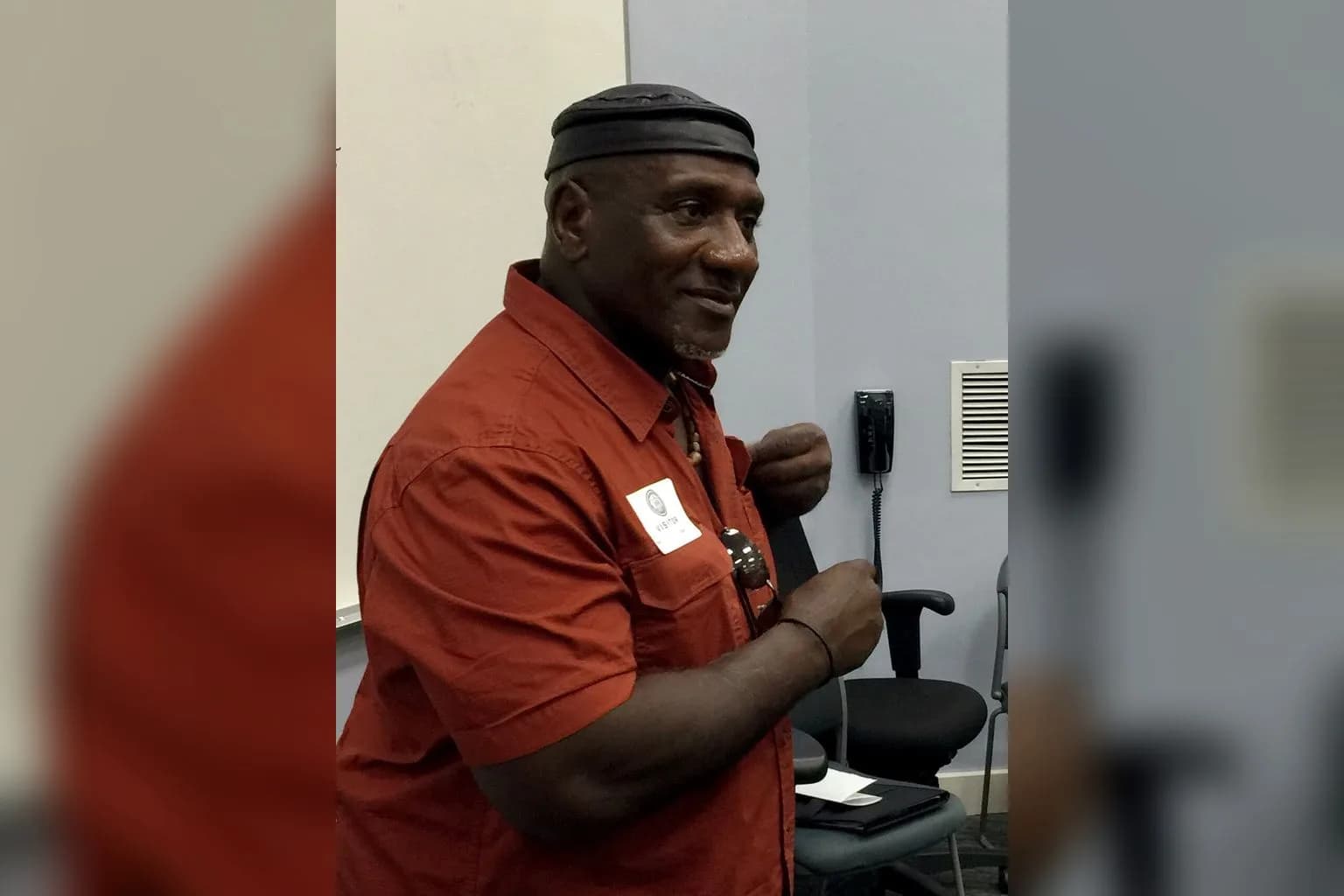
Gary Tyler was sitting on a school bus with other students near Destrehan High School in Louisiana when, according to the account of his arrest, he was wearing a body shirt, sweater, fingerless gloves and bandana. He was arrested for “mouthing off” after a skirmish in which a bullet killed 13-year-old Timothy Weber.
It was 7 October 1974, during violence over school integration. A white mob had attacked the bus carrying Black students, and Tyler, then 16, was arrested and charged with Weber’s murder.
More than five decades later, Tyler’s fabric works are being shown at the Grand Rapids Art Museum in Michigan. His first solo museum exhibition, Gary Tyler: Rebirth, opened on 3 October 2026 and runs through 3 January 2027.
The exhibition brings his quilts into a public setting far removed from Louisiana State Penitentiary, known as Angola, where he spent 41 years. Angola occupies 18,000 acres of a former 19th-century slave plantation.
Tyler’s 1975 trial unfolded amid intense racial tension. He was represented by a divorce attorney, tried before a judge reportedly affiliated with the racist White Citizens Council, and convicted by an all-white jury.
His death sentence was overturned in July 1976 after the US Supreme Court struck down Louisiana’s mandatory death-penalty law. The sentence was then reduced to life imprisonment. Tyler had been the youngest person on death row, according to the account of his case.
A federal appellate court concluded in 1980 that Tyler’s trial had been fundamentally unfair. The sole person to say she saw Tyler fire a gun later withdrew her account, saying police had terrorised her into giving false testimony. Four friends who testified against him also later recanted.
A bus driver said no shots had come from inside the vehicle in which Tyler was travelling. The alleged murder weapon was a pistol missing from a police firing range.
Tyler continued to say he was innocent throughout his imprisonment. The Louisiana Board of Pardons and Committee on Parole recommended a pardon three times, and each recommendation was refused by the state’s governor.
His mother, Juanita, campaigned for his release until her death in 2012. Rosa Parks and Amnesty International joined efforts to secure her son’s freedom at different points.
Inside Angola, Tyler and fellow prisoners began creating a hospice programme in the late 1980s and early 2000s for prisoners who were dying. In the early 2000s, while volunteering as a counsellor, Tyler made his first patchwork quilt to sell in support of patients with AIDS.
The group also made and sold quilts to raise money for coffins. One of Tyler’s quilts raised $30,000 for the hospice programme when it was raffled at the Angola Prison Rodeo.
A 2012 US Supreme Court ruling found mandatory life sentences without parole for juveniles unconstitutional, and the decision applied retroactively. In 2016, prosecutors agreed to vacate Tyler’s murder conviction in return for his guilty plea to manslaughter and a 21-year sentence. He was released immediately because he had already served 41 years in prison.
Tyler was freed on April 29, 2016. He is now 68 and based in Los Angeles.
His quilts use layered fabric designs to reflect his prison experience and the lives of people who remain incarcerated. A reconstructed watch-tower piece he made at Angola is held by the Smithsonian’s National Museum of African American History and Culture.
At the Grand Rapids exhibition, those works stand as the latest chapter in a life shaped first by a murder conviction, then by decades of incarceration, and finally by an art practice begun to care for other prisoners.
Comments (0)