
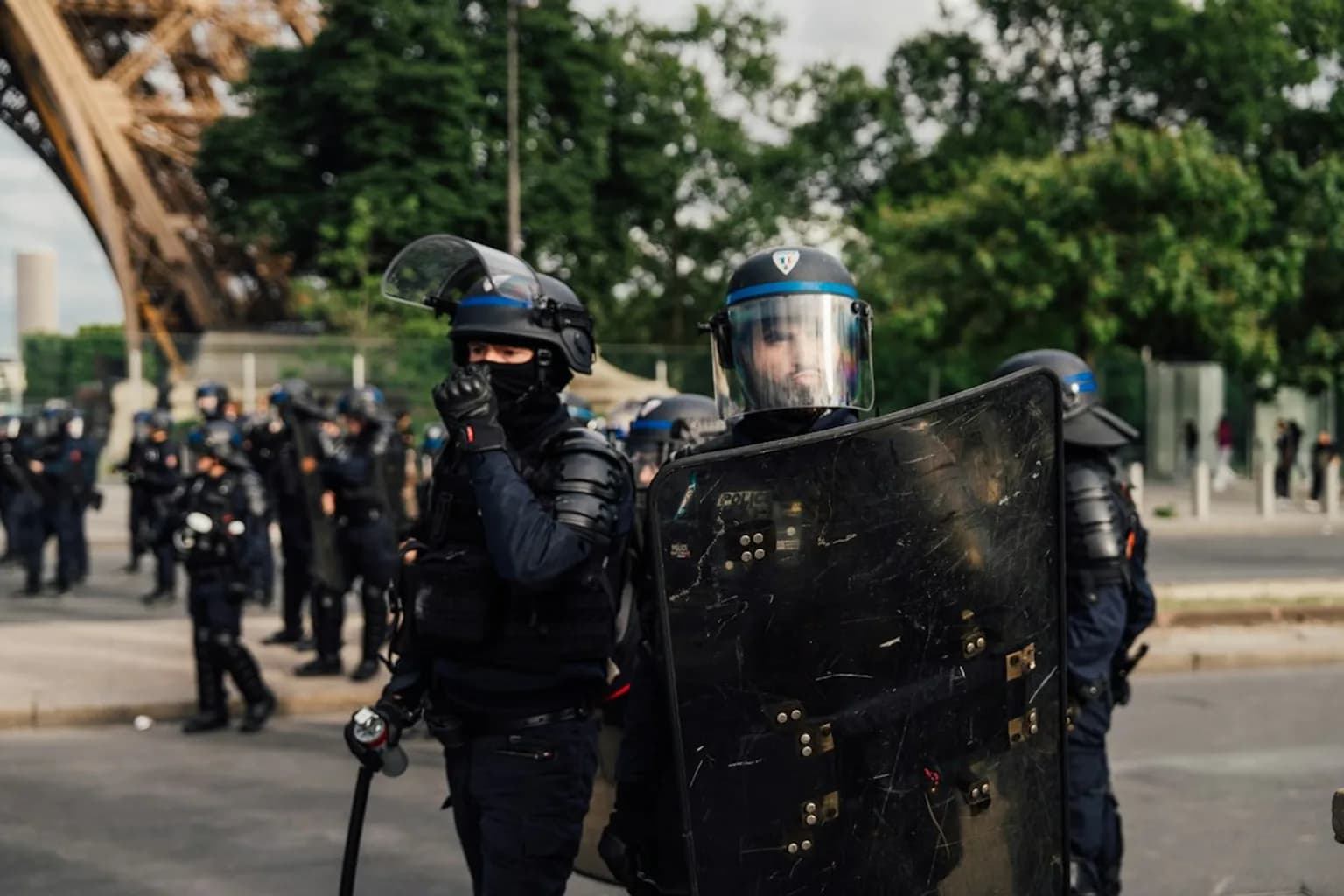
People in French cities face diverted protest routes and a major police deployment on 31 October, as the government tries to protect city centres from further disorder.
The restrictions follow nationwide demonstrations on 17 October that descended into clashes, large-scale looting and vandalism, catching authorities off guard. Macron later said officials had “not anticipated at all” the scale of those protests.
Protesters briefly stormed city hall in Marseille that day. The interior ministry said 410,000 people marched on 24 October, while over 2,700 people were arrested during the previous week’s unrest. Several teenage protesters were seriously injured.
On 26 October 2026, Emmanuel Macron met business owners in Marseille whose premises had been damaged during the unrest. During the visit, the French president warned: “Next Saturday is expected to be another risky day.”
Macron said the new protest routes would stay outside city centres to preserve public order. He said most protests would not be permitted “in city centres, where there is a risk of public disorder”. In Paris, authorities have banned two separate city-centre marches planned by unions and gilets jaunes, authorising one march instead in the far south-east.
The yellow vest movement has announced a “third act” on Halloween, calling for demonstrations outside the National Assembly and town halls across the country. Activists have urged people to show their anger over public services, including education and housing.
Laurent Nuñez, the interior minister, said 31 October would be “a very high risk” day and announced the deployment of 70,000 police officers and gendarmes, including elite units. He said security would include armoured vehicles and water cannon.
Nuñez warned against using Halloween as “a legitimate reason to hide one's face” while causing disturbances in public areas. He accused the “ultra-left” movement and some yellow vest activists of spreading social-media messages calling for a “revolution” on Halloween evening. He also issued warnings to far-right groups and pledged an “extremely firm” response to any excesses.
Student representatives have criticised the government’s response. Manon Moret, secretary general of the Unef student union, described her meeting with Nuñez as “a dialogue of the deaf”. Louis Letoublon, deputy head of the Les Lyceens! student organisation, called Nuñez “an irresponsible minister, incapable of answering for police repression”.
A nationwide strike has been called for 5 November.
Germany is also preparing for demonstrations. The loose Gen Z regelt alliance has called on supporters to rally in more than 30 cities, seeking greater spending on schools, climate protection and housing, and opposing any return to mandatory military service.
By Friday, more than 160,000 people had registered through the alliance’s website to say they planned to attend protests. About 10,000 protesters, mainly pupils, students and their parents, are expected at the Brandenburg Gate in Berlin on Saturday afternoon.
Barbara Slowik Meisel, Berlin’s police chief, said she would assign an additional 1,500 officers to the capital. “We have no concrete evidence of any coordinated looting operations being planned,” she said.
Alexander Throm, a member of the ruling conservative Christian Democratic Union parliamentary group, wrote that “Scenes like those in France must be prevented at all costs”.


Comments (0)