
France Tried to Cut Straight Through Panama, and Paid for It
Ferdinand de Lesseps set out to cut a sea-level canal across the Isthmus of Panama, a plan that treated the passage between the Atlantic and Pacific as one immense excavation. The vision had a ruthless clarity: remove the land in the way, hold the water level, and create a route through the continent. That clarity also concentrated every difficulty in the same place, from the ground itself to the conditions facing the people sent to move it.
Over eight years, the French project consumed more than a billion francs, an investment equivalent to $280 million today, while work hazards, malaria, and yellow fever took 20,000 lives. The scale of the loss sat alongside the scale of the ambition, because this was a project built by excavation and sustained by capital in equal measure. When the effort collapsed, 800,000 shareholders lost their savings, according to the National Endowment for the Humanities.
The collapse left behind a canal route that had already drawn extraordinary resources and human commitment. It also left Philippe Bunau-Varilla, the French project’s chief engineer, still attached to the enterprise. He refused to abandon the canal, preserving its future as the failed effort passed from an engineering undertaking into a political question. The straight cut had proved ruinously expensive, yet the connection between the oceans remained compelling enough to keep the project alive.
Mosquito Control Changed the Odds Before Excavation Could
Expense was only part of the lesson. The route demanded a way to keep people alive and working long enough for any engineering plan to take hold, and that answer had begun to emerge in occupied Havana. There, U.S. Army physician Walter Reed eradicated yellow fever by preventing mosquito breeding, drawing on prevention studies by the Cuban physician and epidemiologist Dr. Carlos Finlay. Finlay’s work gave Reed’s campaign its crucial direction, linking disease prevention to the conditions in which mosquitoes could multiply, according to the National Endowment for the Humanities.
That work changed the canal from a question of excavation alone into a question of operations. A workforce could only sustain a vast project if the place where it lived and worked could be made safer, and mosquito control supplied the first system capable of doing that. The breakthrough was practical rather than abstract: prevent mosquito breeding, and yellow fever could be driven out. With that result established in Havana, the knowledge could travel to Panama with a clear purpose.
William Gorgas, an army doctor, brought those mosquito-suppression methods into the Canal Zone. His task came before the celebrated earthmoving campaign, because the campaign depended on an environment where workers could remain at their posts and the work could continue. The same source describes mosquito suppression as the condition that allowed the American canal effort to succeed where the French effort had failed, placing public health at the foundation of the enterprise rather than at its edge. The NEH’s account of the canal makes the sequence plain: disease control created the workable conditions for construction.
That sequence matters because it changes how the canal’s achievement comes into view. Before a lock could lift a ship or a shovel could reshape the route, officials needed a dependable way to reduce the danger that had overwhelmed the earlier effort. Gorgas’s mosquito campaign provided that dependable system, applying Reed’s approach and Finlay’s prevention research to the Canal Zone. It turned health from a source of mounting uncertainty into an organized part of the project’s daily capacity.
Once that capacity existed, the canal could begin to gather the scale its builders required: people, equipment, authority, and a plan for the terrain ahead. The medical campaign had cleared the first obstacle, leaving the next question in sharper focus. Who would control the ground on which this newly viable project would be built?
A Treaty Gave the United States the Ground, and the Power, to Build
The answer came through politics, where Philippe Bunau-Varilla carried the canal forward after the French venture had collapsed. The project’s former chief engineer allied himself with the attorney William Nelson Cromwell, and their partnership moved the canal from a failed enterprise toward an international agreement with the force to reorganize the isthmus around it, according to the National Endowment for the Humanities. Disease control had made work conceivable. Bunau-Varilla and Cromwell helped create the conditions for deciding who could direct that work.
That decision took shape in the Hay, Bunau-Varilla treaty, which gave the United States virtual sovereignty in the Zone and a free hand to build the canal. Those terms supplied far more than a place to dig. They established the authority required to assemble an immense project across a narrow strip of land, coordinate its competing demands, and keep its purpose fixed on a passage between the Atlantic and Pacific. The canal now stood as a geopolitical undertaking, with control of the Zone serving as the foundation beneath every later engineering choice.
The American commitment also had a president behind it. Theodore Roosevelt launched the canal project shortly after taking office following the assassination of President William McKinley, as the NEH recounts. His administration inherited a project whose dangers had become brutally clear, whose route required a different kind of solution, and whose future depended on sustained command over people, resources, and territory. The treaty gave that command a legal shape. Roosevelt’s backing gave it political momentum.
With sovereignty in the Zone and presidential support for the undertaking, the canal could be treated as a coordinated public work instead of a collection of separate obstacles. Authority could reach from the Atlantic side to the Pacific side, and the work could be organized around a single answer to Panama’s terrain. That answer would soon focus on the Culebra Cut, where the question of how ships would cross the isthmus became the central decision of the entire build.
The Lock Was the Decision That Made the Canal Buildable
The question at the Culebra Cut was how ships could pass through it. John Wallace, a railroad engineer, took charge as the first head of canal construction, bringing the project into contact with the practical demands of moving material and organizing a route across Panama. The deeper question lay in the shape of that route. A sea-level passage asked excavation alone to solve every problem at once, while a lock canal offered a sequence of controllable stages. That distinction came into focus through John Stevens, another railroad builder, whose observations at the Culebra Cut persuaded Theodore Roosevelt to support the lock idea, as the National Endowment for the Humanities recounts.
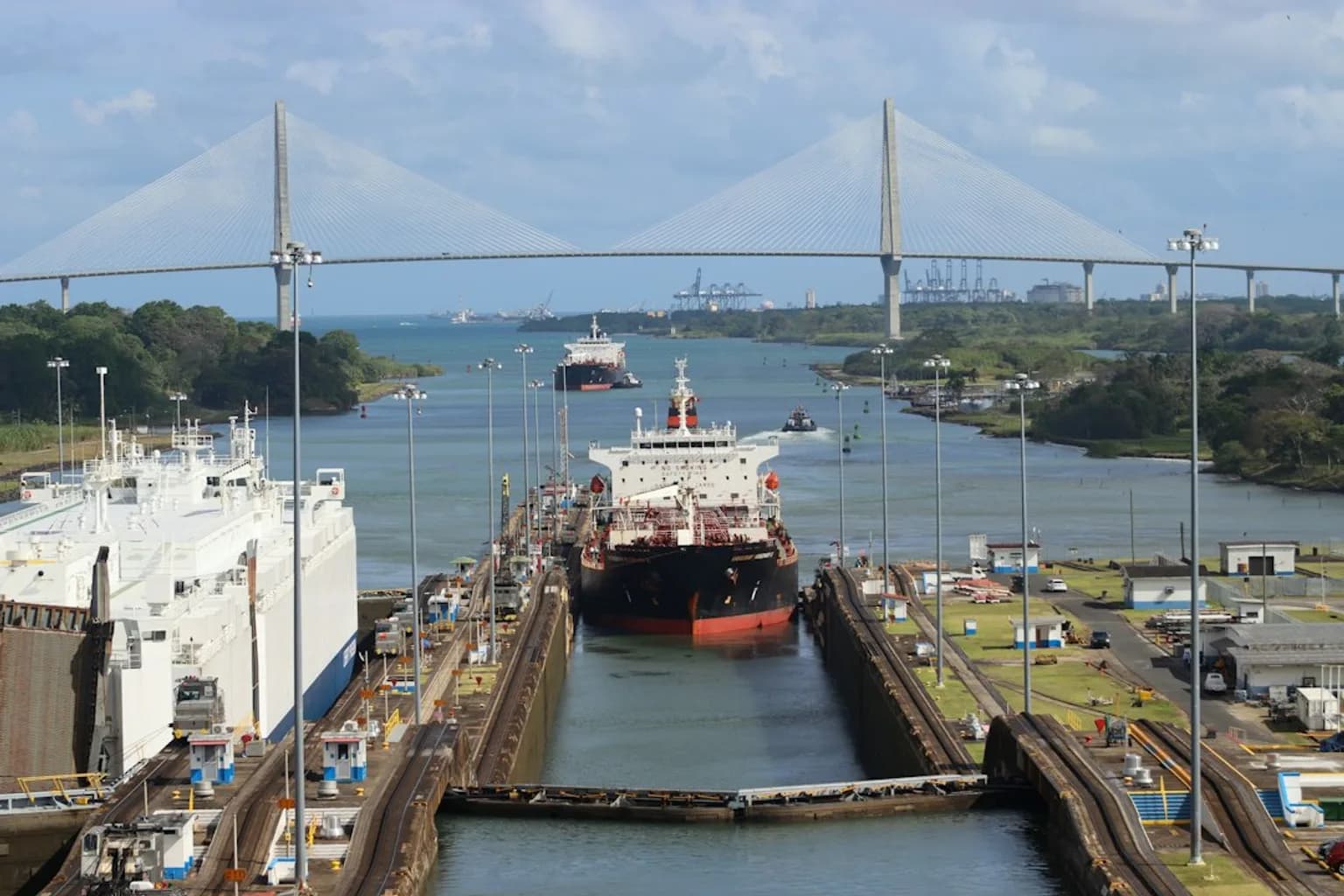
The decision gave the canal a workable physical logic. Ships would rise from sea level through locks to Gatun Lake, which stands 26 meters above sea level, then descend through further locks on the way toward the Pacific. The route therefore became a managed climb and descent, with water levels doing work that sheer excavation could never carry by itself. The Panama Canal Authority describes this system as the structure that raises ships to the lake and returns them toward the ocean.
That logic also changed the scale of the construction campaign. The builders created a highly mechanized waterway whose locks were three times longer than any previously built, a choice that turned the canal into an engineering system of unusually large moving parts. Each transit would depend on chambers, gates, water, and power operating in sequence, so the lock plan demanded equipment equal to its dimensions. By the 1890s, advances in electrical engineering had made hydroelectric-powered, motorized lock systems possible, supplying the means to operate this new kind of waterway. That combination of longer locks and motorized systems gave the project a design built for movement rather than a single heroic cut.
With the lock decision in place, Panama’s terrain became a set of tasks that could be assigned, measured, and powered. The central challenge still ran through the Culebra Cut, where Stevens had seen the limits of a simpler approach, and the plan now called for a construction effort capable of reshaping that passage for the waterway above it.
At Culebra, Machinery Turned a Mountain Crossing Into a Waterway
That effort gathered around the Culebra Cut, the canal’s narrowest passage, a roughly 13.7-kilometer stretch driven through the rock and limestone of the Cordillera Central. The Panama Canal Authority’s history describes a route whose difficulty lay in its material as much as its distance: this was the point where the waterway had to pass through a mountain spine, and every advance depended on moving what stood in its way.
Moving it required a workforce large enough to make the cut feel like a working town. Engineers arrived alongside blacksmiths, carpenters, drill operators, plumbers, ditch diggers, and brush cutters, part of the thousands of men who made their way to Panama for the canal work. The National Endowment for the Humanities records that range of trades, each one attached to a different piece of the same physical problem. Rock had to be drilled, equipment maintained, ground cleared, water managed, and earth carried away. The excavation became a coordinated industrial operation because the terrain demanded one.
At its center stood the steam shovel. Bucyrus machines moved earth three times as fast as the equipment used by the earlier French effort, according to the NEH, giving the project a decisive increase in excavation capacity. That comparison captures the change underway at Culebra: a cut once defined by the scale of what had to be removed now became a continuous cycle of digging, loading, hauling, and returning for more.
George Goethals, a career engineering officer, directed the project as that cycle accelerated. The NEH’s account places him at the head of a construction campaign built from labor, machinery, and a plan whose parts had to keep pace with one another. Under that direction, the Culebra Cut became the hard proof of the canal’s new method: the route through the Cordillera Central could be excavated at the scale the lock system required, turning a mountain crossing into a passage ready to carry water.
The Finished Canal Made Geography Operable
The route through the Cordillera Central could be excavated at the speed its machinery allowed, then carried onward into a waterway governed by exact levels and exact limits. The completed Panama Canal runs approximately 80 kilometers between the Atlantic and Pacific oceans, yet its achievement lies in the sequence that makes that distance usable. Ships enter a system of locks that lifts them from sea level to Gatun Lake, 26 meters above sea level, before guiding them down toward the other ocean, according to the Panama Canal Authority.
That sequence has three named stages, each tied to the town beside it: Gatún on the Atlantic side, then Pedro Miguel and Miraflores on the Pacific side. Together, the lock sets turn the canal into a managed passage, where a vessel moves through successive chambers rather than confronting the continental divide as a single stretch of open water. The route therefore operates through elevation, enclosure, and release, repeated with enough consistency to carry a ship across Panama.
The dimensions explain the discipline built into that movement. Each lock chamber measures 33.53 meters wide and 304.8 meters long, the Canal Authority states, creating a physical frame around every transit. Ships must fit within maximum dimensions of 32.3 meters in width, 294.1 meters in length, and a 12-meter draft in tropical fresh water. Those measurements leave little room for approximation. A ship approaches a chamber built to a known size, enters within a defined envelope, and rises or falls as the water level changes around it.
That is how the canal made geography operable. The Atlantic and Pacific became connected through a controlled chain of water levels, gates, power, and dimensions, with each element setting the conditions for the next. The difficult crossing had become a system that could be entered, measured, and managed, one lock chamber at a time.
Panama’s Canal Remains a Daily System of Labor, Rules, and Routes
Once that controlled chain became a working passage, it began to set the rhythm of a far larger network. Between 13,000 and 14,000 ships use the canal each year, moving along more than 180 maritime routes that connect 1,920 ports in 170 countries, according to the Panama Canal Authority. Each transit carries a vessel through a sequence built to exact limits, and each sequence has to fit within a schedule shared by traffic arriving from two oceans.
That schedule depends on people as much as it depends on chambers, gates, and water levels. The canal operates 24 hours a day, 365 days a year, with approximately 9,000 workers sustaining the flow, the Canal Authority says. Their work turns an engineered route into a daily service: ships arrive, enter the system, pass through it, and continue toward ports across the connected network. The canal’s scale now lives in this repetition, measured in thousands of passages rather than a single feat of excavation.
Panama also placed that daily responsibility inside its own public framework. In 1994, the country modified its National Constitution to include a title on the canal, creating the constitutional basis for its administration, according to the Panama Canal Authority’s history. The Legislative Assembly approved the organic law of the Panama Canal Authority on May 14, 1997, and the law was established on June 11 that year.
Through that framework, the Panama Canal Authority became an autonomous legal person of public law, created under Title XIV of Panama’s Political Constitution. An administrator and deputy administrator direct the authority under an 11-member board, while the administrator serves a seven-year term and may be re-elected for one additional period, as the Authority describes its governing structure. The canal therefore operates through an institution built to match its physical reality: a passage whose locks and routes demand continuous coordination, and whose reach extends far beyond the narrow strip of land where ships begin their transit.


Comments (0)