
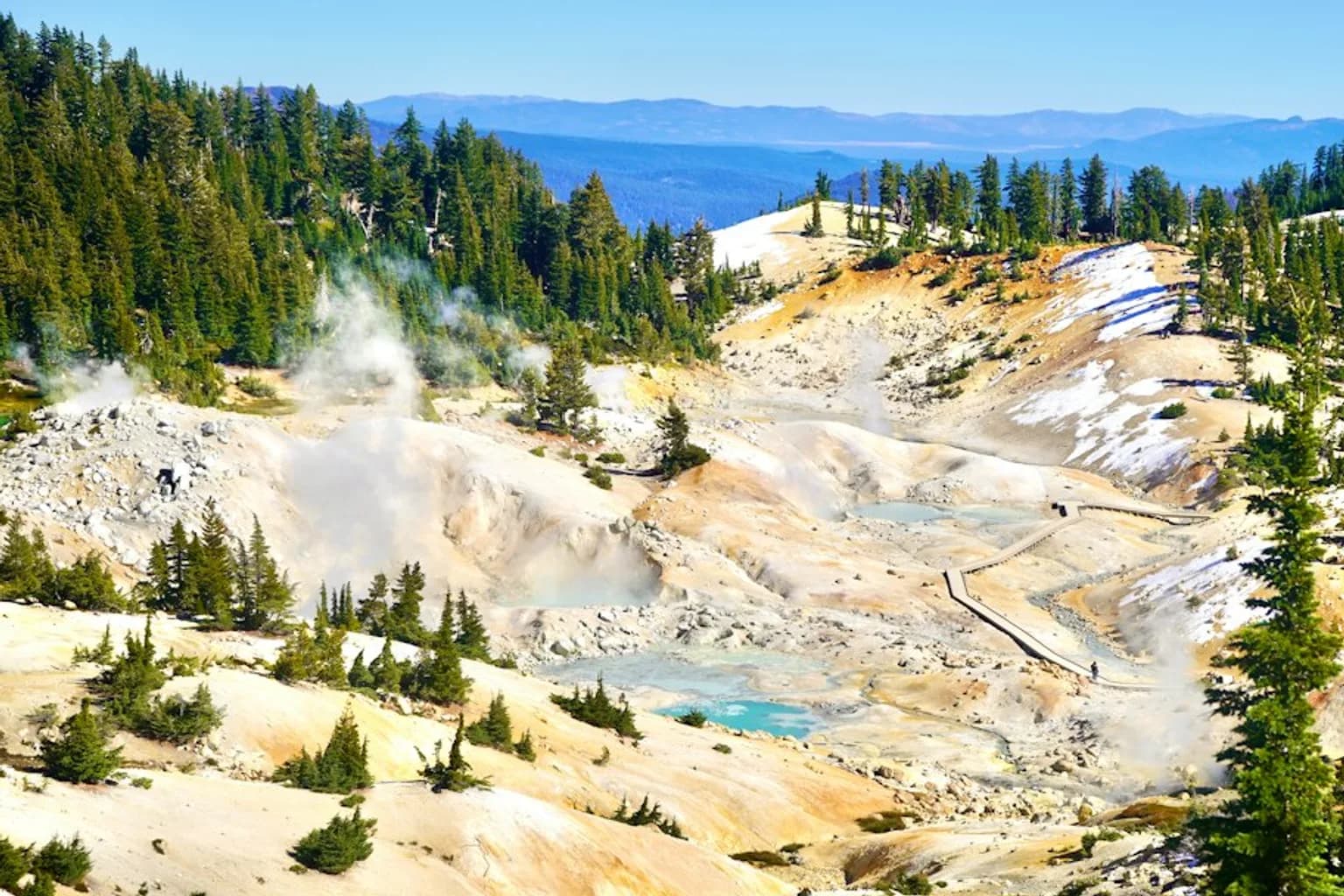
In 2023, Beryl Rappaport travelled to Lassen Volcanic National Park in California with Angela Oliverio to collect samples from geothermal streams. Rappaport, a Ph.D. candidate in microbiology and the study’s lead author, bought the longest barbecue tongs she could find at Walmart to hold test tubes in the heat.
The team worked in a narrow tributary of Hook Springs Creek, where water temperatures ranged from 120 to 149 degrees Fahrenheit because of an underground magma chamber. The amoeba lived in shallow, algae-slicked water near forested trails, and researchers’ gloves peeled from their hands in the heat.
The source was a tributary, separate from Lassen’s famous acidic pools.
Oliverio, an assistant professor of biology at Syracuse University who runs the Oliverio Lab and teaches graduate and undergraduate students how to conduct research, said she had suspected for at least three and a half years that the team had found a record-setting eukaryote. “What we thought was true is not.”
That expectation ran against a rule-of-thumb dating to 1972, when two scientists proposed that life more complex than bacteria could not live above 140 degrees Fahrenheit. The idea persisted for more than 50 years.
Scientists had placed the theoretical limit for eukaryotic life at 143°F (62°C), drawing on observations of fungi at 140°F (60°C). They also believed eukaryotic membranes could not remain stable above roughly 60°C (140°F).
The newly isolated organism, Incendiamoeba cascadensis, is a unicellular eukaryote found in geothermal springs in Lassen Volcanic National Park in Northern California.
NASA-supported researchers cultured the amoebas in a laboratory at rising temperatures. They continued growing from 57°C to 60°C, then kept dividing at 63°C (145°F).
That reproductive temperature, 145°F (63°C), is the highest yet recorded for eukaryotic life. The amoeba also actively crawls at 147°F (64°C).
At 70°C (158°F), the amoebas formed cysts, dormant structures able to survive extreme conditions.
Most studied eukaryotic organisms with cell types similar to human cells live at temperatures close to those of the human body, averaging 95 degrees Fahrenheit (35 degrees Celsius). Bacteria, by comparison, have been recorded living up to 212°F (100°C).
Incendiamoeba cascadensis has organelles, an active cytoskeleton and a relatively large genome. It also has a large reservoir of heat shock proteins and unusual protein building blocks that help hold proteins together.
Genome and RNA analyses found enhanced systems for protein maintenance, DNA repair, genome stability and membrane trafficking. Many of the genes that become active or more active as temperatures rise remain unknown.
The study was published at the end of September 2026 in the journal Cell. Members of the Oliverio lab are using the same culturing techniques to find additional extreme microbes, while the discovery may also reveal thermostable molecules useful in biotechnology.

Comments (0)