
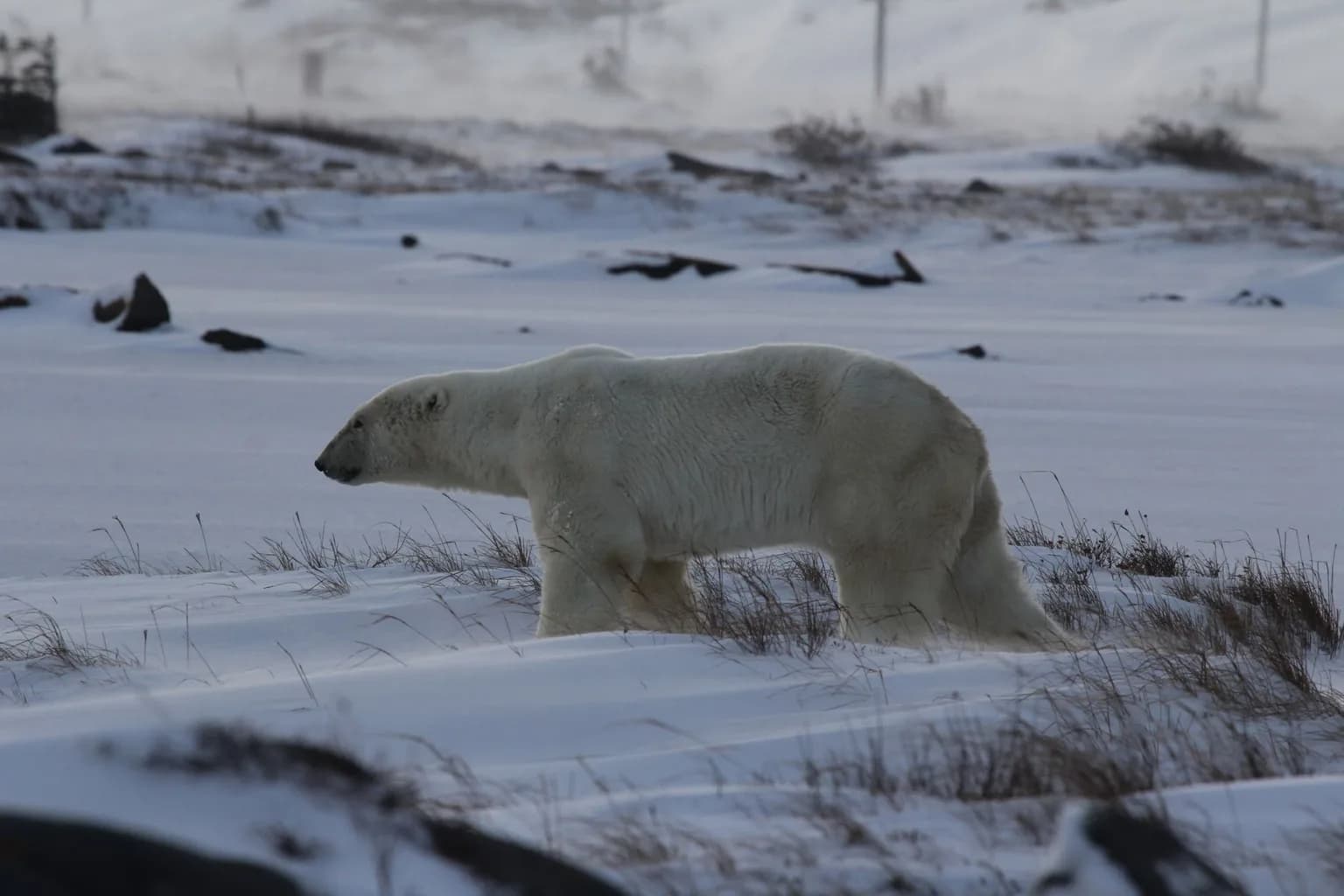
At Churchill’s waste facility on the coast of Hudson Bay, an international team is setting up an artificial intelligence-powered doorbell camera intended to spot polar bears before they reach people or rubbish. The trial is designed to give local communities early warning of approaching animals.
The system, called Bear-vision, was created by the conservation charity Polar Bears International and is designed as a cost-effective warning tool for homes and businesses. It works like a video doorbell, learning what a polar bear looks like and sending an alert when one approaches so people have time to get somewhere safe.
Churchill, in northern Manitoba, is sometimes called the Polar Bear Capital of the World. Every autumn, hundreds of polar bears gather nearby as they wait for Hudson Bay to freeze, allowing them to hunt seals.
The need for an earlier warning system has sharpened as the ice-free season around Hudson Bay has grown three to four weeks longer than it was in the 1980s. Polar bears now spend approximately one month longer waiting on land than their grandparents did.
A fire destroyed Churchill’s waste site in 2024, leaving bears to paw through rubbish for food.
Polar Bears International created Bear-vision. The camera system builds on Bear-dar, which combines radar and video equipment to detect movement across the Arctic landscape and follow nearby animals.
The initial Bear-vision unit has been deployed at the waste facility. Around it, the team has installed new electric fences and Bear-dar equipment, while a group of Churchill experts travelled to Greenland to examine a similar waste-management facility and inform their approach.
Polar Bears International, Brigham Young University and Churchill’s Polar Bear Alert Programme are also testing drones as an affordable, non-lethal way to move bears safely away from communities. Researchers are testing ultrasonic sound, conductive materials and a new odour-based bear spray formula.
Krista Wright, executive director of Polar Bears International, has overseen decades of work with the Churchill community aimed at helping wildlife conservation and communities coexist. “We're experiencing first-hand how co-existence is becoming part of everyday life in more places,” Wright said.
That work sits alongside programmes developed in Inuit communities. Derrick Pottle, an elder and skilled guide from the Inuit community of Tikigâksuagusik in Nunatsiavut, founded BearSafe Planning in 2005 to train and certify students to guard against polar bears and black bears in northern Labrador. He developed the programme with input from Parks Canada, conservationists, Inuit elders and academics.
Sherri Wolfrey, a trained bear guard in Tikigâksuagusik and a mother of four, became interested in bear monitoring in 2015. She was last year contracted as a bear guard in Akami-Uapishkᵁ-KakKasuak (Mealy Mountains National Park Reserve).
Sixty to 80 per cent of the world’s polar bear population lives in Canada, according to Environment and Climate Change Canada. The Arctic is warming nearly four times faster than the rest of the planet.
The Bear-vision trial coincides with Polar Bear Week 2026, organised by Polar Bears International and held from 1 to 7 November 2026.

Comments (0)