
A Signal Stops at 21:02:23
At 21:02:23 UT on 13 September 1959, Luna 2’s radio signal abruptly ceased. In Moscow, the clock had already passed midnight, making it 12:02:23 a.m. on 14 September. The silence marked the moment the Soviet probe struck the Moon, according to NASA’s National Space Science Data Center.
For a little more than a day and a half, the craft had been a moving radio source on its way through space. Then the transmission ended with a result no spacecraft had delivered before: Luna 2 had made the first contact with another body in the solar system. It became the first human-made object to impact the Moon, a threshold recorded by Wired as the arrival of humanity’s first artifact on the lunar surface.
The fact arrived with remarkable force because the evidence was so spare. There was no landing broadcast, no image from the surface, no human voice describing an alien horizon. A signal crossed the distance between Earth and the Moon, then stopped. That disappearance turned a technical event into a public measure of reach: a nation had sent a machine across space and put it onto another world.
Luna 2 therefore gave the Moon a new role. The lunar surface remained distant, hard to see, and physically untouched by people, yet it had become a destination against which technological power could be tested. The mission showed that national achievement could be registered in a single, verifiable instant, carried by radio receivers and fixed to a precise time.
That precision matters. The impact point was estimated east of Mare Serenitatis, near the Aristides, Archimedes, and Autolycus craters, while the exact location remained only roughly defined within a small range of lunar coordinates, NASA’s mission record states. The location gave the event geography; the stopped signal gave it certainty. Together, they transformed the Moon from a distant object of observation into the clearest proving ground of the space age.
The rest of Luna 2’s story begins inside that silence: a flight designed to reach the Moon, the measurements it returned before contact, and the political weight gathered by a machine that made history when it could no longer speak.
A Soviet Moonshot With One Job: Make Contact
That silence had been the aim from the beginning, because the Soviet Union had spent the previous year trying to place a spacecraft on the Moon. The effort reached a revealing near-success in January 1959, when Luna 1 passed the Moon by about 6,400 kilometres and continued on to become the first spacecraft to enter orbit around the Sun, according to SpaceDaily. The miss left a clear target for the next attempt: close the remaining distance, reach the surface, and turn a near pass into contact.
Luna 2 was shaped by that clarity. It carried no camera, had no propulsion system, and was built for impact rather than a soft landing, as Wired describes the mission. Those choices gave the flight a stark economy. A camera would have asked Luna 2 to observe the Moon from afar. A landing system would have asked it to survive the arrival. This spacecraft had a simpler assignment: travel outward, send measurements home during the crossing, and arrive at the lunar surface.
That assignment made the mission feel both limited and unusually bold. Luna 2 could gather information on its way toward the target, yet every part of the plan pointed toward a single final proof. The Moon had to become a reachable place. Success would be registered through contact itself, with the spacecraft’s final transmission carrying the meaning of the flight as clearly as any image could have done.
The pressure around that proof extended beyond the Soviet program. By the time Luna 2 flew, the Soviet achievement followed four failed American Pioneer attempts and a distant Pioneer 4 flyby, SpaceDaily reports. Each attempt made the lunar distance a public test of rockets, navigation, communications and timing. A flyby could demonstrate reach, while an impact would demonstrate command over the final approach.
For the Soviet Union, Luna 1 had already shown that a spacecraft could leave Earth and pass through the Moon’s neighborhood. Luna 2 therefore carried a more focused burden: it had to convert that earlier trajectory into a destination. The design left little room for any other story, which is why the mission’s abrupt ending could carry such force. Before that ending, however, the first obstacle stood on Earth, at the launch pad, where a planned departure suddenly had to wait.
The Launch That Had to Wait
The first obstacle stood at the launch pad. Luna 2 had been scheduled to leave on September 9, yet the Blok I core stage failed to reach full thrust at ignition, and controllers shut it down before the mission could begin. The account of the attempt leaves the moment in practical terms: the rocket had to deliver the power expected of it from its first seconds, and this one did not. A journey built around a direct path to the Moon therefore paused before it had even cleared Earth.
That shutdown set off a larger piece of work on the ground. Crews removed the booster from the pad and replaced it with a different vehicle, a process that delayed the flight by three days. According to SciHi, the September 9 attempt gave way to a new launch opportunity rather than a revised mission. The destination remained fixed; the timetable had to catch up with it. For a project aimed at a single, decisive arrival, the replacement booster became the bridge between an interrupted start and another chance to leave Earth.
That chance came on September 12. At 6:39:42 UT, Luna 2 lifted off from Tyuratam in the U.S.S.R., the site also known as Baikonur Cosmodrome. NASA’s mission record identifies its launch vehicle as a Modified SS-6, called Sapwood, fitted with a second-generation longer upper stage. The description matters because the mission’s path began with that combination of launch vehicle and upper stage, carrying the spacecraft away from the pad after the earlier booster had forced the wait.
The three-day slip also sharpened the meaning of the successful departure. September 12 turned the mission from an intended flight into an active one, with the rocket’s work now measured in distance rather than preparation. The Soviet Union had a spacecraft on its way, and the launch sequence had given way to the far harder task of following it across space. Later that same day, Luna 2 would provide trackers with a striking sign that the journey had truly begun.
A Bright Sodium Cloud Marks the Way
That harder task began with an object small enough to describe plainly and important enough to require constant attention: Luna 2 was a 390.2-kilogram sphere, built along the same basic lines as Luna 1, with antennae and instrument parts extending from its body. NASA’s mission record gives the craft’s mass and design, details that make the flight feel tangible. The Soviet mission had sent a compact piece of hardware outward, and every signal from it now helped ground teams follow a journey whose destination lay far beyond the launch site.
The flight supplied a striking marker on its first day. At 18:42:42 UT on September 12, Luna 2 released a bright orange cloud of sodium gas. The cloud aided spacecraft tracking while serving as an experiment in the behavior of gas in space, according to NASA’s account. For observers, that release gave the mission a visible event in the darkness, a brief orange signature tied to a spacecraft already moving away from Earth.
Its value reached beyond spectacle. A journey to the Moon demanded a way to keep hold of the craft’s path as distance grew, and the sodium cloud added a fresh point of reference to the radio signals coming from Luna 2. The experiment joined practical tracking with a question about the environment through which the probe was traveling. Gas released into space could be observed as part of the same mission that was carrying a spherical craft, its antennae and instruments exposed to the journey ahead.
That combination gave the flight a steady rhythm: the spacecraft moved outward, tracking continued, and each transmitted sign located the mission more firmly along its direct route. Luna 2 had become a vehicle that could be followed in more than one way, through its radio presence and through the orange cloud released on launch day. The Soviet Union had turned a distant target into an active flight path, and the measurements gathered along that path were already beginning to matter.
What Luna 2 Learned Before It Hit
That active flight also became a moving laboratory. As Luna 2 continued along its route, its instruments sampled the environment ahead of the first encounter with the lunar surface, turning every transmission into a report from a region that spacecraft had never reached before. The payload included Geiger and scintillation counters, a magnetometer, ion traps, and micrometeorite detectors, a compact set of tools built to gather evidence about cosmic rays, magnetic fields, and the tiny impacts that occur in space. Space Daily describes the craft’s suite as it traveled toward the Moon, while EBSCO identifies cosmic rays, magnetic fields, and micrometeorite impacts as central targets of the mission.
The magnetometer supplied one of the clearest answers. Luna 2 found that the Moon had no appreciable magnetic field, a result recorded in NASA’s mission account. Its other instruments added a second finding: they returned no evidence of radiation belts at the Moon. Together, those results gave the approaching world a sharper scientific outline. The Moon lay within a space environment whose magnetic and radiation conditions could now be described from direct measurements rather than inferred at a distance.
That practical work gave the mission a second purpose alongside its drive toward contact. The counters registered conditions through the flight, the magnetometer tested for a lunar field, and the micrometeorite detectors watched for the small particles moving through the spacecraft’s path. Each reading traveled back by radio while Luna 2 was still in transit, so the same link that allowed observers to follow the probe also carried the first scientific record of its approach to the Moon. Wired notes that the data returned before the end of the mission confirmed both the lack of a lunar magnetic field and the absence of radiation belts. With those measurements secured, Luna 2 was carrying more than a claim of arrival toward the lunar surface. It was carrying answers gathered on the way there.
Thirty-Six Hours to the Lunar Surface
Observers on Earth could follow those returning readings for only as long as Luna 2 remained in flight, and the remaining distance closed quickly. The probe was traveling on a direct path toward the Moon, a journey described as lasting around 36 hours from launch to impact by SciHi; Wired gives the flight time as 33.5 hours. Either measure captures the essential fact of the mission’s final day: the spacecraft had one continuous run from Earth toward the lunar surface, with its instruments sending their work home as the target grew nearer.
That run demanded a final course held with unusual precision. Luna 2 lacked its own propulsion system, so the third stage of its SS-6 booster guided the spacecraft until the two separated shortly before impact, according to Wired. The arrangement gave the last stretch a stark logic. The booster delivered the probe onto its trajectory, stayed with it through most of the crossing, and then fell away as Luna 2 continued alone toward the Moon.
By then, Luna 2 was moving at about 3 kilometres per second, a speed recorded by Astronomy. Its destination lay east of Mare Serenitatis, near the Aristides, Archimedes, and Autolycus craters, as NASA’s mission record places it. The exact impact point remains a very rough estimate, centered near 29.1 degrees north latitude and close to zero degrees longitude, yet the wider region was clear enough to turn the final approach from an intention into a location on the lunar map.
The operational proof arrived through the same radio link that had carried the flight’s data. At 21:02:23 UTC on September 13, receivers at Jodrell Bank in England lost Luna 2’s signal, SpaceDaily reports. NASA’s account treats that abrupt silence as the indication of impact. In that instant, the mission’s radio transmissions gave way to physical contact: Luna 2 had reached the lunar surface, and the first human-made object had arrived at another world.
Soviet Pennants Reach the Moon First
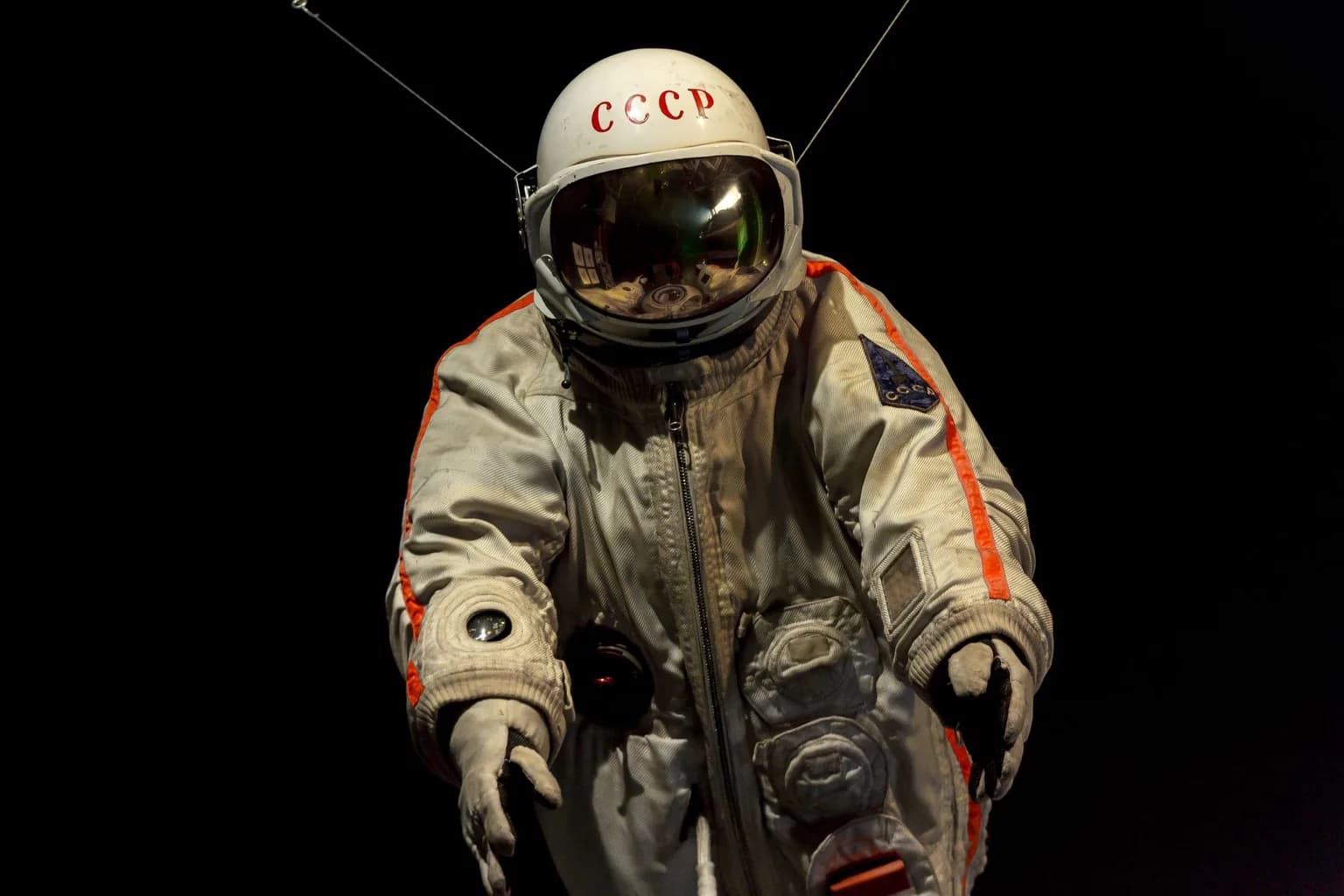
The Soviet Union had arranged for that contact to carry its name. Luna 2 held Soviet pennants made from small metal pentagons, each engraved with a hammer-and-sickle symbol, a star and the Cyrillic letters CCCP, then attached to metal balls, NASA’s mission record says. The probe had reached the Moon without a camera or a soft-landing system, yet it carried these compact pieces of national symbolism all the way to the impact area. In the final seconds of the flight, the mission’s scientific purpose and its political meaning travelled together.
Those markers took a form suited to an impact. Accounts describe two spherical pennants that Luna 2 deposited on the lunar surface when it crashed, according to Astronomy. Another account reports 144 small steel plates arranged inside explosive spheres, intended to scatter Soviet pieces across the site, SpaceDaily reports. The details mattered because the Moon had become a place where a successful arrival could carry a visible signature. The engraved pentagons turned an engineering feat into a claim that people could recognize at once.
That claim extended far beyond the impact point. The hammer and sickle, the star and CCCP placed Soviet symbols alongside the mission’s instruments, making the lunar journey part experiment and part public demonstration. Each small marker belonged to a flight that had already sent measurements across the distance, and each gave the accomplishment a durable physical form on the surface. Luna 2’s arrival therefore supplied the Soviet Union with more than a report of success: it supplied an object, an emblem and a story that could travel through newspapers, official meetings and public memory.
That story soon found a diplomatic setting. After the impact, Soviet Premier Nikita Khrushchev presented President Dwight Eisenhower with a replica of the Luna 2 pennant during his visit to the United States, Astronomy records. The replica brought the Moon mission into a meeting between the leaders of the two countries whose competition gave each launch added weight. A small Soviet emblem had crossed to the lunar surface, and its copy then crossed a room in the United States, carrying the same message: the first arrival had a flag-like mark attached to it.
The Moment the Moon Became a Scoreboard
The replica brought the Moon mission into a meeting between the leaders of the two countries whose competition gave each launch added weight. A small Soviet emblem had crossed from a fast-moving probe to the lunar surface, then into a diplomatic encounter, and that journey captured the new meaning of spaceflight. Luna 2 had turned arrival at the Moon into a public measure of national capability.
Its force came from the chain of achievements gathered inside one brief mission. The Soviet Union had sent a spacecraft away from Earth, tracked it across the intervening distance, received its radio reports, and brought it to the Moon. A contemporary account of the mission describes the flight as the first instance of radio communication at the half-million-kilometre distance, while NASA’s mission record identifies Luna 2 as the first spacecraft to contact another body in the solar system. The accomplishment had a sharp, visible final proof: the signal ended at the Moon.
That proof arrived with remarkable speed. Luna 2 launched less than two years after Sputnik 1’s successful flight, according to Astronomy, and it carried the first human artifact to the lunar surface. The compressed timeline made every part of the mission matter. Launch systems, guidance, tracking, communications, instruments and arrival all became elements of a single national demonstration. The Moon, once a distant destination for telescopes and speculation, had become a place where a country could register a first.
That first also set the direction of the next decade. The route from Luna 2’s impact led toward later lunar milestones, including Neil Armstrong’s first footprint on the Moon a decade afterward, as Wired notes. Armstrong’s step would offer a human image of lunar arrival; Luna 2 had already established the underlying contest in a more austere form, through instruments, radio and a collision on a distant plain.
For all the machinery behind it, the mission’s lasting claim rests on one simple sequence. A radio signal crossed the distance to the Moon. At 21:02:23 UT, it stopped abruptly, a loss that NASA’s record identifies as the indication of lunar impact. In that sudden silence, the Soviet Union held the first lunar claim, and the space race acquired its clearest scoreboard.


Comments (0)