
A Network Designed for Earth Is Remaking the View From Earth
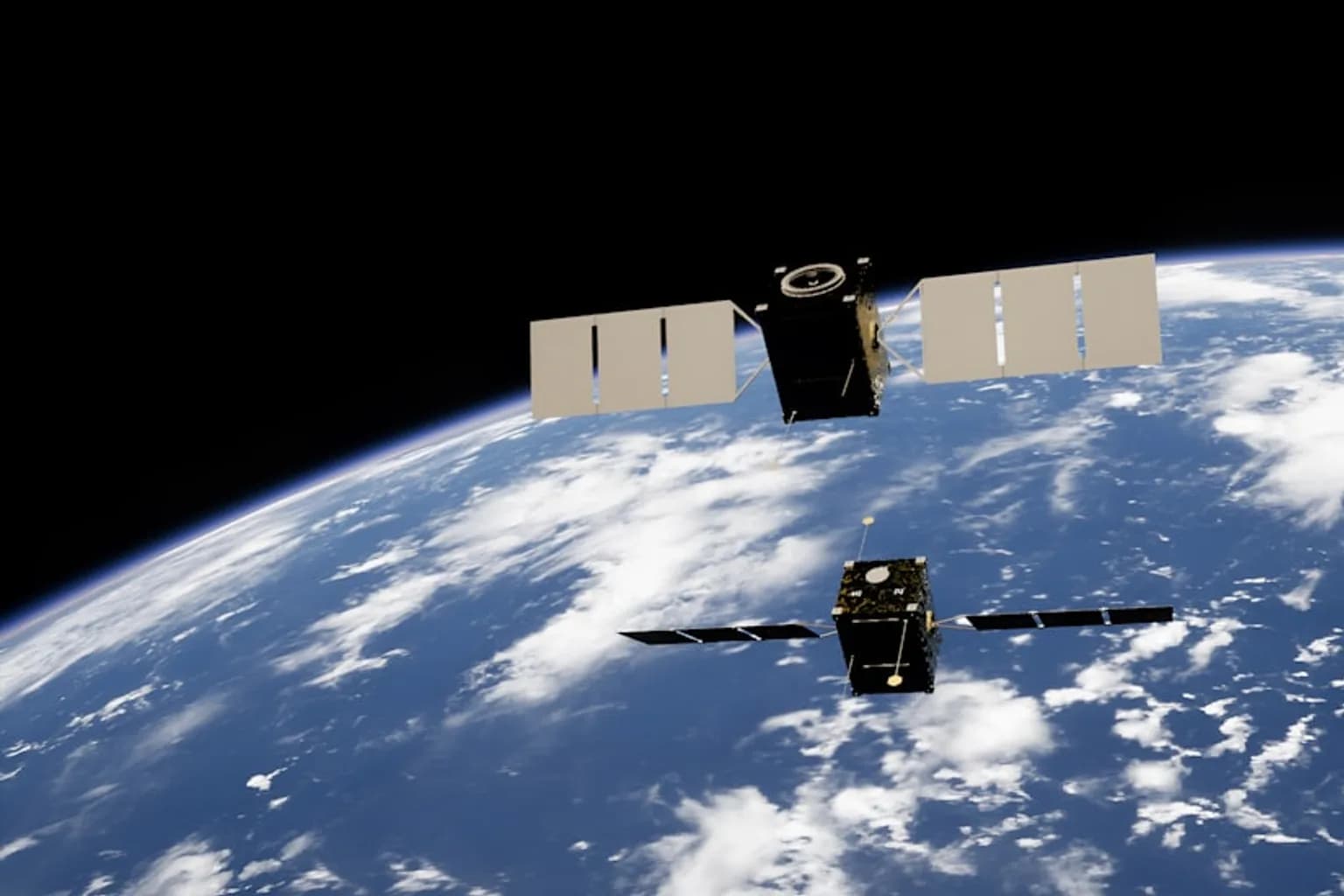
On an ordinary evening, the scale of the new network overhead remains easy to miss. Yet Jonathan McDowell’s September 2024 list counted 21 planned satellite constellations with 550,000 satellites planned in total, including 7,180 already launched. Each satellite serves a purpose on the ground: carrying communications across distance, linking places that a terrestrial network may reach slowly or unevenly, and helping build global coverage from orbit. Taken together, those individual missions create a new presence in the sky above every place those networks are meant to serve.
The scale follows directly from the service being promised. Starlink, OneWeb and other operators aim to provide global telecommunications with very low latency, and Olivier Hainaut’s overview explains the chain of requirements: low latency calls for very low altitude, while very low altitude calls for a very large number of satellites. A satellite closer to Earth can support the speed the network requires, yet it covers a smaller portion of the planet at any given time. The system answers that constraint by multiplying spacecraft and arranging them as a fleet.
That multiplication has moved quickly from plan to visible era. On 24 May 2019, the first batch of 60 Starlinks launched, placing a clear marker in the recent rise of telecom mega-constellations. The launch represented one early batch in a model built around repeated launches and large, coordinated networks rather than a small collection of isolated satellites.
For people using the service, the logic is straightforward: a dense network in low Earth orbit can make a global connection feel immediate. For people studying the sky, the same logic changes the conditions of observation. The future described by the planned totals is therefore also a question about a shared line of sight, from observatories on Earth toward objects far beyond the satellites themselves.
That question begins with a basic shift in perspective. The night sky has long functioned as the field through which astronomers collect light and signals from elsewhere in the universe. It is now becoming part of the operating environment for a rapidly expanding communications system. The next question is practical and precise: when an observer points a telescope upward, how often does a satellite network enter the frame?
Why a satellite can cross a telescope’s frame even when the sky feels empty
The answer begins with where the satellites are arranged. A typical constellation spreads its spacecraft across a series of regularly spaced orbital planes, creating an ordered pattern around Earth rather than a single crowded patch of sky. From the ground, that pattern continually changes as Earth turns and as satellites move along their paths. Olivier Hainaut’s satellite-visibility guide explains that higher satellites stay above the horizon for longer, so a greater share of their constellation remains visible from any one observing site. A telescope can therefore meet a moving satellite along a chosen line of sight even when a person scanning the sky sees only a sparse handful of points.
The horizon sets the first practical limit on that encounter. Typically, 3, 10% of a constellation sits somewhere above the horizon, according to Hainaut’s guide, while about ten times less, or 0.3, 1%, stands above 30 degrees elevation. That distinction matters because most professional telescopes cannot point below 20 degrees, and most observations take place above 30 degrees. The lowest slice of the sky is also difficult terrain for viewing: an object between zero and 10 degrees elevation sits very close to the horizon. Astronomers generally aim higher, where the fraction of visible satellites is smaller yet still present.
Visibility alone, however, does not determine what an optical instrument records. Illumination does. Satellites in Earth’s shadow are completely dark, which means the same orbital population can produce sharply different conditions as the geometry between Sun, Earth and telescope changes. Hainaut’s guide adds another useful proportion: 90% of illuminated satellites lie close to the horizon, while 10% sit above 30 degrees elevation. For an observer, the relevant question becomes more specific than how many satellites are overhead. It becomes which ones are sunlit, how high they are, and whether their routes cross the particular field under study.
That is why an apparently open sky can still contain a satellite’s path through a telescope frame. The likelihood changes with altitude, the direction of the telescope, the time of night and the observing schedule, all governed by the shifting geometry of an orbiting network. Twilight can place many satellites in sunlight while the ground has grown dark; at other times, Earth’s shadow removes them from optical view. These changing conditions turn satellite visibility into a problem of prediction as much as counting, and that prediction leads directly to what a bright moving object does when it enters an astronomical image.
A bright moving object can interrupt a still image of the universe
From a telescope’s image, the effect arrives as a bright line moving through a field built to hold still. Low-Earth-orbit constellations have the potential to affect astronomical observations and limit scientific discovery, as the International Astronomical Union’s Centre for the Protection of the Dark and Quiet Sky summarized in 2023. That broad warning becomes practical at the level of an observation: an astronomer points a telescope toward a chosen patch of sky, gathers light for an image, and a sunlit satellite can cross the frame during that work. The resulting trail places a moving, human-made object across an image intended to record distant sources.
Researchers have turned that practical disruption into a technical question with specific instruments, observing programs and possible responses. A paper published in The Astronomical Journal on 27 October 2020, “Mitigation of LEO Satellite Brightness and Trail Effects on the Rubin Observatory LSST,” examined precisely the paired problems in its title. Brightness matters because a satellite can register strongly in an optical image; trails matter because its orbit carries that brightness across the image rather than leaving it at a fixed point. Together, those effects shape how an observatory can plan, collect and interpret its observations.
The same question reached another major survey program. On 17 January 2022, a study titled “Palomar Survey Instrument Analyzes Impact of Starlink Satellites” examined effects on the Zwicky Transient Facility at Caltech’s Palomar Observatory. The progression from a general concern to studies of the Rubin Observatory LSST and the Zwicky Transient Facility shows where the stakes sit: in the daily work of facilities designed to make repeated, useful records of the sky. A satellite crossing becomes consequential when it enters those records often enough to shape the work around them.
A 2021 IAU presentation offers a concrete image of how that work may unfold under a fuller sky. Its projection for 2027 described a few tens of satellites brighter than magnitude V<5 during twilight, along with approximately 10 during midnight summer. Those are visible objects in conditions when observatories are already working through the changing light of the night. The image brings the issue into focus: a still astronomical frame can become the meeting point of two very different systems, one looking outward for faint and distant signals, the other moving overhead on a schedule of its own.
The interference question extends beyond what the eye can see
The image brings the issue into focus, then carries it past the visible streak in a telescope frame and into another kind of observing problem. Radio astronomy works with signals rather than brightness, so the central concern shifts from an illuminated object crossing an image to emissions entering an observing environment. A satellite can therefore matter to an observatory even when it makes no visual impression on the sky at all.
That distinction has already produced a specific piece of evidence. The study titled “Unintended electromagnetic radiation from Starlink satellites detected with LOFAR between 110 and 188 MHz” appeared in Astronomy & Astrophysics on 10 March 2023, as listed by the International Astronomical Union’s resource collection. Its title states the result with useful precision: the radiation was unintended, it came from Starlink satellites, and the detection covered frequencies from 110 to 188 MHz. The finding gives the wider debate a second dimension, one that cannot be assessed by looking up at twilight.
That second dimension changes the meaning of a usable astronomical sky. Optical observers need conditions that support their images, while radio observers need conditions that support the signals they are trying to receive. Each field faces its own practical questions, yet both work beneath the same growing layer of satellite infrastructure. The result is a shared challenge with several observing conditions in play at once: what passes through a field of view, what shines into it, and what emissions reach an instrument built to listen.
The language of a dark and quiet sky holds those conditions together. “Dark” describes the visual environment that supports optical observation; “quiet” captures the radio environment in which faint signals can be studied. The distinction also keeps the conversation clear. A brightness measure can address one part of the astronomical impact, while unintended electromagnetic radiation belongs to a different part of the same operating environment.
That is why the question now reaches beyond any single telescope, frequency range, or observing schedule. Satellite constellations create a set of linked conditions that astronomers and satellite operators have to describe in practical terms, using the evidence each kind of observation can provide. The next step is already visible in the record: experts from both communities began meeting to turn that shared problem into a working agenda.
Astronomy and satellite operators have already built a forum for the collision
Experts from both communities set out to turn that shared evidence into a working agenda. The American Astronautical Society hosted SATCON1 virtually from 29 June to 2 July 2020, convening a discussion with a precise purpose: to quantify the effects of satellite constellations at optical wavelengths and explore possible ways to mitigate them, as the International Astronomical Union’s reading list records. The framing mattered. Quantification turns a broad concern into questions that engineers, observatories and operators can work on together: which observations face disruption, under what conditions, and what changes might reduce it.
Those questions carried directly into SATCON2, which the AAS also hosted virtually from 12 to 16 July 2021. Across 2020 and 2021, experts from astronomy and the satellite community met regularly to characterize how low-Earth-orbit constellations affect different kinds of astronomical observation. That sustained contact gave the issue a practical home. Astronomers could bring the requirements of their observing programmes into the conversation, while satellite specialists could engage with the conditions created by orbital systems and their operation.
The meetings therefore made room for a more useful kind of disagreement: one organized around evidence, measurement and possible adjustments. Optical impacts formed SATCON1’s stated focus, while the wider pattern of regular meetings recognized that astronomical observation takes several forms and each carries its own exposure to satellite activity. A trail in an image, an observing window, and a frequency range present different technical circumstances, so a shared response needs to identify those circumstances clearly before it can test a remedy.
That is the value of a forum built early enough to shape an agenda. It creates a place where the expanding network above Earth and the instruments pointed through it can be discussed as connected systems, with specific effects to measure and specific operating choices to examine. By the time the conversation moved from its first virtual meeting into a second year of regular exchanges, the collision had acquired the beginnings of a working process: quantify the impact, map the observing conditions at stake, and explore practical mitigation.
Mitigation has become part of the satellite-operator conversation
The collision had also reached the people who make choices about satellites themselves, and in August 2022 SpaceX published a “Brightness Mitigation Best Practices for Satellite Operators” white paper. The title matters because it puts brightness in the language of operations: a feature that can be addressed through practices, shared with the companies responsible for deploying and running these networks. That gives the earlier meetings a practical destination. Their work on effects and observing conditions can inform decisions made before a satellite enters the sky, while its operators still control how those decisions take shape.
That connection had already appeared in the research agenda. A paper titled “Mitigation of LEO Satellite Brightness and Trail Effects on the Rubin Observatory LSST” was published in The Astronomical Journal on 27 October 2020, placing brightness and trails together as problems that could be studied in relation to a major observing programme. The operator white paper followed two years later, carrying the word “mitigation” into an industry-facing document. Between them sits a useful chain: researchers identify the conditions that affect observations; forums bring astronomers and satellite experts into sustained contact; operators can translate part of that evidence into their own practices.
Each link in that chain carries weight because the networks under discussion are so large. The planned fleets described across the earlier debate turn small choices in design and operation into choices with consequences for many observations over time. Brightness practices therefore belong alongside the technical work rather than at its edge. For observatories, the relevant question is how well those practices perform under the real conditions that shape an observation: the satellite’s position, its illumination, the direction of a telescope and the schedule of a survey.
The value of this operator conversation lies in its timing. Satellite networks are still expanding, while the research and coordination work has already established a vocabulary for discussing their effects. A white paper cannot settle every question raised by vast planned fleets, yet it shows that mitigation has entered the conversation in a form that operators can use. The next challenge comes through the cumulative scale of the launches themselves, as each addition turns those operating choices into part of the sky astronomers work within.
A changed sky will arrive through accumulation, one launch at a time
The next challenge comes through scale, because each additional launch joins a network whose effects accumulate across the sky. Olivier Hainaut’s overview judges it plausible that more than 100,000 constellation satellites could be launched in the coming years, while Jonathan McDowell’s September 2024 list counted 21 planned constellations with a combined planned total of 550,000 satellites. Those figures turn mitigation from a useful practice into a continuing design responsibility, carried across fleets that may grow for years.
That responsibility now sits at the centre of a wider scientific record. On 3 December 2025, Alejandro S. Borlaff, Pamela M. Marcum and Steve B. Howell published the open-access paper “Satellite megaconstellations will threaten space-based astronomy” in Nature, volume 648, pages 51, 57. The paper’s reach offers a measure of how widely the issue has travelled: Nature lists 83k accesses, 19 citations and an Altmetric score of 1529. An Author Correction followed on 27 May 2026, further placing the work within an active and closely watched discussion.
The numbers matter because infrastructure changes a shared environment gradually. A single launch adds satellites to orbital systems already designed to extend global telecommunications coverage. The resulting sky is shaped by the sum of those additions, along with the choices made in the design and operation of every expanding network. Visibility and radio quiet therefore belong alongside the operational constraints that guide those choices, especially while the future fleet remains a plan rather than a finished fact.
That is the practical meaning of the debate: satellite constellations carry communications infrastructure outward from Earth, and their consequences reach back into the astronomical skies used to study the universe. The work ahead lies in making preservation part of the expansion itself, launch by launch and design decision by design decision.



Comments (0)