
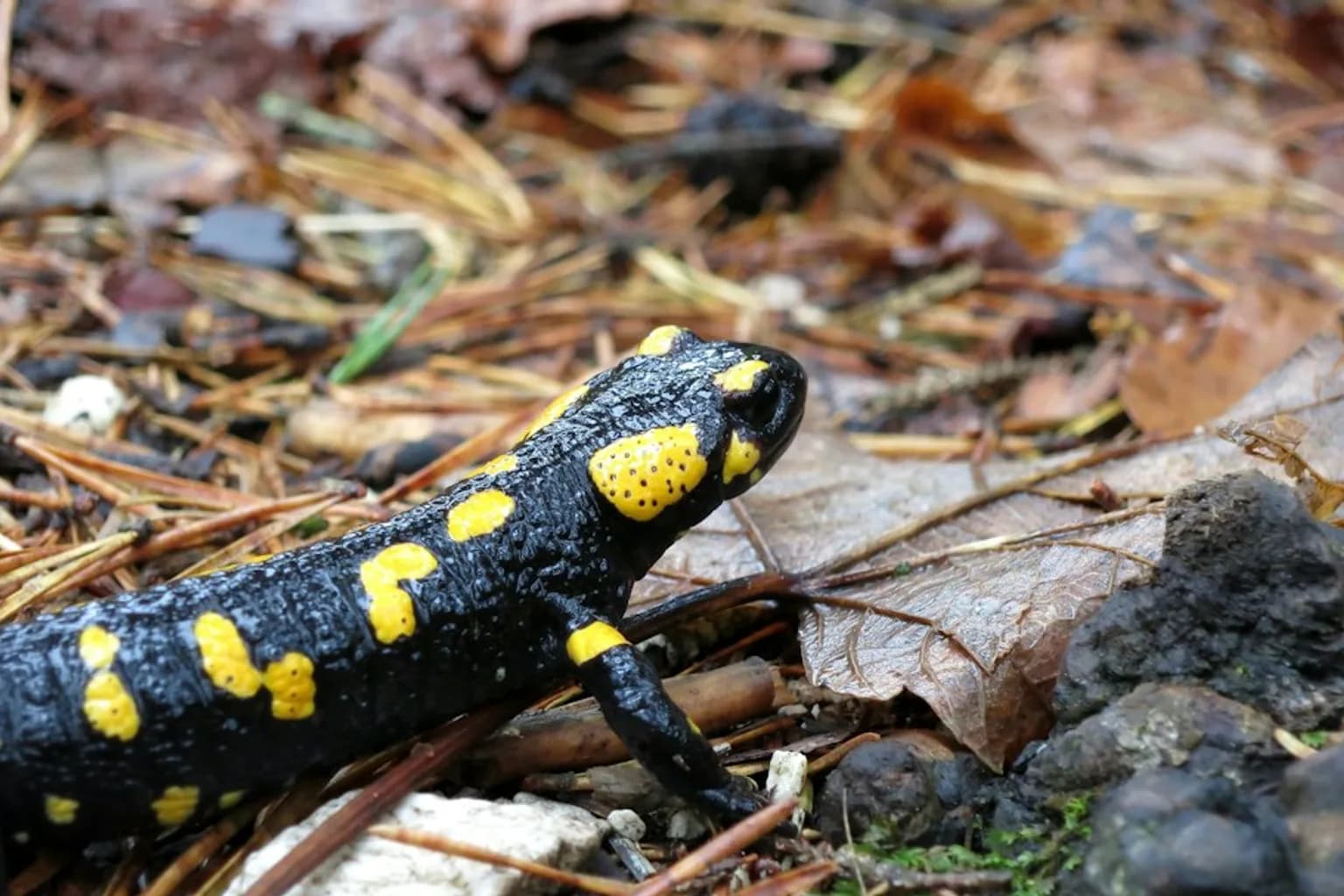
In damp forests, streams and mountainous regions across Europe, fire salamanders are recognised by their black-and-yellow colouring and the poisonous substances they release to deter predators. Researchers have now found another feature hidden from ordinary view: the animals fluoresce under ultraviolet light.
The effect is strongest on the salamanders’ yellow undersides and along their sides, where it produces vivid green and cyan colours. It is a form of biofluorescence, meaning it depends on an outside source of illumination. Full moonlight contains a greater proportion of ultraviolet and violet wavelengths than daylight, potentially lighting up the otherwise concealed colours.
Researchers traced the fluorescence mainly to glands in the animals’ skin and to the substances those glands release. Those secretions can remain fluorescent for more than 24 hours after leaving a salamander’s body.
Fire salamanders’ chemical defences include samandarines, highly toxic steroidal alkaloids produced from cholesterol precursors. The chemical responsible for the fluorescence itself, however, has yet to be identified.
The researchers have proposed two possible uses for the glow. It may help salamanders recognise one another or assess potential mates, and it may make their warning colours easier for predators to notice.
Bernat Burriel, the study’s first author, works at the Museum of Natural Sciences in Barcelona. Andrés Brunetti, a co-first author, is a researcher at the Max Planck Institute for Chemical Ecology. The co-authors also include Martin Kaltenpoth, director of the Department of Insect Symbiosis at the Max Planck Institute for Chemical Ecology, and Salvador Carranza, a researcher at the IBE (CSIC-UPF).
The International Union for Conservation of Nature classifies fire salamanders as ‘vulnerable’ on its Red List of Threatened Species. The proposed roles of their fluorescence remain to be established, while the substance that creates it is still unknown.




Comments (0)