
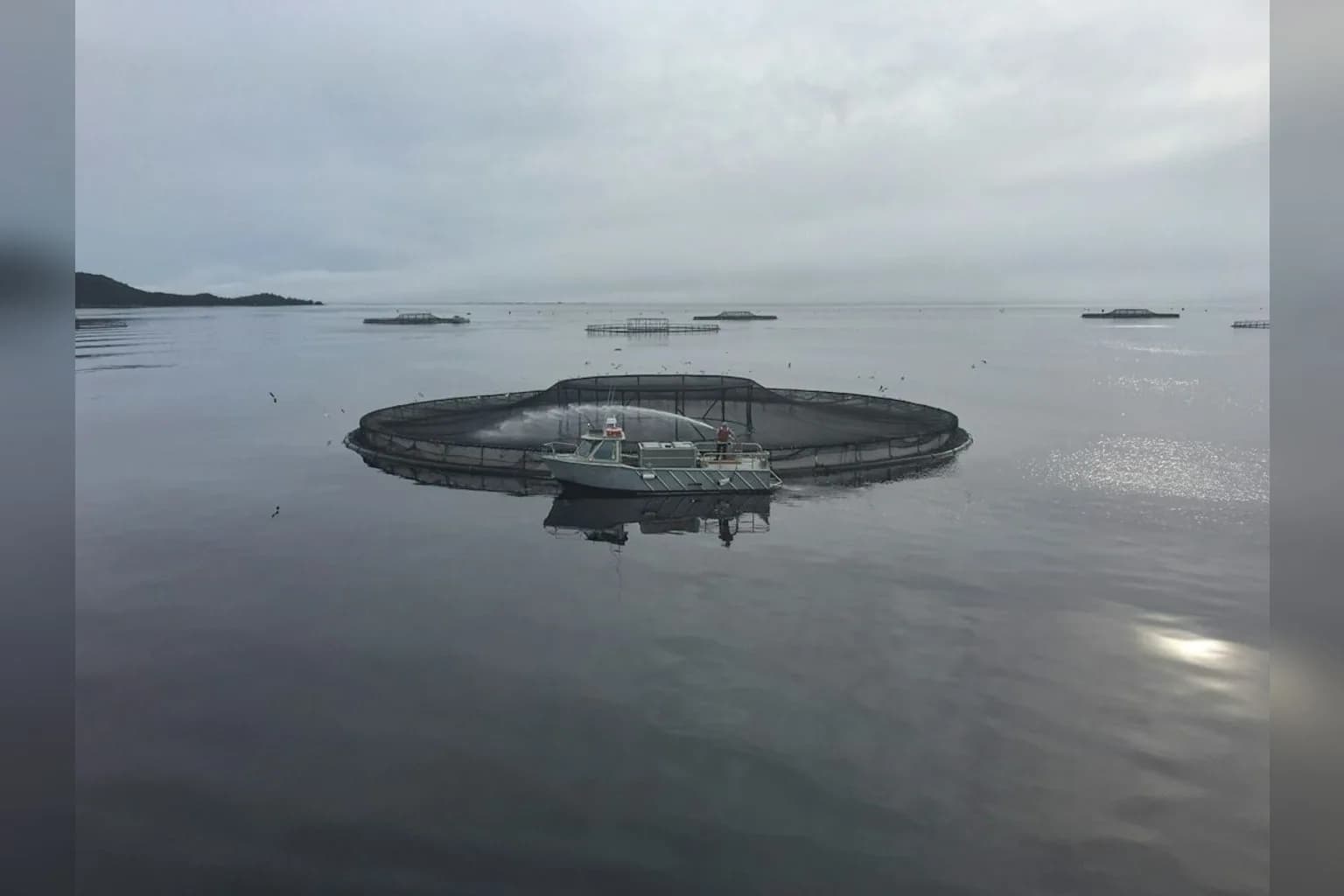
Pascal Goumain, president of Saumon de France, was showing visitors his company’s salmon pens in Cherbourg on 6 March 2024.
France’s Ministry of Agriculture has set a goal of farming 20,000 tonnes of salmon by 2030. In 2023, the Haut-Commissariat au Plan said “responsible development” of aquaculture could increase supply without damaging the fishing sector.
The expansion comes as aquaculture has become the $313-billion fastest-growing food sector. Half of seafood eaten worldwide is farm-raised, and two-thirds of global aquaculture produces species fed fishmeal and fish oil.
Those ingredients are made by cooking and pulverising wild-caught fish. More than a fifth of all marine life taken from the oceans goes into feed, mainly for farmed fish, and salmon on some farms consume more than six times their weight in wild-caught fish before sale.
Salmon, shrimp, trout, sea bass and sea bream are the leading farmed seafood types eaten in France. Daniel Pauly, project director of the Sea Around Us initiative at the University of British Columbia, said these species are fed the same kinds of wild fish that aquaculture presents itself as protecting, accelerating depletion of the oceans.
Annick Girardin, France’s former minister of the sea, pointed to the pressure behind the policy in 2021. “The quantities caught are not sufficient to feed consumers,” she said.
Over five years, an international team of journalists at The Outlaw Ocean Project investigated the global fishmeal trade across 64 countries. It documented artisanal fishers losing work, workers facing chronic chemical exposure and preventable deaths, and protests prompted by the odour from fishmeal factories.
Peru is the world’s largest fishmeal producer. More than 9.5 million people around the world live within 1.5km of fishmeal plants.
In 2020, government investigators went to United Marine Products in Goa, India, after local residents said the factory had made the air difficult to breathe and their drinking water dangerous. Investigators found that operators had drilled bore holes in a field behind the plant to dispose of wastewater illegally.
Authorities concluded that the bore holes probably contaminated groundwater and made villagers and livestock ill. The factory supplied Skretting, a major feed producer used by dozens of fish farms, whose products reach consumer shelves in Canada and France.
The fallout from fishmeal production has also reached the streets. In Sanyang, The Gambia, demonstrators in March 2021 burned down a police station and attacked the fishmeal plant at the Nessim facility. The unrest followed the killing of a Gambian man by a worker and drew force from wider grievances, including pollution from the factory.
In Kayar, Senegal, at least 50 protesters took to the streets in August 2022 seeking the closure of the Touba Protein Marine fishmeal plant. It had been built less than 500m from homes and had caused health problems, according to the investigation.
Dozens of residents marched outside the Omega fishmeal plant in Joal Fadhiouth, Senegal, in July 2024, demanding its closure over black smoke and dangerous air pollution. One resident said the pollutants were “like ash falling into their meals”.
The industry has also brought millions of dollars in tax revenue and thousands of jobs to Mauritania, Senegal and The Gambia, among other countries.
The Outlaw Ocean Project concluded that poorer countries bear the social and environmental effects of fishmeal production, where the fish are caught and processed. Wealthier countries consume the resulting farmed seafood.





Comments (0)