
South Korean and Japanese shipyards hold commercial order books stretching past 2028 while operating with chronic yard labour deficits. Skilled welders are an ageing demographic in Japanese, South Korean and American shipyards, where manual structural welding remains standard practice.
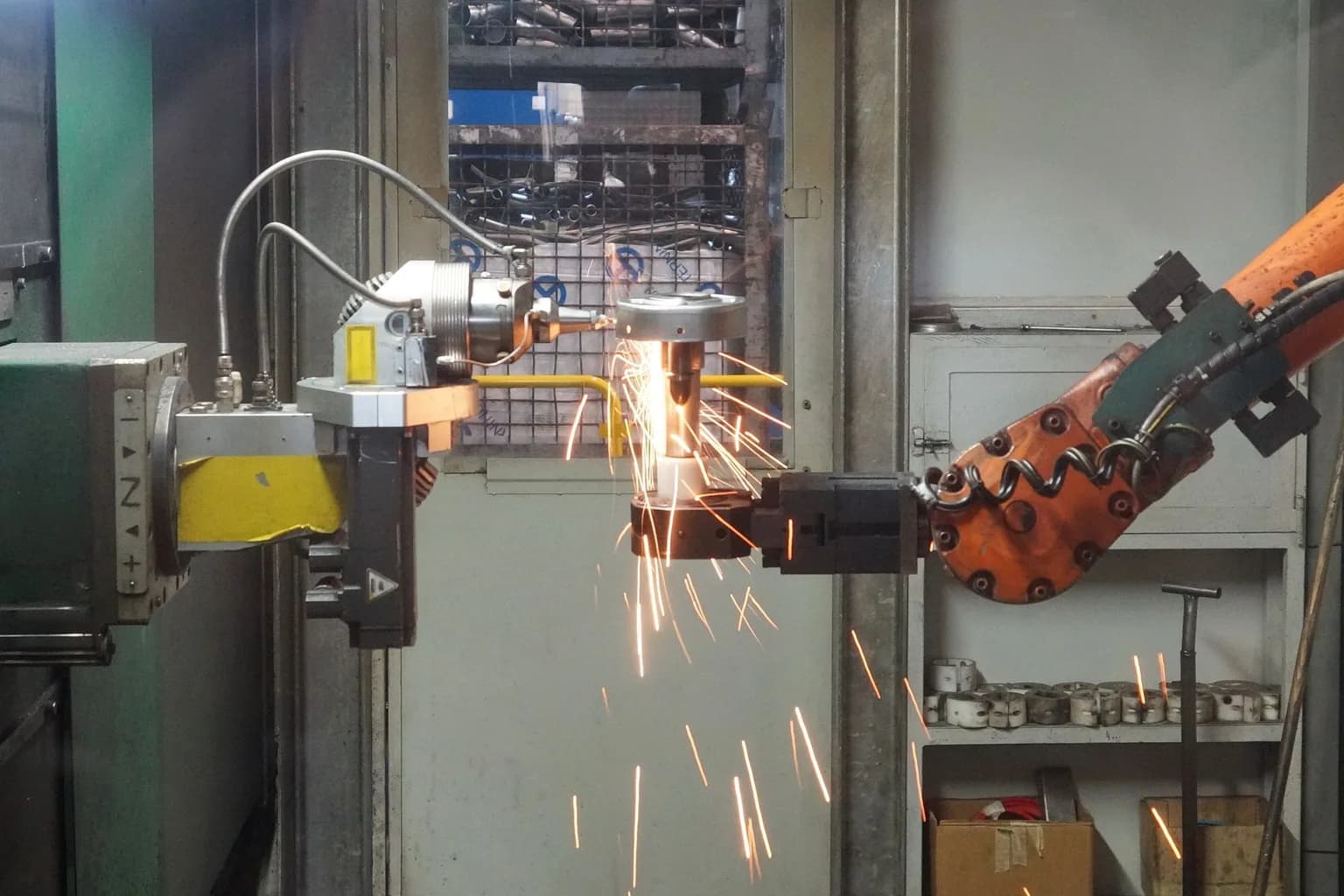
Fanuc and Google Cloud unveiled an autonomous welding system on 10 September 2026 that reads two-dimensional and three-dimensional engineering blueprints and turns them into movement coordinates without human operators manually teaching the machine. The system combines Fanuc industrial arms with Google Gemini Enterprise foundation models, while Alphabet’s Intrinsic subsidiary provides the open robot operating system layer.
Public demonstrations began on 14 September 2026 at IMTS in Chicago and ran through 19 September 2026.
Conventional robotic welding requires engineers to set every joint path, torch angle and voltage setting with a teach pendant. Preparing one custom structural workpiece can take several days of specialised engineering work before production starts.
Fanuc has an installed base of 1.1 million industrial robots worldwide, roughly one-fifth of operational factory manipulators globally. It has shipped more than 1,000 units configured for physical artificial intelligence applications since December 2025.
Commercial shipments of the Fanuc-Google welding system are due to begin in December 2026 under a subscription model.
Japan has set a goal of doubling domestic annual shipbuilding capacity from approximately 9 million gross tons currently to 18 million gross tons by 2035.
South Korea’s production automation rate reached 68% through automation and digital technology, shortening delivery times, according to OECD findings. Korea has also set a target of a 50% automation rate in production processes by 2040.
The country is developing robots for high-risk welding and painting work, along with block assembly systems designed for 24-hour operation.
HD Hyundai, which operates the world’s largest shipbuilding operation at the Ulsan yard, is launching humanoid welding robots in 2026 with Persona AI in the US and Neura Robotics in Germany. At its Samho shipyard, the company is adapting a Blackwell GPU digital twin with Nvidia and Siemens, with a 2030 target.
Samsung Heavy Industries has partnered with Dassault Systemes on a smart yard that links a vessel’s virtual twin to work on the yard floor. Hanwha Ocean uses 3D digital models and drone photography taken twice daily to monitor its yard in real time, and has contracted NC AI to develop a vision-recognition-based autonomous welding system.
China builds ships at a rate multiple orders of magnitude greater than the United States.
For Japan and South Korea, the contest centres on whether software, robots and virtual replicas of shipyards can help them deliver vessels on schedule while reducing their dependence on a shrinking pool of specialist labour.





Comments (0)