
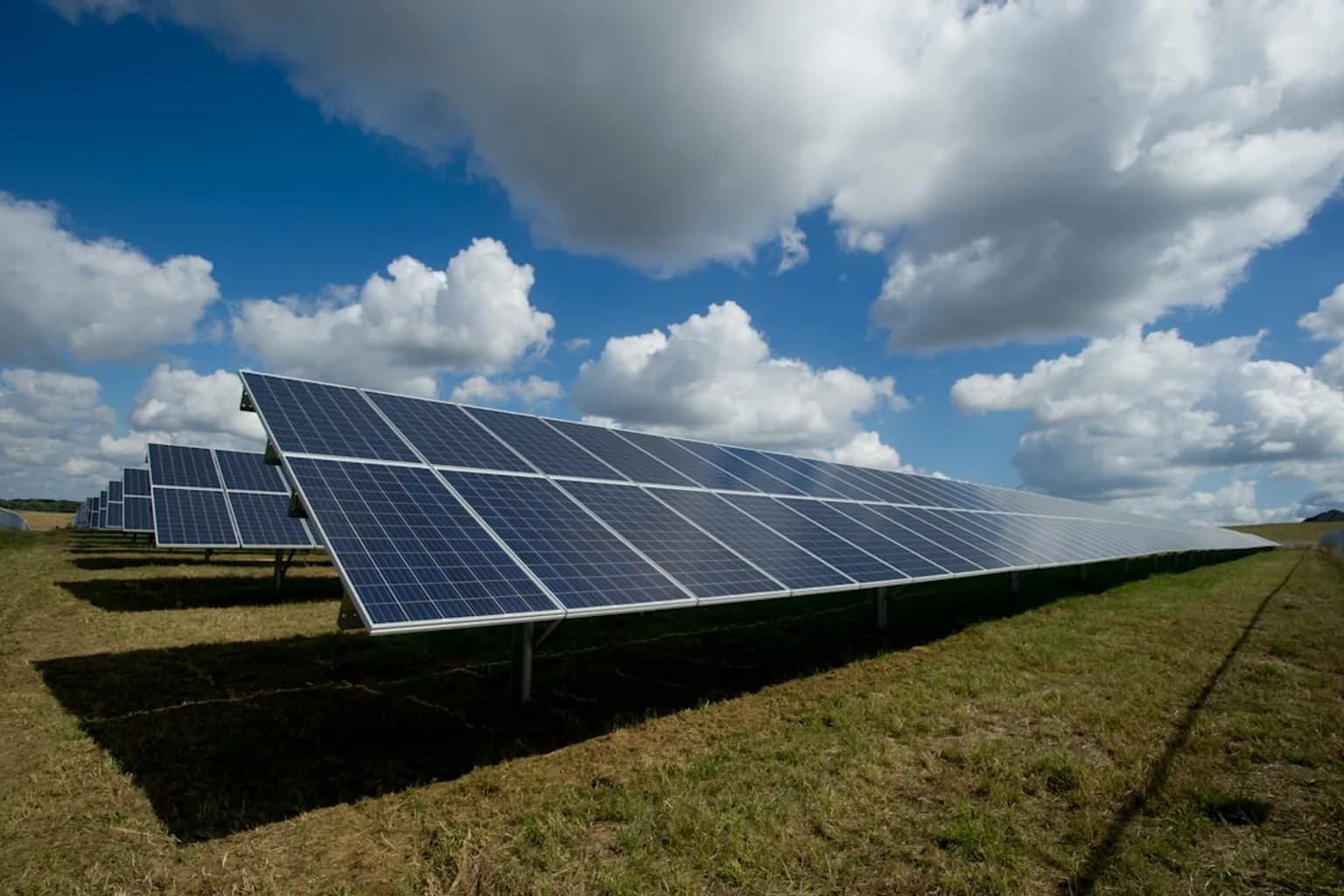
Solar power generation has moved from one of the costlier sources of electricity to one of the cheapest, as large-scale project costs fell from $408/MWh in 2010 to $44/MWh globally in 2024–2025. The decline of roughly 90% means new solar projects can undercut new coal- and gas-fired generation in many markets without subsidies.
The figures describe the levelised cost of electricity, or LCOE, which measures the lifetime cost of building and operating a plant against the electricity it is expected to produce. In 2024, average solar power costs stood at 44 US dollars per megawatt hour worldwide. The International Renewable Energy Agency, IRENA, put the weighted-average utility-scale solar LCOE at $0.043/kWh, or about $43/MWh, in 2024.
Costs vary by location, financing and project conditions. Lazard’s June 2025 report put unsubsidized U.S. utility-scale solar LCOE at $38–78 per MWh. The International Energy Agency’s World Energy Outlook 2025 estimated utility-scale solar generation costs of $30–55/MWh in 2024 across the United States, European Union, China and India.
IRENA said solar costs in 2024 were about 41% below fossil-fuel generation. More than 90% of large-scale renewable projects commissioned in 2025 produced electricity at lower cost than the cheapest new fossil fuel power plants in their regions. One measure put the share at 91 percent of newly built utility-scale renewable capacity.
The main mechanism is manufacturing scale combined with steep declines in the price of the equipment itself. BloombergNEF said solar module prices fell from $0.8/W in 2013 to $0.088/W in 2025. The expansion of manufacturing capacity, Chinese competition and increasingly mature technology have driven costs down faster than many forecasts anticipated.
Solar also led new generation deployment in 2024, when 553 GW was added. That volume outpaced every other generation technology. Lower equipment prices have therefore fed deployment, which in turn has supported the industrial scale that reduces equipment costs. Electricity markets are fond of a virtuous circle when someone else has already paid to build the factories.
The growing role of batteries has widened solar’s economic reach. A four-hour battery energy storage system, or 4-hour BESS, stores electricity for four hours. Its price dropped by 95%, from $2,634/kWh in 2010 to approximately $140/kWh in 2025. In China, the price of a 4-hour BESS has fallen below $70/kWh.
BloombergNEF recorded a similar fall in average lithium-ion battery pack prices, from $827/kWh in 2013 to $108/kWh in 2025. Cheaper storage allows solar generation to be shifted into periods when panels are not producing electricity, making solar-and-storage projects better able to offer firm power.
According to IRENA, the cost of meeting 95% of annual demand with additional solar capacity and a 4-hour BESS in regions with excellent solar irradiance fell from over $100/MWh in 2020 to approximately $54–82/MWh in 2025. In sunny regions with favourable framework conditions, IRENA said photovoltaic, or PV, systems combined with battery storage can already cost less than a new coal- or gas-fired power plant.
The economics extend to household systems, though they depend more heavily on installation costs, local rules and incentives. U.S. Department of Energy cost benchmark research found that residential solar hardware and installation costs fell 65% from 2010 to 2024. The installed cost of a residential system declined from $9.23 per watt in 2010 to $3.25 per watt in 2024.
For homeowners, the calculation has become more complicated after the 30% federal residential solar tax credit ended for systems placed in service after December 31, 2025. Utility electricity rates have risen roughly 30% in recent years, according to federal energy data, providing a separate reason for households to examine their own generation costs.
Deployment is also expanding beyond utility-scale projects. Rooftop solar capacity in the Philippines nearly doubled over the 12 months to April 2026. The pace at which remaining barriers, including grid interconnection and permitting, are resolved remains uncertain. So does the post-tax-credit path for residential systems, including whether lower deployment is followed by replacement incentives from state, local or corporate programmes.
For now, solar’s advantage rests less on a policy promise than on project arithmetic. The remaining questions concern whether battery prices continue to fall, how quickly grids can absorb additional generation and whether trade policy or geopolitical shifts alter module and battery prices. Those variables will shape the next stage of deployment, while the cost figures have already redrawn the starting point for any new power plant.





Comments (0)