
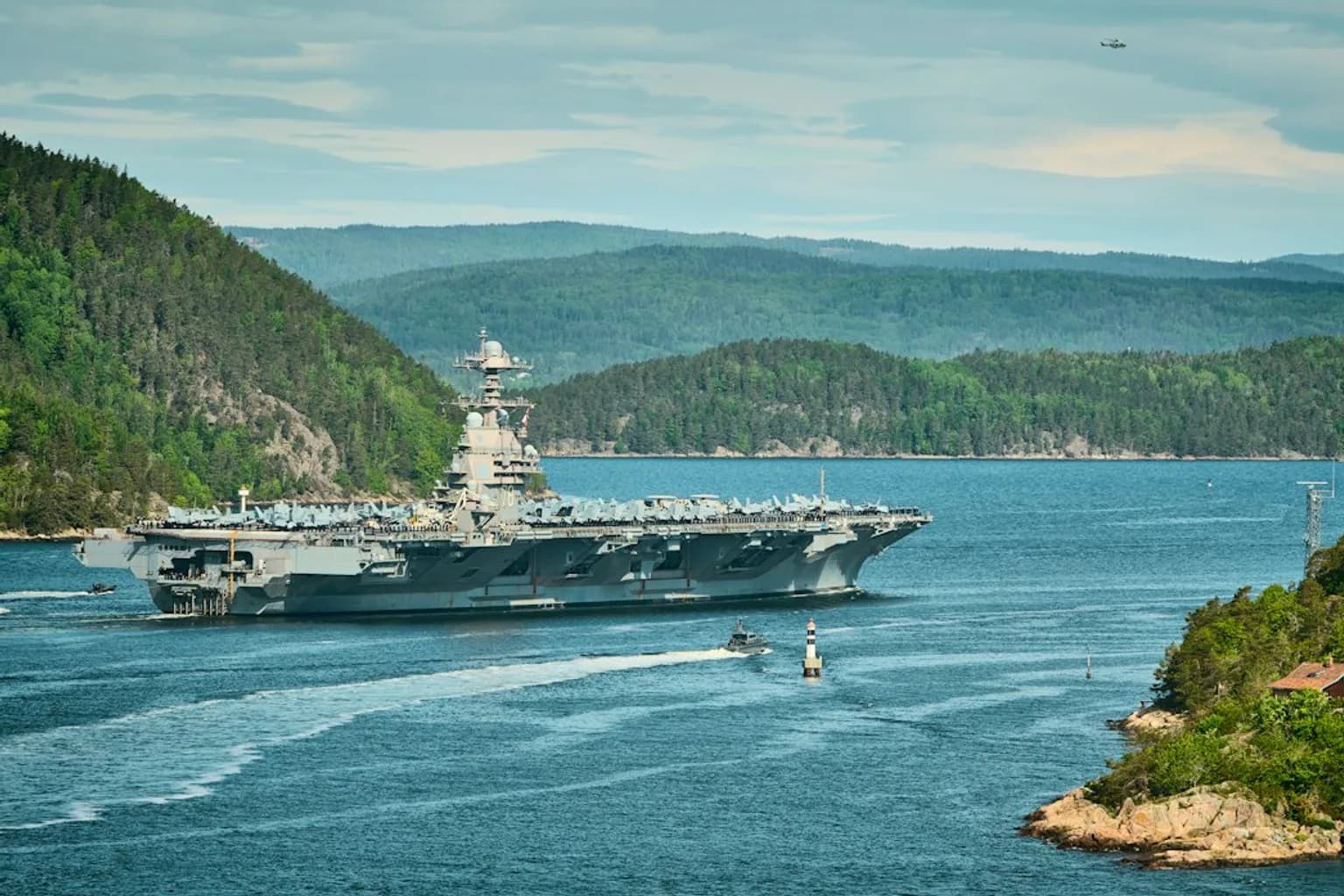
When President Trump hosts Xi in Washington on 24 September, the meeting will come as his administration seeks to rebuild US shipbuilding capacity in the face of China’s commercial and naval strength. The period from 24 September to 9 November is a six-week window for decisions affecting the fleet.
The administration has issued an executive order creating a national maritime strategy and requested $65.8 billion for Navy shipbuilding in FY2027. The push combines naval spending with an effort to restore commercial construction capacity that has diminished over two decades.
China held roughly five percent of global shipbuilding capacity in 1999. It now holds more than half. China operates at 23.2 million tons of annual production capacity, compared with less than 100,000 tons in US commercial shipbuilding. In 2024, Chinese yards launched 1,400 merchant vessels and American yards launched five.
China’s People’s Liberation Army Navy passed the US Navy in hull count four years ago. The United States now builds less than one percent of the world’s commercial ships.
Alex Wong, the global chief strategy officer of Hanwha Group, is a former principal deputy US national security adviser to the president, deputy special representative for North Korea and deputy assistant secretary of state for East Asia Pacific. Wong said: “America doesn't have 20 years” to regain its maritime dominance.
Before Trump’s meeting with Xi, an event scheduled for 16 September at the Hudson Institute is set to discuss the SHIPS for America Act. Senator Todd Young, a Republican from Indiana, and Senator Mark Kelly are co-leads of the bipartisan shipbuilding legislation. Brent Sadler, a senior research fellow in naval warfare and advanced technology at the Heritage Foundation, is a 26-year Navy veteran and former nuclear submariner.
The existing industrial base has lost up to 40% of its waterfront facilities over two decades. The US-flagged oceangoing fleet had fallen to 178 ships last year. Only eight American shipyards can build a ship over 400 feet, and all are fully committed. The industry needs roughly 250,000 skilled workers over the next decade that it does not currently have.
A company recently bought Philadelphia’s shipyard, once a cornerstone of American shipbuilding. The USS Lincoln also pulled into port in Thailand after months at sea conducting combat operations against Iran.
New capacity is beginning to emerge. Construction has started at Port Alpha in Brownsville, Texas, with initial operations targeted for 2028. More than $3 billion in planned investment is intended to create up to 10,000 direct jobs. The yard is due to begin with 150,000 gross tons of annual shipbuilding capacity, more than doubling current US commercial shipbuilding capacity, and could scale to over 2 million gross tons.
The first vessels built at Port Alpha will be Landing Craft Utility, or LCU, vessels under a US Navy contract awarded to Saronic. A new submarine-component factory in Alabama is already producing parts.
Policy remains another part of the administration’s approach. A fee designed to protect American shipbuilding jobs lasted six days before being removed. Its one-year suspension runs out on 9 November.





Comments (0)