
Physicists including researchers from the University of Oxford have found strong evidence that pairs of Z bosons produced in Higgs boson decays have entangled spin states. The result, published in Physical Review Letters in September 2026, extends collider studies of quantum entanglement from top quarks to Z bosons, massive elementary particles that survive for only about 3 x 10-25 seconds.
The analysis rejected a specific alternative in which the Z bosons were not entangled at 4.7 sigma. That falls just below the 5-sigma standard particle physicists traditionally apply before calling a result a discovery. The measurement is the first involving entangled elementary particles known as qutrits, which have three possible spin states.
Quantum entanglement describes correlations between particles that share a quantum state, even when they are separated. It has long been examined in laboratory experiments involving photons and other light particles. The new measurement ranks among the highest-energy confirmations of entanglement ever recorded.
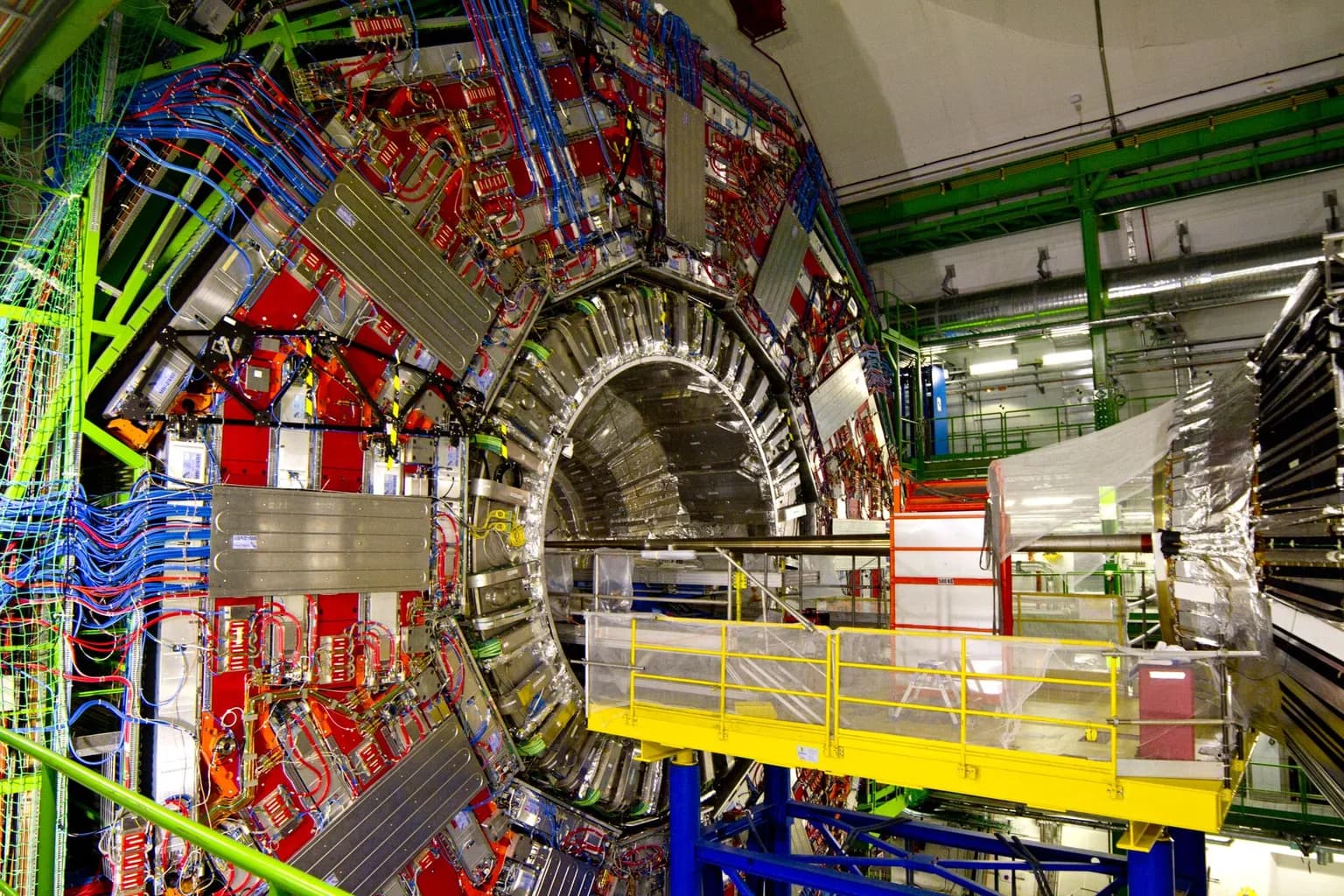
Both the ATLAS and CMS Collaborations used data from the second and third runs of CERN’s Large Hadron Collider near Geneva, Switzerland, to find strong evidence of entanglement between Z bosons from Higgs boson decays. The ATLAS analysis drew on about 400 events. Collision energies reached thirteen trillion electron volts, while protons travelled at 99.99% the speed of light.
The Higgs boson was discovered at the Large Hadron Collider in 2012. It can decay into two Z bosons. If one Z boson from such a decay has a spin state of +1, the other must have a spin state of -1.
The Z bosons decay too quickly to be observed directly for long. Researchers instead examined the electrons and muons released in their decays. Statistical analysis of those decay products allowed the team to reconstruct the spin properties of the original Z bosons and measure the degree of entanglement.
Professor Alan Barr said: 'We're used to thinking of entanglement as something delicate, seen in laboratory experiments with single photons.'
Z bosons provide a more complex system than the top quarks used in an earlier collider measurement. In quantum information language, a Z boson is a qutrit because it has three possible spin states. Top quarks have two possible spin states. In 2024, the ATLAS Collaboration reported the first observation of quantum entanglement between pairs of top quarks produced at the Large Hadron Collider.
Juan Antonio Aguilar-Saavedra of the Institute of Theoretical Physics in Spain said: 'The spins of the two Z bosons are extremely entangled, considerably more so than in the top-antitop case that was measured previously.'
The new measurement establishes strong evidence for the effect in a different type of elementary particle, under conditions in which the particles decay almost immediately. It remains unknown whether further data will push the result beyond the 5-sigma threshold, why entanglement persists in such massive and short-lived particles, or whether similar studies will be extended to other particle pairs at the Large Hadron Collider.





Comments (0)