
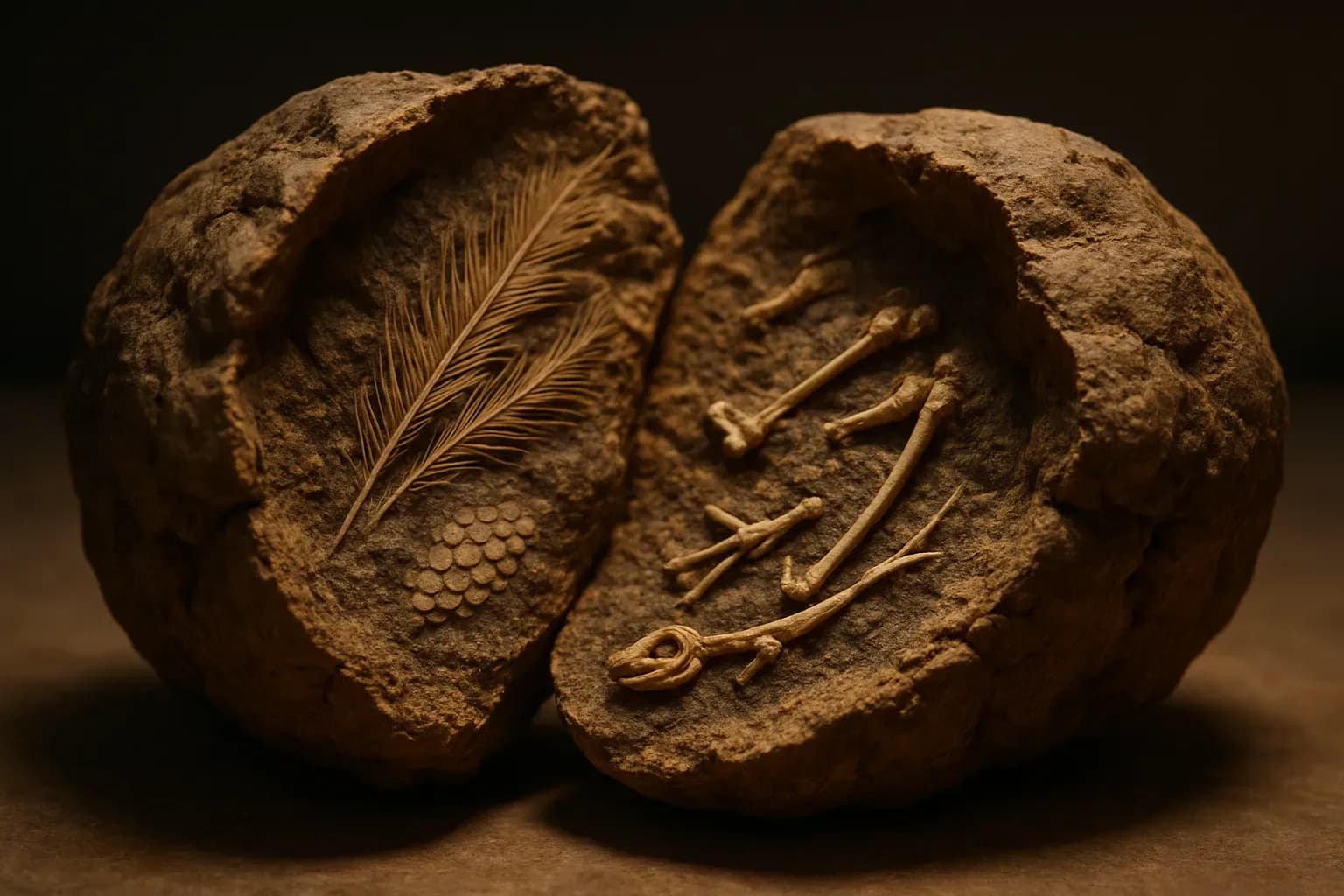
A feather found inside 66-million-year-old fossilised dinosaur dung in northeastern Montana has given researchers rare direct evidence of bird life close to the mass extinction that reshaped life on Earth. The discovery comes from the Hell Creek Formation, where feathers had not previously been found despite more than 150 years of prospecting.
The specimen was discovered in 2016 by David DeMar, Jr. The rock containing it was about half the size of a golf ball. Scientists used CT imaging to examine the coprolite, the term for fossilised dung, without destroying it.
The scans revealed several feathers, tiny scales from a gar fish and leg bones from a hesperornithiform bird. Hesperornithiforms were aquatic birds with an ecology similar to that of loons. Most could not fly and used specialised feet to dive for fish.
The discovery matters because the bird remains belong to a lineage closely related to Neornithes, the group that survived the mass extinction and eventually produced modern birds. Hesperornithiforms were part of a separate lineage, however, and disappeared alongside most other birds at the Cretaceous-Palaeogene, or K-Pg, boundary.
An asteroid struck Earth 66 million years ago and triggered a global mass extinction. The fossil therefore preserves evidence of avian diversity at the point when one bird lineage survived while another close relative died out.
Jingmai O'Connor, the lead author of the paper and associate curator of fossil reptiles at the Field Museum in Chicago, led the study. The remains allow researchers to examine anatomical features of a hesperornithiform and compare them with the lineage that led to modern birds.
O'Connor has proposed that differences in feather types and moulting patterns may help explain why some bird lineages survived the extinction while others did not. The coprolite provides material for comparing traits in a lineage that perished with those associated with the surviving Neornithes lineage.
The identity of the dinosaur that produced the coprolite remains unknown. Its contents show that the animal consumed feathers, fish scales and bird bones, though the find does not establish broader differences in diet or ecology between bird lineages that survived and those that disappeared.
Birds had already existed for a long period before the asteroid impact. Archaeopteryx, the oldest known bird, lived about 150 million years ago. Yet fossils preserving direct evidence of birds from the Hell Creek Formation have been scarce, making the feathers and bones within the coprolite a valuable record of a lineage near the end of the age of dinosaurs.





Comments (0)