
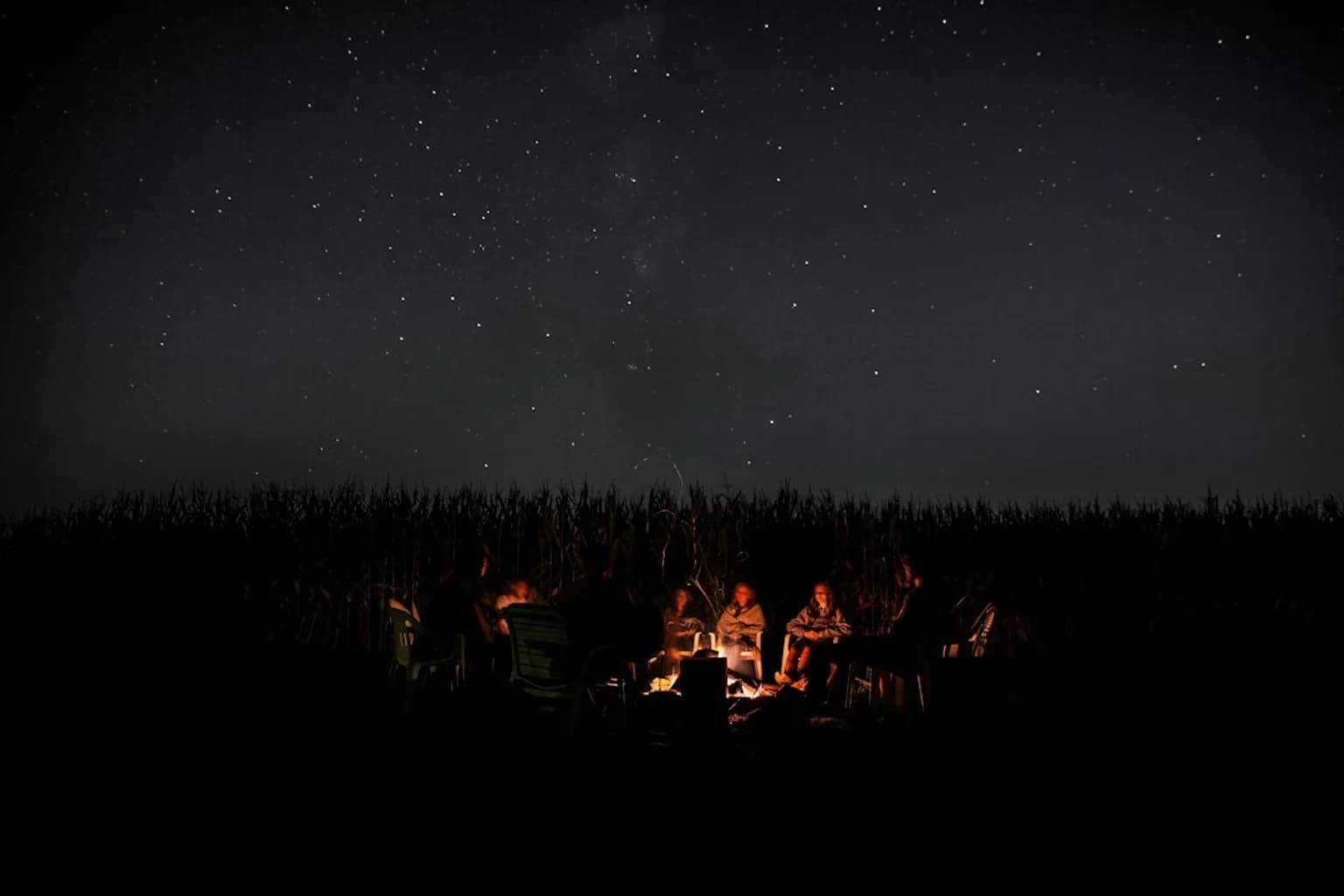
Control of fire may have helped early humans develop complex spoken language by creating evenings suited to shared storytelling, according to a peer-reviewed paper published on 2 September 2026.
Catherine Hobaiter, a professor in the School of Psychology and Neuroscience at the University of St Andrews, and Nathaniel J. Dominy of Dartmouth College argue that fire altered both the available time for social life and the sensory setting in which communication took place. Their paper, published in Proceedings of the Royal Society B: Biological Sciences, brings together earlier research with preliminary measurements of firelight.
The authors propose that managing a local fire for food, safety and comfort, a behaviour unique to humans among apes, extended wakeful social time by about four hours after sunset. They say this additional time may have favoured forms of communication that worked in the dim and changing light around a fire.
The central argument concerns three features of firelight: its very low blue-light emission, its flicker and its abundant long-wavelength, or infrared, output. Firelight contains little blue light, the researchers say, allowing people to remain socially active later without strongly disrupting the body’s preparation for sleep.
Its flickering quality may also have mattered. The researchers measured campfire flicker at roughly 1.4–2.7 fluctuations per second (Hz), a range overlapping with neural rhythms associated with attention and memory. Human neurons synchronise to the frequency of flickering firelight, the paper says. The authors suggest that people sharing the same flickering rhythm could have aligned their attention, helping listeners and storytellers form a strong social connection.
The paper also raises the possibility that the infrared light produced by fire and embers had photometabolic effects on mitochondria. The authors present this as a possible mechanism rather than a demonstrated explanation for language development.
Hobaiter and Dominy place their theory in the wider question of why humans developed complex speech while other primates did not. Eastern chimpanzees use more than 140 distinct gestures, while mountain gorillas have a gesture catalogue of more than 120. Young children also use many gestures shared with other apes while their own speech is still developing.
Those findings show that sophisticated communication can exist without language. The paper argues that firelight may have shifted the balance towards speech because it is potentially too dim for the meaningful elements of early gestural communication. Fully expressive storytelling after dark would therefore have needed a channel that did not depend so heavily on seeing another person’s movements.
The authors draw on a 2014 ethnographic study of Ju/'Hoansi foragers, which found a division between practical daytime activity and storytelling at night. They argue that fireside settings could have made storytelling a recurring social activity, creating conditions in which spoken communication gained importance.
Fire control emerged roughly 1.9 to 1.8 million years ago, around the time that complex spoken language appears to have developed, according to the paper. Hobaiter and Dominy say the timing supports a possible connection, though it does not establish that fire caused language to emerge. Other evolutionary pressures, including tool use, diet and group size, remain part of the unresolved picture.
“For all their incredible, rich communication and cultures, no other ape is inventing algebra, writing King Lear, or heading out into interstellar space,” Hobaiter stated.
The researchers describe their proposal as a set of testable hypotheses rather than settled proof. They lay out around half a dozen claims for future study, including whether firelight flicker changes how people interpret gestures and whether the longer wavelengths emitted by embers can extend evening socialising without disrupting sleep.
They call for controlled experiments on light and sleep, comparative fieldwork among foraging societies, and archaeological work to assess whether patterned night fires can be identified at relevant timescales. Such work could help determine whether firelight’s effects on attention, memory and social behaviour contributed directly to language evolution, and whether an extra four hours of social time was enough to make a difference.





Comments (0)