
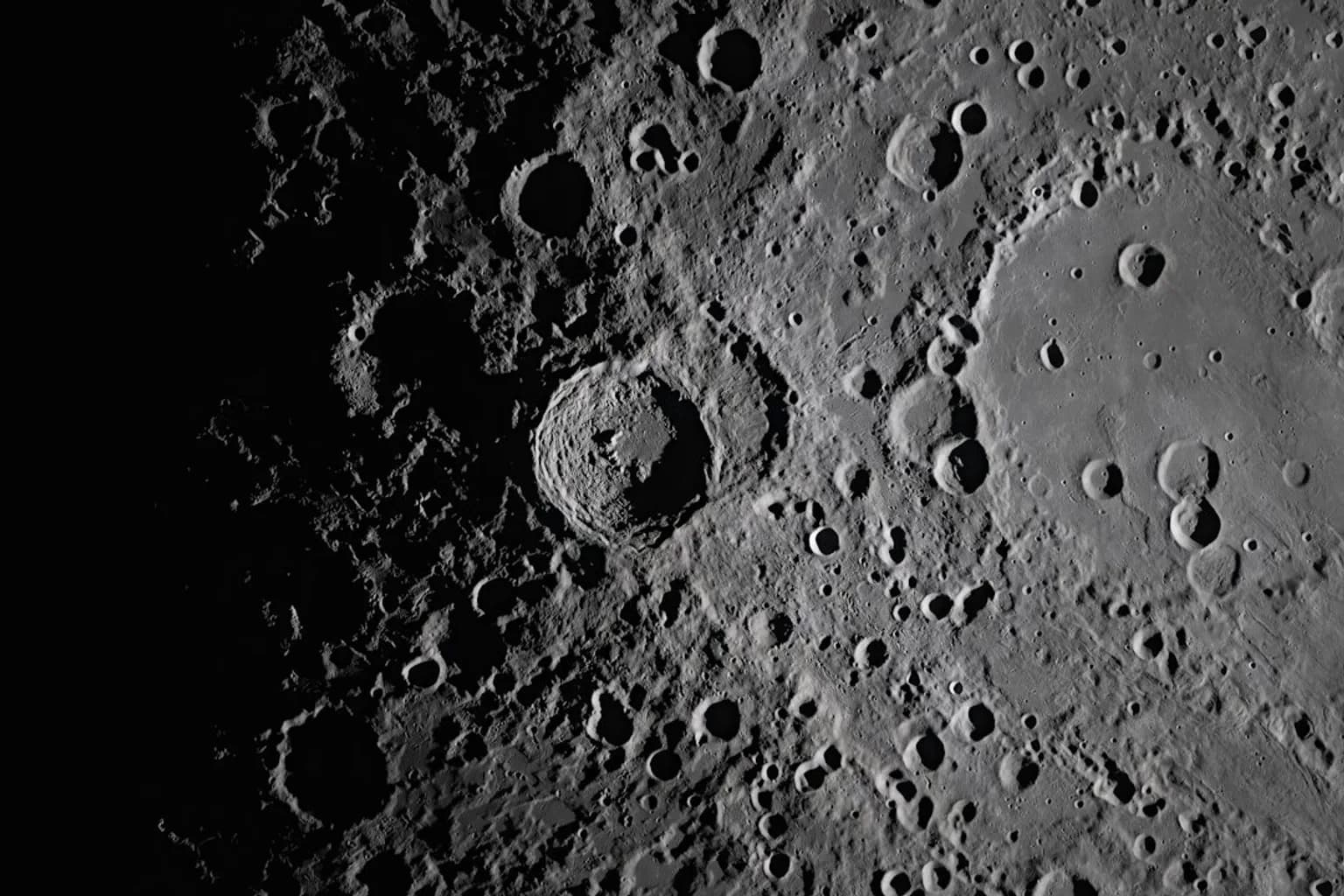
NASA researchers have identified the largest newly formed crater ever found in the solar system, a 728-foot-wide depression on the Moon created by a comet or asteroid impact in the spring of 2024.
The crater, named McGetchin in honour of the pioneering lunar scientist Tom McGetchin, is 141 feet deep and larger than the Roman Colosseum. It formed near the Moon’s eastern edge, on the near side, between April 11 and May 22, 2024, according to a study published in Science Advances on September 16, 2026.
Scientists concluded that an asteroid or comet roughly the size of a three- to six-story building hit the lunar surface. The collision released approximately 65 billion kilojoules of energy.
Such impacts are rare. Scientists estimate that an event of this scale occurs on the Moon about once in a century or longer. A large-scale impact of this magnitude is estimated to occur only once every 132 years.
The Moon has virtually no atmospheric layer, so incoming space debris does not slow down or burn up before reaching the surface. That makes the lunar landscape a record of impacts, though large fresh craters of this size remain unusual.
Robert Wagner, an image-processing specialist at Intuitive Machines, discovered McGetchin on October 24, 2025, while examining global images taken by the Lunar Reconnaissance Orbiter’s Wide-Angle Camera. He spotted an unusually bright patch surrounded by a dark halo. The feature appeared in imagery as a large bright area circled by darker material.
The Lunar Reconnaissance Orbiter, known as LRO, has identified at least 1,000 new impact craters during more than 17 years of observations. The Science Advances study determined that McGetchin was the largest new crater discovered through such work anywhere in the solar system.
The impact also changed the surface beyond the crater itself. An area roughly 4 miles wide around McGetchin becomes about 16 degrees Fahrenheit colder at night than nearby terrain. Researchers said the collision loosened surface material, reducing its ability to retain heat.
The finding gives scientists a chance to study the effects of a large, recent lunar impact in detail. It also has practical relevance as NASA prepares for a sustained human presence on the Moon and future crewed missions are planned by both the United States and China.
NASA engineers are calculating the risk that material ejected by impacts could strike the agency’s planned moon base. The brief did not establish whether McGetchin itself poses a direct risk to any planned facility.
McGetchin’s discovery provides a rare recent example of an event that is usually separated by more than a human lifetime. Its size, age and visible thermal effects offer researchers a new reference point for understanding how large impacts alter the Moon’s surface.




Comments (0)