
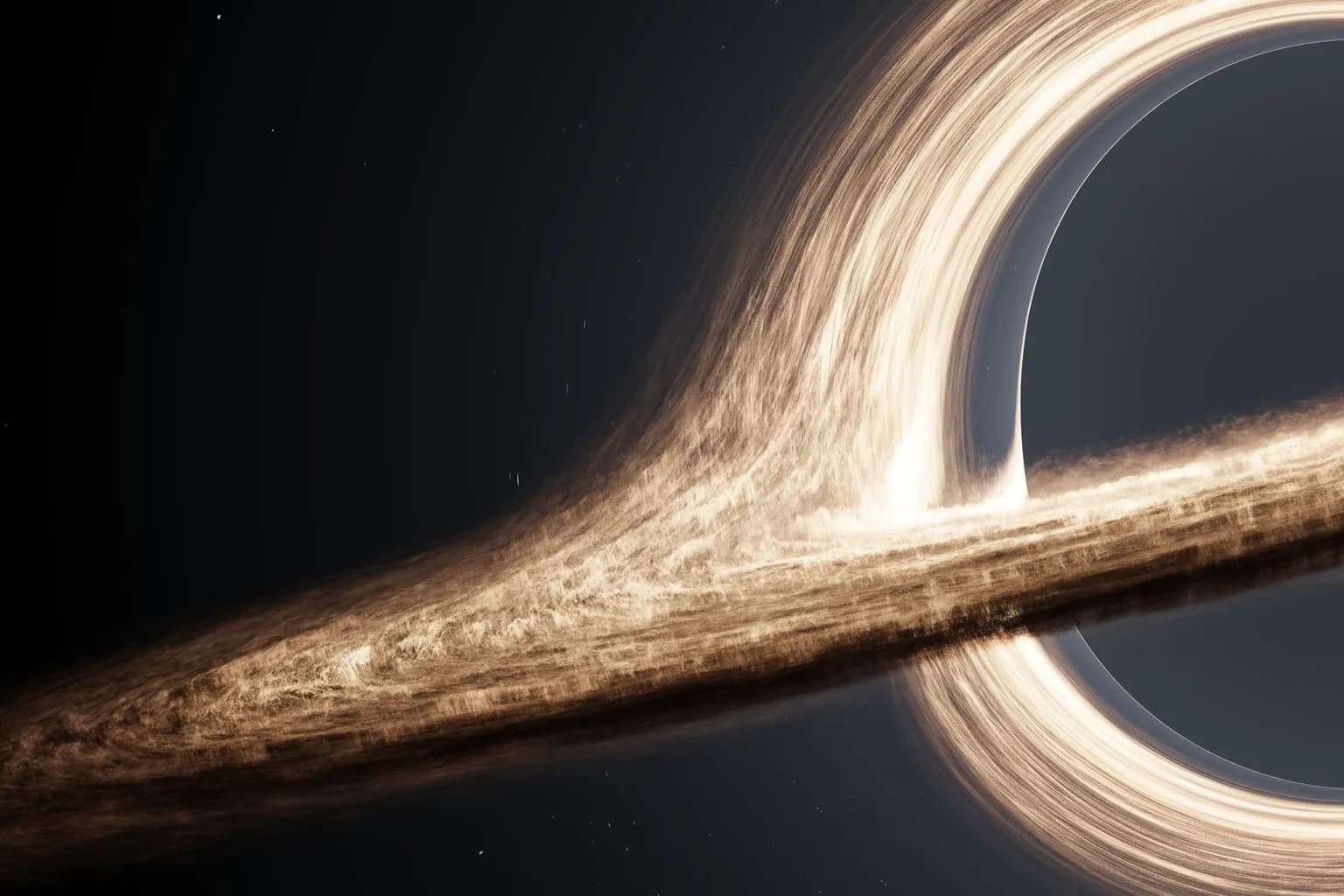
Astronomers have confirmed the youngest known planet yet detected, identifying a Jupiter-sized world that is less than 1 million years old and remains embedded in the gas and dust around its host star. The planet, Elias 2-24 b, orbits a star about 450 light-years from Earth and is still gathering material from the disk from which it formed.
The finding was published September 16 in The Astrophysical Journal Letters. It places Elias 2-24 b well below the ages of the previous youngest known planets, which are all more than 5 million years old. Those earlier record holders are four planets: two orbiting PDS 70 and two orbiting WISPIT 2.
Andrea Bernardi, a doctoral candidate at Universidad Diego Portales in Chile, led the study. The work drew on archival observations from the W. M. Keck Observatory in Hawaii, alongside evidence from the Atacama Large Millimeter/submillimeter Array, known as ALMA, and the European Southern Observatory’s Very Large Telescope in Chile.
Elias 2-24 b is roughly as massive as Jupiter. It lies about 55 times farther from its star than Earth is from the Sun. Its exact mass, orbital period, composition and atmospheric properties remain unknown. Astronomers also do not yet know the rate at which it may be continuing to gather material, how long its formation will last, or the long-term stability of the system.
The planet’s youth makes it important for research into the earliest stages of planet formation, which remain poorly understood. Current models suggest that a Jupiter-size planet at Jupiter’s distance from the Sun takes about 5 million years to form. Elias 2-24 b has reached a roughly Jupiter-scale mass and size in less than 1 million years, while still within its natal disk.
The evidence came together through several observations of the system. ALMA had revealed a gap in the dusty disk around the young star Elias 2-24. The Very Large Telescope later detected a faint point of light within that gap, a location consistent with a planet affecting the surrounding material.
Researchers then examined images taken in 2018 and 2020 with Keck Observatory’s coronagraph and its Near Infrared Camera 2, or NIRC2. A coronagraph blocks the bright light of a star, allowing fainter objects and structures nearby to be studied. The initial Keck observations in 2018 had shown a faint signal, though the evidence was insufficient at the time to identify a planet.
Bernardi returned to the 2018 material using newer data-processing methods. The reanalysis enabled the team to distinguish a planet from what had previously appeared to be noise in the images. Alice Zurlo, a professor at Universidad Diego Portales and an author of the study, had carried out the initial research on the system in 2018. Lucas Cieza, also a professor at Universidad Diego Portales, was a co-author.
The result also highlights the scientific value of older observations. The discovery emerged through the Keck Observatory Archive, a NASA-funded partnership between Keck Observatory and the NASA Exoplanet Science Institute at Caltech/IPAC. Elias 2-24 was one of seven young stars whose archived coronagraph images the team reviewed.
For astronomers, the system provides a view of a giant planet at a stage that is rarely accessible: formed enough to be detected, yet still surrounded by the material that is helping shape it. Further observations will be needed to establish the planet’s detailed properties and to track how its surrounding disk changes as formation continues.




Comments (0)