
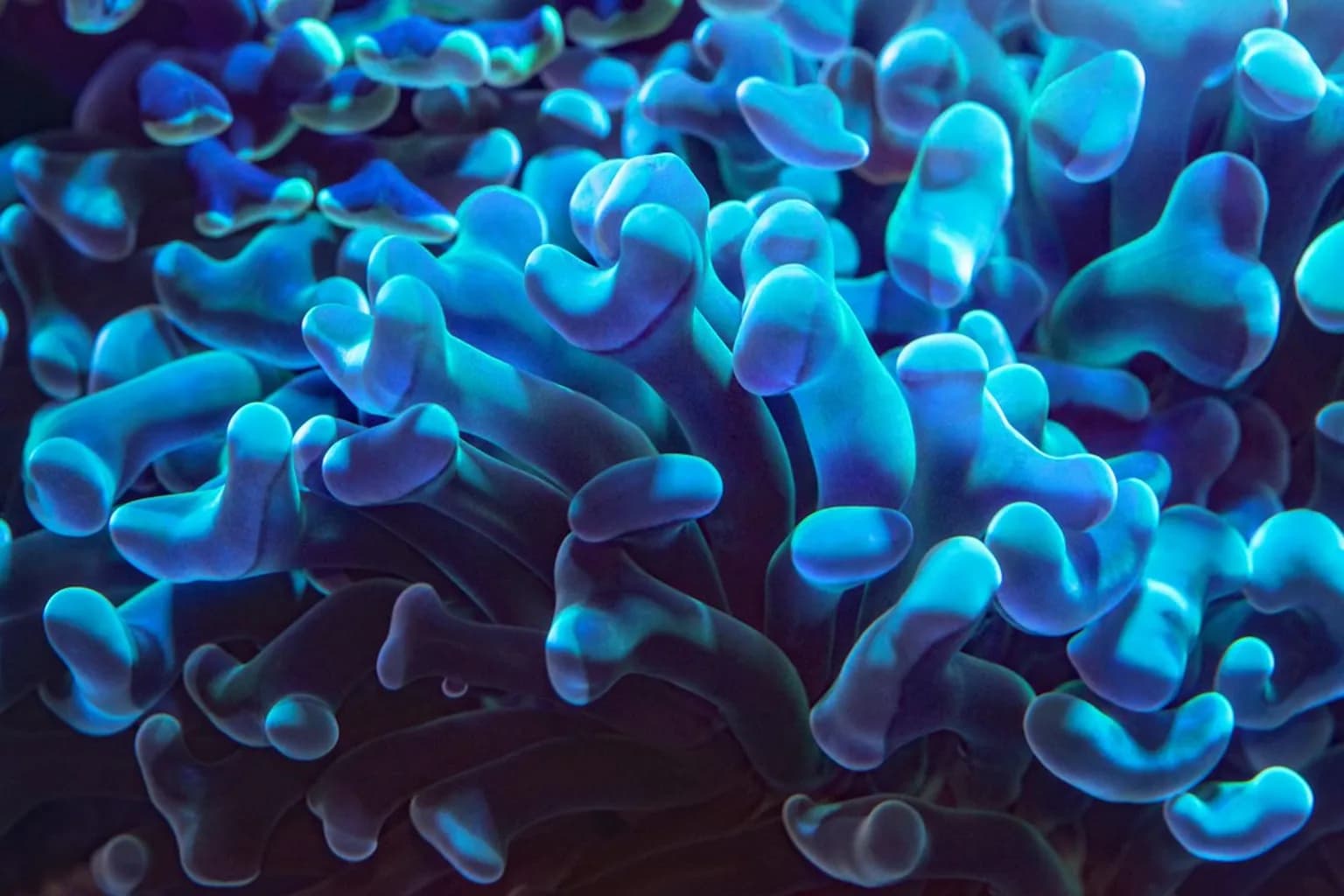
Corals use microscopic hair-like structures to pump oxygen-rich water towards their tissues, but the system can fail under intense heat, leaving polyps unable to breathe, recent research has found.
The findings concern cilia, which line coral polyps and work in coordinated patterns to move water across their surfaces. Research published in Science in May 2026 has added to understanding of how corals regulate this process despite lacking a central nervous system or brain. The work also describes what can happen when the water around them becomes warmer.
The mechanism was unknown to science before 2014. That year, researchers from the Massachusetts Institute of Technology (MIT) and the Weizmann Institute showed that coral cilia actively generate currents of oxygen-rich water. Scientists had previously thought corals obtained oxygen passively through diffusion.
Diffusion is slow around a coral. Oxygen can take up to 4 minutes to move just 1 mm in this way. Each colony is also surrounded by a thin boundary layer of water, where movement is slowed by friction against the coral surface. Those conditions make it difficult for oxygen to reach coral tissue through diffusion alone.
Orr Shapiro, a microbiologist who led the MIT research in 2014, described the discovery as a “paradigm shift”. The cilia of each polyp are organised in hexagonal units, allowing their movements to be coordinated and the resulting water currents to be regulated.
The currents are especially important at night. During daylight hours, symbiotic algae within coral tissues produce oxygen through photosynthesis. Once that process ends at dusk, the surrounding water becomes a polyp's only source of oxygen.
Warmer seawater holds less dissolved oxygen. Cilia respond by beating faster, helping corals compensate for the lower oxygen available in the water. Yet the same response can become harmful beyond a temperature threshold. The rapid ciliary movement uses all the oxygen coral tissue can absorb, causing the polyps to suffocate.
In 24-hour tank experiments, researchers exposed Porites lutea corals to gradually rising temperatures of up to 39°C. The cilia began slowing as the water neared 37°C, equivalent to human body temperature. Above 39°C, they stopped working completely and the corals died.
The laboratory results identify a physiological vulnerability, although the precise temperatures at which corals fail in the wild remain unknown across species and locations. Researchers also do not yet know whether corals can adapt or acclimate to higher temperatures over evolutionary timescales, or the exact molecular and neural processes by which they sense heat and alter the frequency of their ciliary beating.
Corals have a neural network that processes sensory information, despite having no brain or central nervous system. Biophysicists, marine biologists, mathematicians and modelers are now working together to examine the physiological and hydrodynamic forces involved. Questions also remain over how thermal stress affects symbiotic algae beyond the specific studies already carried out, and whether intervention or restoration could help corals endure projected warming.
The stakes extend beyond individual colonies. Corals occupy less than 1% of the ocean floor while supporting approximately 25% of marine life. Vietnam has more than 1,100 km of coastline and important coral reefs in areas including Nha Trang Bay, Con Dao, Phu Quoc and Cat Ba.
A strong El Niño phenomenon predicted for the end of 2026 could potentially trigger the fifth global coral bleaching event. The timing and severity of that event remain uncertain. The research on cilia offers a clearer account of one way heat can place pressure on corals, while leaving open how different reef systems will respond in changing conditions.





Comments (0)