
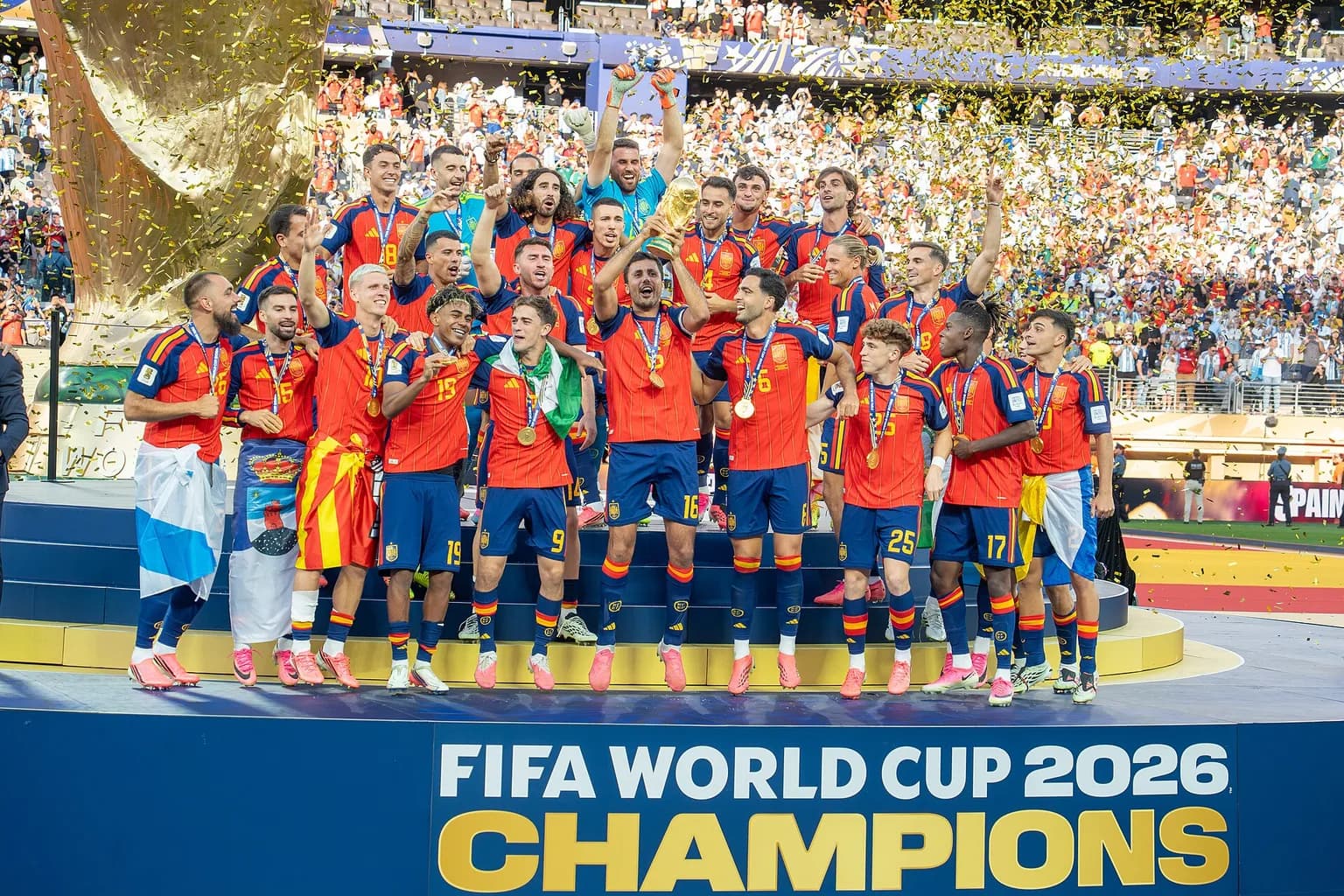
FIFA entered the 2026 Men’s World Cup with a human rights policy, bidding criteria and a framework for local organisers. Rights groups say those promises did not hold when the tournament arrived.
Andrea Florence, executive director of the Sport & Rights Alliance, leads one of the organisations behind a new assessment of FIFA’s record. FIFA adopted its 2017 Human Rights Policy and later built human rights criteria into the World Cup bidding process, alongside an “FWC26 Human Rights Framework” for 16 local host committees.
Before play began, the Sport & Rights Alliance and other groups had warned that human rights conditions in the host countries, particularly the USA, could directly threaten the tournament. They pointed to discriminatory immigration policies, limits on expression and protest, attacks on LGBTQI+ rights and threats to press freedom.
The World Cup ran through June and July 2026, with most matches played in the USA. It was the first Men’s World Cup staged across Canada, Mexico and the United States, and it brought together 48 nations for 104 matches.
At borders and in host cities, fans, athletes, technical staff, referees and journalists encountered visa restrictions, entry requirements and prolonged questioning. The restrictions fell especially heavily on people whose nationalities were subject to stricter migration rules.
The report says the tournament also saw mass immigration detentions and deportations, as well as discriminatory visa bans. It identifies cost and accessibility barriers for fans, players and journalists.
Journalists in Mexico worked under death threats. Media workers in the USA reported surveillance, visa revocations and harassment, especially when their reporting was critical.
There were effects far beyond stadium gates. The Football Policing Unit in the United Kingdom recorded 384 domestic violence incidents linked to the tournament, its highest figure for a World Cup and a 223% increase from Qatar 2022. English national team matches accounted for 93% of those incidents.
In Canada, three-quarters of shelters said demand grew during the World Cup.
Racist, xenophobic and discriminatory incidents unfolded across host cities. Human Rights Watch said they formed part of a wider pattern of discrimination that FIFA was failing to handle with the necessary seriousness.
Frank Conde Tangberg, a policy adviser at Amnesty International, worked with the organisation to document human rights failures before and during the tournament. Anna Johansson, secretary general of Amnesty Sverige, said: “If FIFA does not immediately implement an updated risk assessment and demand that host countries respect and protect all people's rights, the tournament risks being a direct threat to human rights.”
On 13 October 2026, the Sport & Rights Alliance and Football Supporters Europe published their joint 50-page report, “Profit Over People: The 2026 FIFA Men’s World Cup”. It found that FIFA had left host governments, local authorities and other organisations to deal with possible violations without enough guidance, oversight or funding, and without setting consequences for failures to comply.
More than 120 immigrant rights organisations had issued a joint warning that “players, fans, journalists and visitors could be at risk of serious human rights violations” during the tournament. Over 65,000 people joined Amnesty International’s call for FIFA and the host nations to address the risks and guarantee protections.
The groups’ argument is that a tournament of this scale needs FIFA’s policies to operate in practice, including for people who never set foot on the pitch. The report documents the gap they say opened between the governing body’s framework and the protections available in its host countries.


Comments (0)