
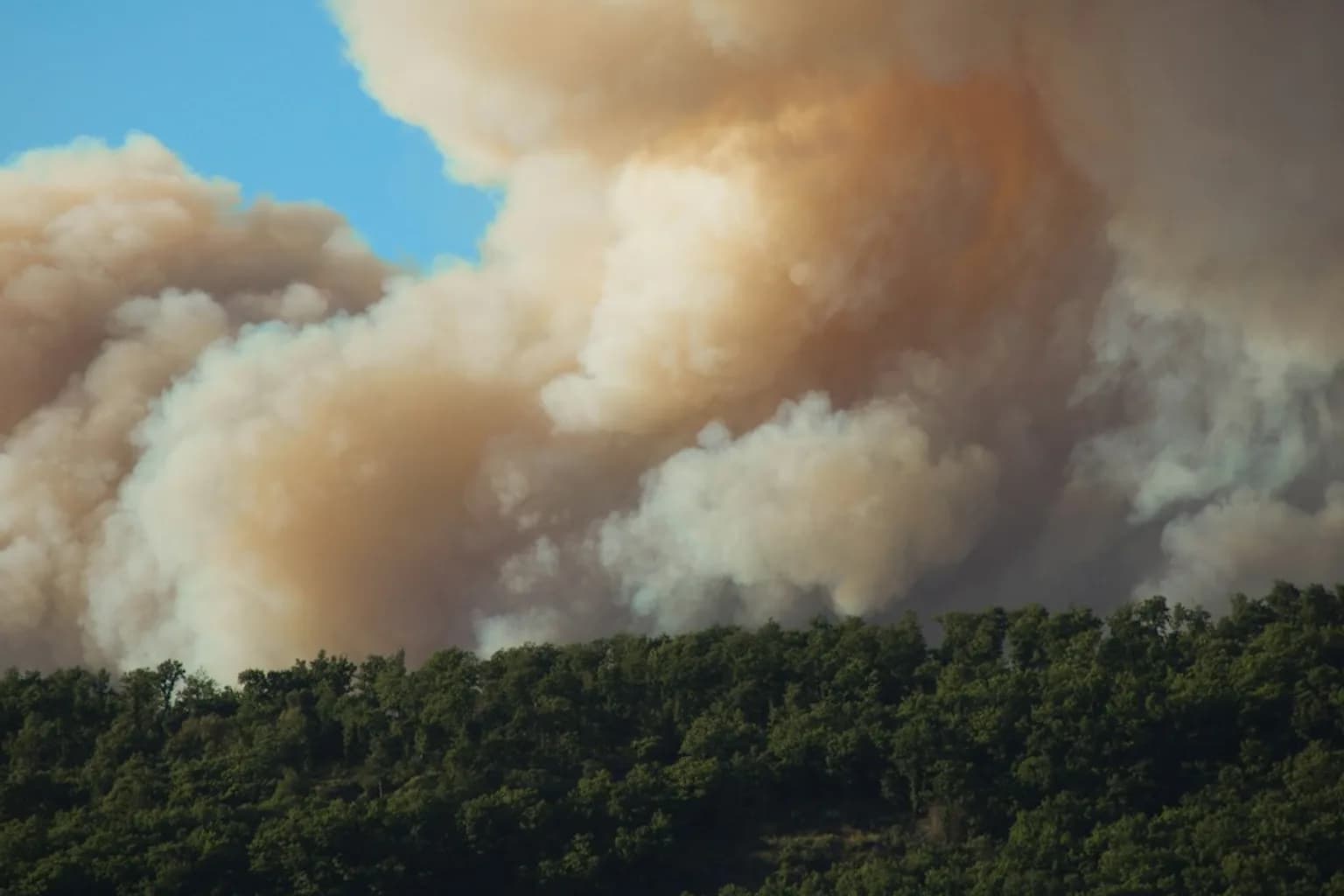
Successive heatwaves began sweeping Europe in June 2026, driving chemical reactions that turned emissions from vehicles, industry and power plants into ground-level ozone. The summer brought large fires as well. On 22 July, wildfires in France’s Gironde and Landes regions burned nearly 50,000 hectares and forced 40,000 people to evacuate.
Fires in Madrid and Ávila in Spain later burned more than 50,000 hectares combined. They led to 56,000 evacuations and confined nearly 30,000 people indoors. Both regions recorded their highest carbon emissions from wildfires since at least 2003.
By late September, the Copernicus Atmosphere Monitoring Service said these events formed part of a global pattern. Its inaugural Atmosphere Watch publication drew on millions of data points from satellites, ground networks and aircraft to assess atmospheric conditions.
Between 1 January and 15 September 2026, 34% of the global population was exposed to air classed as “extremely poor” for ozone, while another 17% breathed “very poor” air. More than half therefore faced very high or extremely high ozone exposure. A separate measure covering the first eight months found nearly 40% of the global population exposed to extremely high ground-level ozone.
Only 5% of the world’s population experienced “good” ozone levels in 2026, and 15% experienced “reasonable” levels. Copernicus said ozone exposure during 2026 was higher than in the past five years.
Ground-level ozone is created when nitrogen oxides, produced mainly by fossil fuel combustion, and volatile organic compounds react in sunlight and high temperatures. The World Health Organization guideline recommends a maximum exposure of 100 micrograms of ozone per cubic metre, averaged over eight hours.
The burden was greatest in Asia, where 53-60% of the population breathed “extremely poor” air and another 22% experienced “very poor” ozone. In New Delhi, Dhaka, Chongqing and Lahore, people breathed air classified as “extremely poor” under WHO guidelines.
Half of Europe’s population was exposed to “poor”, “very poor” or “extremely poor” ozone levels. Forty-five per cent was specifically exposed to “poor” or “very poor” air. Two-thirds of North America’s population faced “poor” or “very poor” air quality during the eight-month period.
Heatwaves from June to August significantly increased ozone levels across Europe. Italy, particularly the north, Spain’s Mediterranean coast and Guadalquivir valley, and Greece were the European areas most affected by ozone exposure.
Pollution also travelled well beyond the places where it began. Smoke from intense North American fires crossed thousands of kilometres to parts of Europe, adding to pollution concentrations. Large fires in France, Spain, Belgium and the United Kingdom sent smoke hundreds of kilometres away, affecting air quality elsewhere.
Episodes of Saharan dust also carried particles from North Africa across the Atlantic or Mediterranean to Europe, the Caribbean and other regions. Around 2 billion tons of sand and dust enter the atmosphere each year. Las Palmas and Santa Cruz de Tenerife had recorded 20 and 18 dust alert days respectively so far in 2026.
Florian Pappenberger, the European Centre for Medium-Range Weather Forecasts Director-General, said the analysis showed that “air pollution knows no borders”, with wildfire smoke, ozone and dust able to travel thousands of kilometres and affect communities far from their source. Laurence Rouil, director of the Copernicus Atmosphere Monitoring Service, said pollution and a changing climate affected air chemistry, ecosystems, health and the ability to grow food. He said air pollution could cross continents and oceans.
Ground-level ozone harms human health, ecosystems and crop yields. Ian Marnane, an official at the European Environment Agency, said ozone pollution was linked to 60,000 premature deaths a year in Europe.
Gaige Kerr, lead author of the Tropospheric Ozone Assessment Report, Phase II, said premature deaths associated with long-term ground-level ozone exposure nearly doubled worldwide between 2000 and 2020, reaching an estimated 480,000 deaths annually.




Comments (0)