
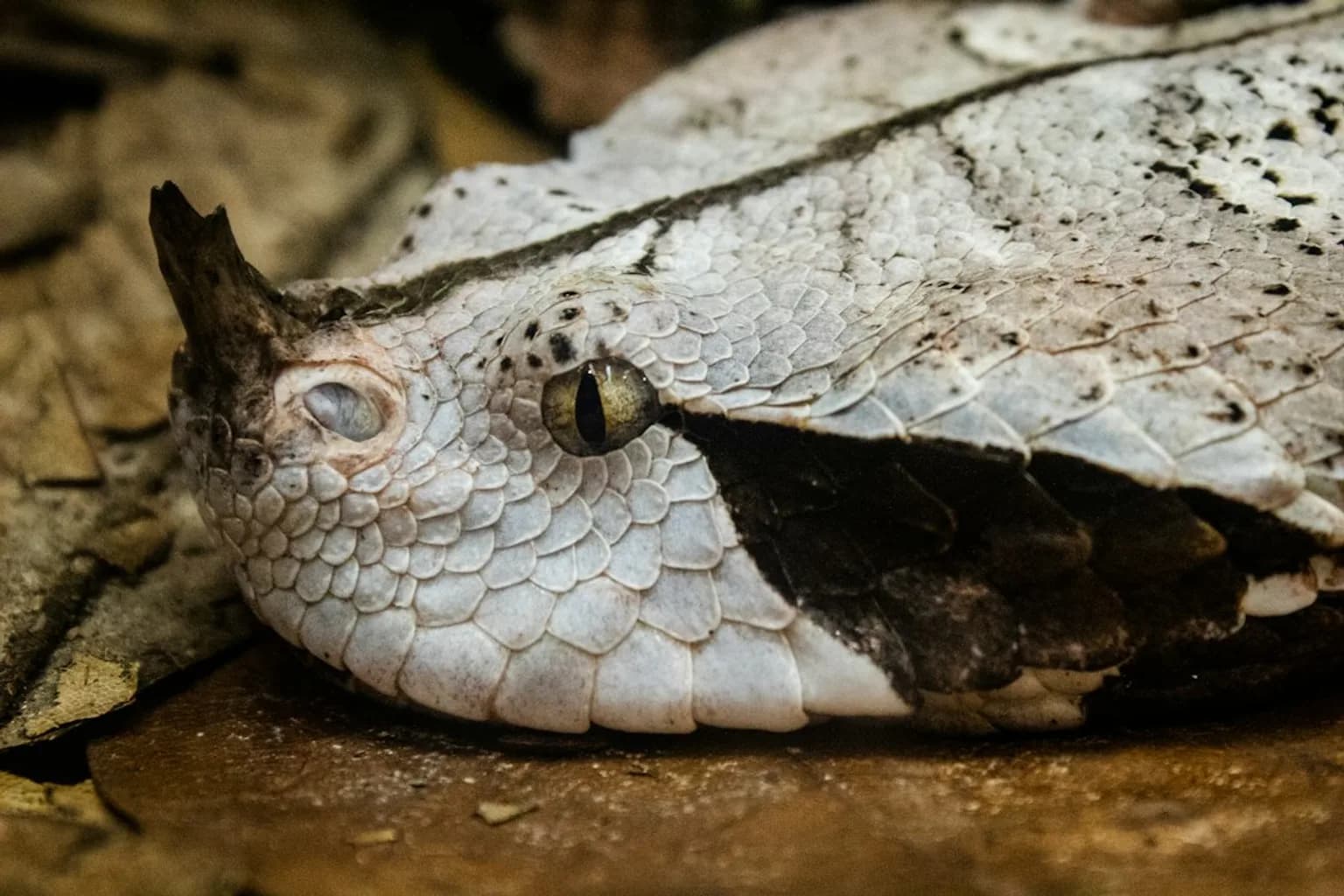
Among the rocks of western Iran’s Zagros Mountains, the Iranian spider-tailed horned viper can remain still, its body colour providing camouflage, while its tail moves. The bulbous tip and its leg-like scales resemble a large, chunky spider.
The snake twitches that tail to mimic a small moving spider for birds looking down from above. Mammals and birds may approach the apparent prey, before the viper attacks from an appropriate distance.
Scientists have now established that the spider is an illusion made entirely from skin and scales. Micro-computed tomography, or micro-CT, scans of a reference specimen found normal tail vertebrae and no extra bones forming the ‘spider legs’.
The species, Pseudocerastes urarachnoides, is endemic to western Iran. Its main habitat is the rocky, limestone terrain of the Zagros Mountains.
The tail tip is made up of enlarged, elongated and modified scales, a feature unique among living reptiles. At the end of the tail, the scales became stretched during evolution to form flexible filaments.
Georgios Georgalis, an associate professor at the Polish Academy of Sciences’ Institute of Systematics and Evolution of Animals in Kraków, led the examination of the 1968 specimen. He said the spider-shaped tip is external morphology, while the vertebrae in the tail itself are typical.
The first known specimen was collected in 1968 and placed in the Field Museum of Natural History in Chicago. Scientists initially could not tell whether its unusual appendage was part of the animal or the result of an abnormality, tumour or parasitic activity.
A second specimen, found in 2003, showed that the spider-like tail was a natural trait of the species. The viper was formally described as Pseudocerastes urarachnoides in 2006.
Georgalis and his collaborators had expected the scan of the earlier specimen to reveal a specialised bone structure at the tail’s end. Instead, their research found that the elaborate form comes from changes to the snake’s outer covering alone, a rare evolutionary adaptation created by changes to skin and scales.
The viper has one of the most complex known forms of tail luring among snakes because it produces a close visual imitation rather than simply making a movement. Video records have confirmed that the appendage lures birds.
Researchers also identified a likely case of convergent evolution in the resemblance between the tail and the tail filaments of ancient ornithodiran archosaurs from the Triassic and Jurassic periods. The viper’s spider-like tail section is soft tissue, which usually does not survive in fossils.
The species has a limited distribution and is considered one of Iran’s least-known species. Its population size has not been precisely established.
The study was published in The Anatomical Record on 10 September 2026.




Comments (0)