
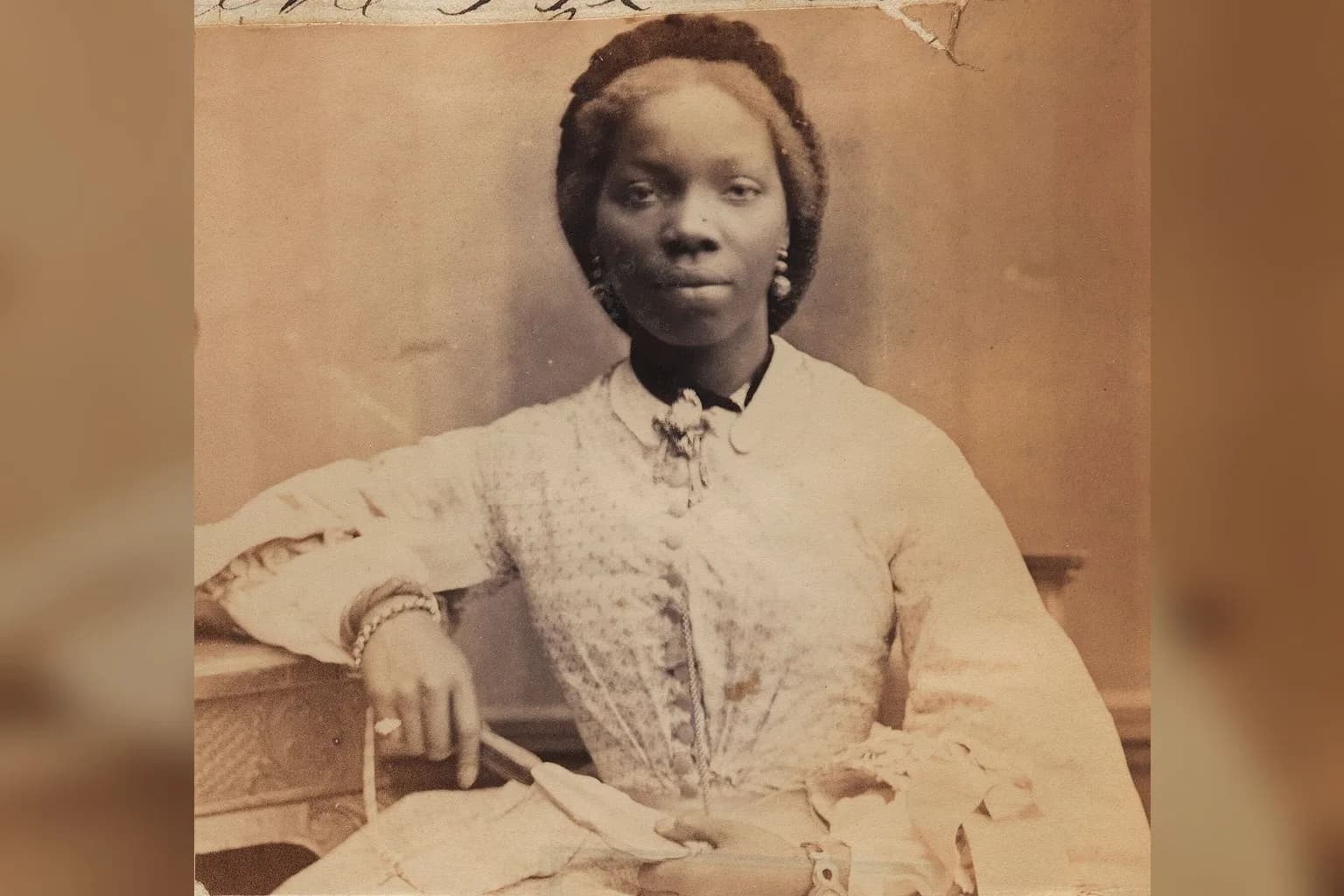
Àìná was five when an attack on her town in 1848 killed her family. She was then taken by the agodjié, an all-female regiment, and held at the court of King Ghezo of Dahomey.
She was born in 1843 in Òkè-Òdàn, southwest Nigeria. Her captivity brought her into the path of Frederick Forbes, an officer with the Royal Navy’s West Africa Squadron, who went to Dahomey in 1850 to seek King Ghezo’s signature on an anti-slavery treaty.
Forbes asked King Ghezo to let him bring the girl to England, and the king agreed. Before reaching England, Forbes petitioned for her to be made 'the property of the crown'.
Before arriving, she was given the name Forbes and the name Bonetta, taken from a Royal Navy ship. As Sarah Forbes Bonetta, she was presented to Queen Victoria at Windsor Castle at age seven as a 'diplomatic gift'.
Advertisement
The description suggested ceremony. Under post-abolition legal structures, Bonetta was effectively indentured to Queen Victoria until age 19.
Victoria paid for Bonetta’s education, and they met over the years. In 1851, Benedetto Pistrucci, the Royal Mint’s chief engraver, sculpted a plaster bust of Bonetta. She attended the 1858 wedding of the Queen’s daughter, the Princess Royal.
Victoria later approved Bonetta’s marriage to James Pinson Labulo Davies, a merchant and philanthropist. Bonetta wrote of him: 'I don't feel a particle of love for him'.
The Queen became godmother to Bonetta’s eldest daughter, Victoria. With the Queen’s help, Victoria was educated at Cheltenham ladies’ college. Bonetta died from tuberculosis in Madeira in 1880 at age 37.
Her life is recounted in Prof Henry Lovejoy’s new biography, 'Becoming Sarah Forbes Bonetta: A Yorùbá Woman in Queen Victoria's Court'. Bayo Randle is Bonetta’s great-great-grandson.
Advertisement

Comments (0)