
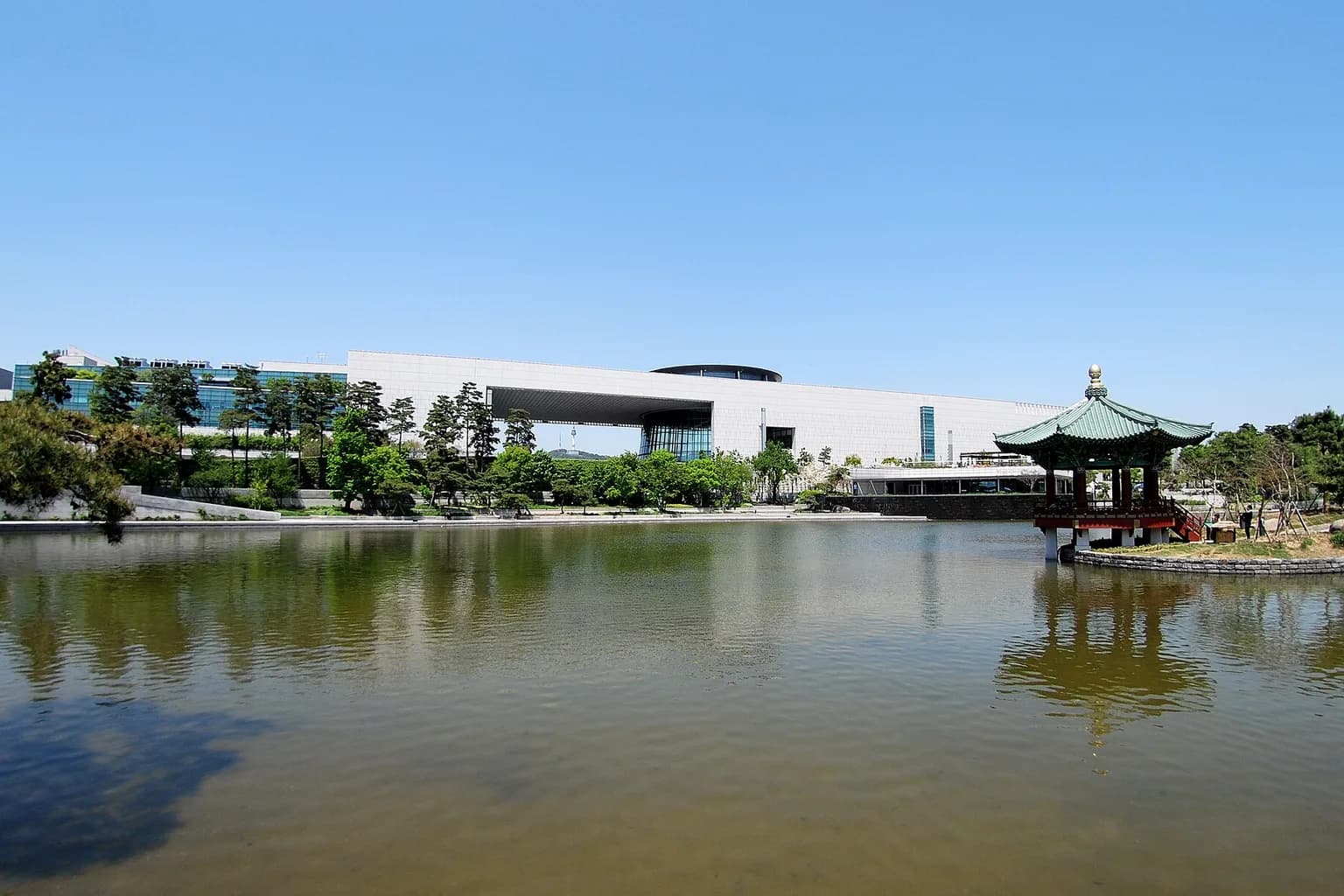
You Hong-june lent a calligraphy work from his private collection to the National Museum of Korea for its special exhibition, ‘The Korean Table: Food, Nature, and Life’, which opened July 1.
The work, titled ‘Ilban sigukeun’, was displayed as the work of Park Won-geun (1912–1950), an independence activist from Boeun in North Chungcheong Province. Its inscription means “even a single bowl of rice is a grace bestowed by the nation.”
Its colophon read “Han-in Park Won-geun”, leading to the initial attribution to the activist, who fought Japanese colonial rule (1910–1945).
More than a month after the exhibition opened, outsiders raised questions over whether the work had been correctly identified. The museum removed it after objections from the activist’s descendants.
Advertisement
On September 7, following a re-examination, the museum confirmed that the calligraphy was by Park Jung-yang (1874–1959), a pro-Japanese collaborator who had at one point used the name Park Won-geun.
Park Jung-yang had served on the Central Advisory Council, as governor of Hwanghae Province and North Chungcheong Province, and as an imperially appointed member of the Japanese Imperial Diet’s House of Peers. He also took part in suppressing the March 1st Independence Movement of 1919.
Questions had also been raised internally during the exhibition’s planning. A source in the museum’s Archaeology and History Department said some people had wondered whether the piece fitted with the rest of the exhibition.
The museum confirmed in documents supplied to People Power Party lawmakers Jung Yeon-wook and Cho Eun-hee that the work belonged to You and had been borrowed “at the director’s recommendation.” The museum also said that “the owner of the work is Director You.”
You said he had believed the calligraphy was the work of an independence activist. He had planned to donate it to the Buyeo Cultural Center in South Chungcheong for the establishment of a county museum.
At a special lecture, ‘Taste vs. Taste’, at the museum’s main auditorium in Yongsan-gu, Seoul, on September 10, You issued a formal apology. “It pains me deeply that a mistake involving the calligraphic work shown at the exhibition caused confusion for the public,” he said.
In a separate apology that day, You said: “The museum’s failure to correctly interpret the artifact was a mistake that exposed its lack of expertise.” He added: “For a museum, avoiding even one mistake matters more than doing a hundred things right.”
You donated 865 artifacts valued at roughly 2.7 billion won ($2 million) between 2019 and 2024.
People Power Party lawmakers made parliamentary inquiries into the case, and a parliamentary audit was scheduled for the following Monday.
Advertisement
Comments (0)