
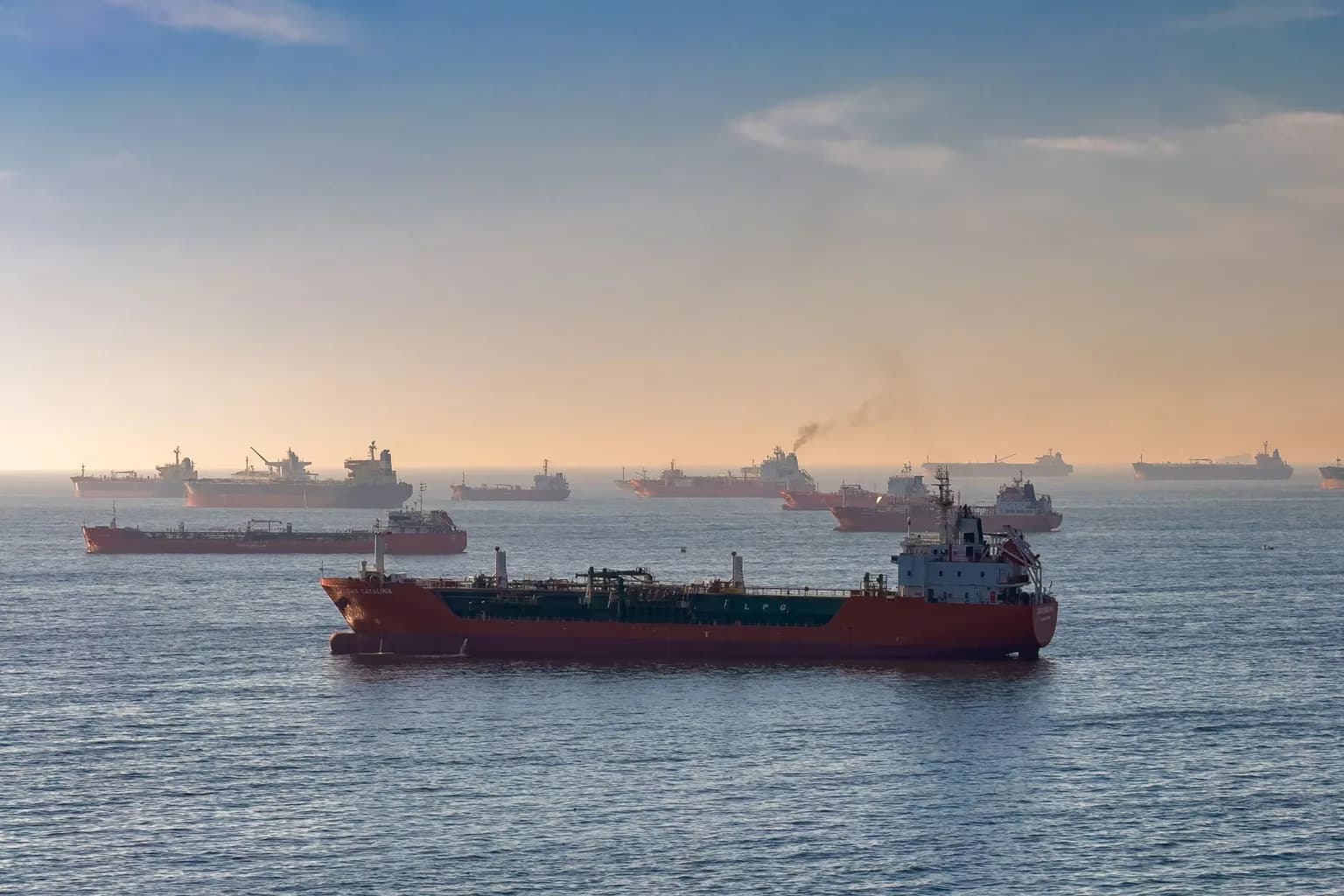
The price of crude is only part of the bill for a refinery. Freight charges now make up about a fifth of the cost of delivering crude, according to Argus Media, as disruption around the Strait of Hormuz, the Red Sea and Bab el-Mandeb has pushed up tanker costs.
On the benchmark Persian Gulf-to-China route, the daily cost of hiring a tanker exceeded $1 million for the first time in mid-September, Bloomberg reported. The TD3C assessment for a very large crude carrier (VLCC) voyage from Ras Tanura in Saudi Arabia to Ningbo in China reached $1.099 million a day at 1600 on 15 September, up from $1.034 million the day before.
Rates continued to rise. The Signal Group put weekly spot earnings for Middle East Gulf-China VLCCs at $1.412 million a day by 9 October.
The pressure extends well beyond Middle Eastern cargoes. Freight from the Americas to Asia rose to more than $80 million, or about $40 a barrel, in the week before 12 October, against roughly $10 million to $15 million near the start of the year. The TD22 rate for a VLCC carrying 2 million barrels of US crude to China reached $637,675 a day on 8 October, the highest daily rate recorded for that route since it began.
Advertisement
Higher transport costs have fed back into the value of oil at the point of sale. Reuters, citing Argus Media, reported that flagship Canadian, Colombian and Ecuadorian heavy crude grades had each fallen by more than $10 a barrel to six-week lows.
The constraint is physical as well as financial. S&P Global said daily crossings through the Strait of Hormuz averaged 21 in September, compared with 135 before the war. The International Energy Agency said about 20 million barrels a day of crude and oil products travelled through Hormuz in 2025, around 25% of world seaborne oil trade.
Some Arabian Gulf cargoes are now moving through a shuttle and ship-to-ship transfer process. Tankers International said this adds about 10 vessel days to a cargo’s journey compared with a normal Arabian Gulf-to-China movement. With about 45 Arabian Gulf cargoes loading for China in September, the group estimated that this used roughly 450 additional vessel days during the month, the equivalent of about 15 VLCCs employed full time.
Saudi Arabia sold roughly 60 million barrels for ship-to-ship transfer at Sohar, Oman. Iran’s army chief, Maj. Gen. Amir Hatami, said on 15 October that the strait would stay closed until Iran’s rights were respected.
The disruption has continued outside the strait itself. UKMTO documented new tanker attacks off Saudi Arabia’s al-Jubail on 16 October. Two tankers were struck roughly 68 and 78 nautical miles north-east of al-Jubail, and each was carrying about 2 million barrels of crude.
UKMTO counted 254 transits, comprising 129 inbound and 125 outbound movements, in the seven days to 14 October. That was about 70% below pre-war levels.
The immediate result is a higher landed cost for oil, even where the crude price itself is unchanged. Producers can seek different routes or use transfers between vessels, while refineries must weigh the freight bill alongside the oil price. The remaining question is how long constrained shipping capacity will keep those costs elevated.
Advertisement



Comments (0)