
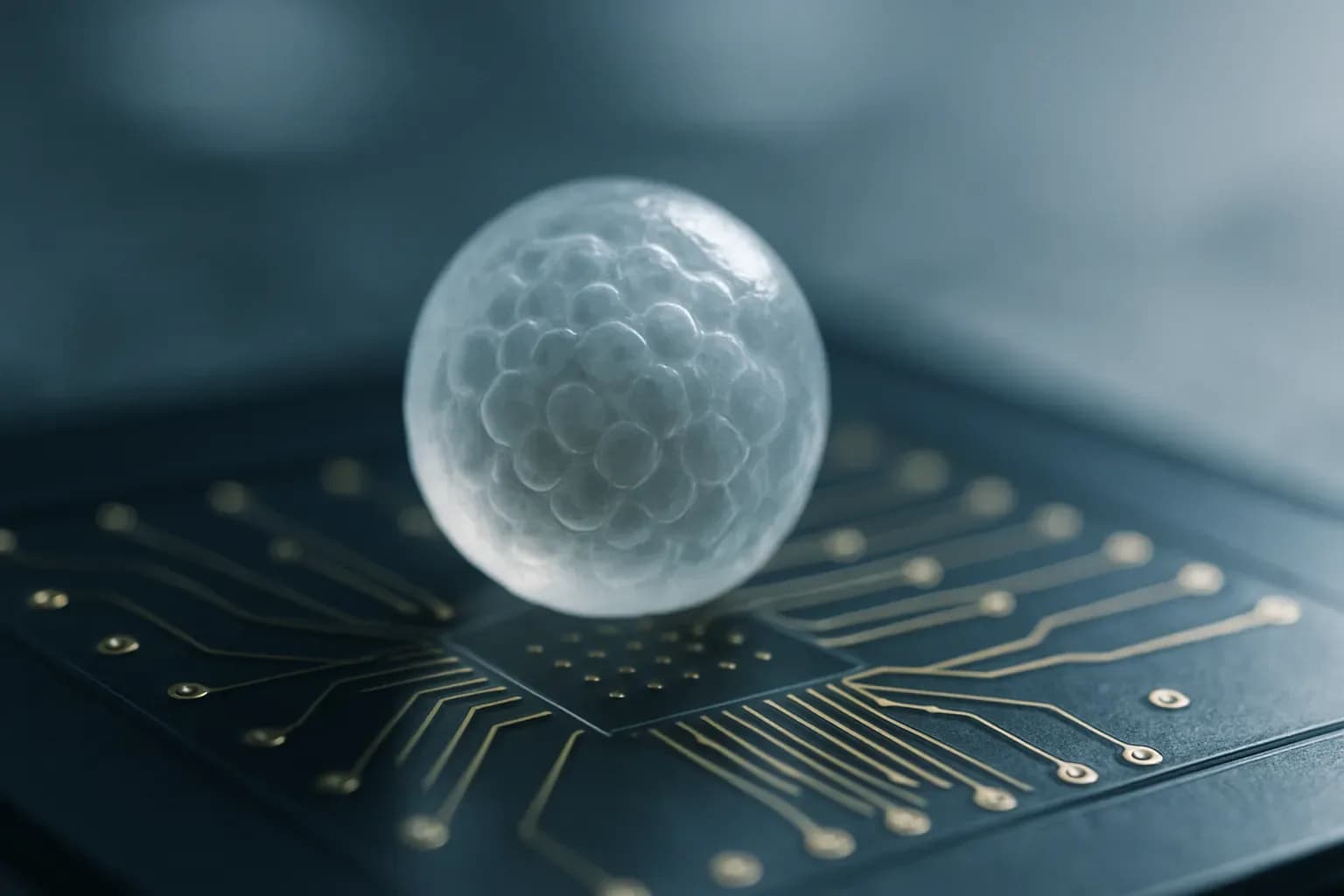
Tianyi Liu, a PhD candidate at the University of Bristol whose work focuses on how robots sense and respond to touch, led an experiment that gave human brain organoids a task based on Braille. The clusters, derived from stem cells, identified letters after receiving electrical signals corresponding to tactile patterns.
The organoids were smaller than a millimetre and sat on multielectrode arrays in a system designed to keep the tissue alive while monitoring its responses. A tactile sensor scanned the 26 letters of the Braille alphabet, which is formed from arrangements of raised dots.
The researchers converted those tactile readings into electrical stimulation patterns and delivered them to organoids containing about 10,000 neurons. Each letter produced its own pattern of neural activity.
A computer decoder then used a support vector machine, a simple machine-learning algorithm, to determine which letter had produced each response. A single organoid classified Braille letters with about 61 percent accuracy.
Advertisement
Teams of three organoids reached 83 percent accuracy. They also distinguished signals from artificial noise more effectively than a decoder analysing the obscured signals directly, without organoids.
The study, whose senior author was Dr Benjamin Ward-Cherrier of the University of Bristol, was published on Friday, 16 October 2026, in Frontiers in Artificial Intelligence. The researchers presented it as the first evidence that human brain organoids can perform Braille letter identification.
The work sits within the emerging field of organoid intelligence, which explores using organoids as biological “wetware” in computing applications. Earlier studies had established that organoids could recognise spoken Japanese vowels and play the game Pong.
Liu said the aim was to test information processing in living neural tissue. “The human brain can perform incredibly complex information processing while consuming relatively little energy, and artificial neural networks were originally inspired by biological nervous systems,” she said.
She added that the original goal “wasn't to prove that organoids could read Braille like humans, or that they were already intelligent enough to understand Braille.”
The results show that the organoids could contribute to a computational task involving tactile data. Whether such systems can be scaled for practical computing, how long they can operate, whether their accuracy can exceed 83 percent, and how their energy use compares with artificial neural networks in practice remain unknown.
Advertisement


Comments (0)