
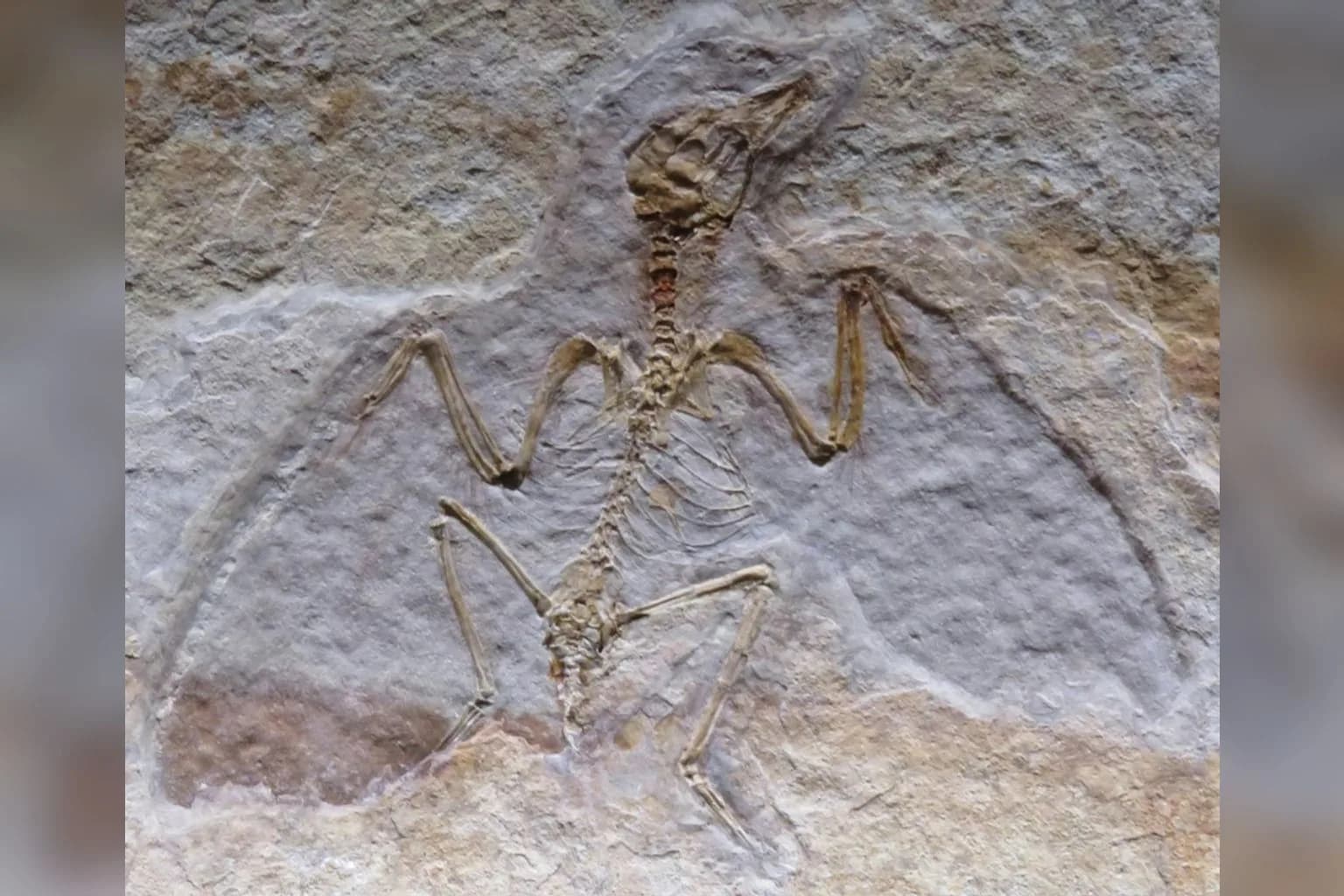
In Fujian Province in southeastern China, paleontologists unearthed a nearly complete fossil of a crow-sized bird from approximately 150 million years ago, during the Jurassic Period. They have named it Yuezhuornis yangyuanensis.
The bird weighed an estimated 1.8 pounds (800 grams), and its fully developed wings were disproportionately small for its body. Researchers say they were too undersized to allow robust flying.
Its legs and other limb proportions instead resembled those of modern pheasants. The researchers say Yuezhuornis likely lived much like a modern roadrunner, running for most of its movement and taking short flights when necessary.
Min Wang, a paleontologist at the Institute of Vertebrate Paleontology and Paleoanthropology who helped lead the Nature study, agreed with that comparison. “Yes, that is likely,” he said when asked whether the bird may have moved in the way of a roadrunner.
Advertisement
The skeleton also carried several features more familiar from dinosaurs. It had a sickle-shaped claw on a flexible second toe, similar to those of meat-eating dinosaurs including Deinonychus, Velociraptor and Troodon. Its jaws held relatively large, closely packed serrated teeth, and it had a long, bony dinosaurian tail.
Steve Brusatte, a University of Edinburgh paleontologist who was an outside expert on the finding, called the skeleton a “Frankenstein monster mashup.”
For decades, Archaeopteryx from Europe was regarded as the oldest-known bird. It combined avian and dinosaurian traits, though its well-proportioned wings showed that it was built for flying.
Yuezhuornis is one of the earliest-known birds and is similar in age to Archaeopteryx. It is among a small number of birds of comparable age found more recently.
That contrast has implications for a long-held view of bird evolution. The traditional paradigm held that early bird evolution was driven primarily by flight, with the avian body plan shaped almost exclusively by the selective pressures of getting better at it.
Wang said Yuezhuornis challenges that picture. “So this new fossil just changes our assumption about what a Jurassic bird looks like,” he said.
The discovery suggests that early birds occupied a wider range of ecological roles than previously assumed. Some species may have evolved to live on the ground, or returned to terrestrial life, rather than relying on flight.
The study also supports evidence that flight arose multiple times among early dinosaur groups. Outside experts say the fossil indicates that the earliest birds and their close relatives had more varied anatomical body plans than previously believed.
Advertisement




Comments (0)