
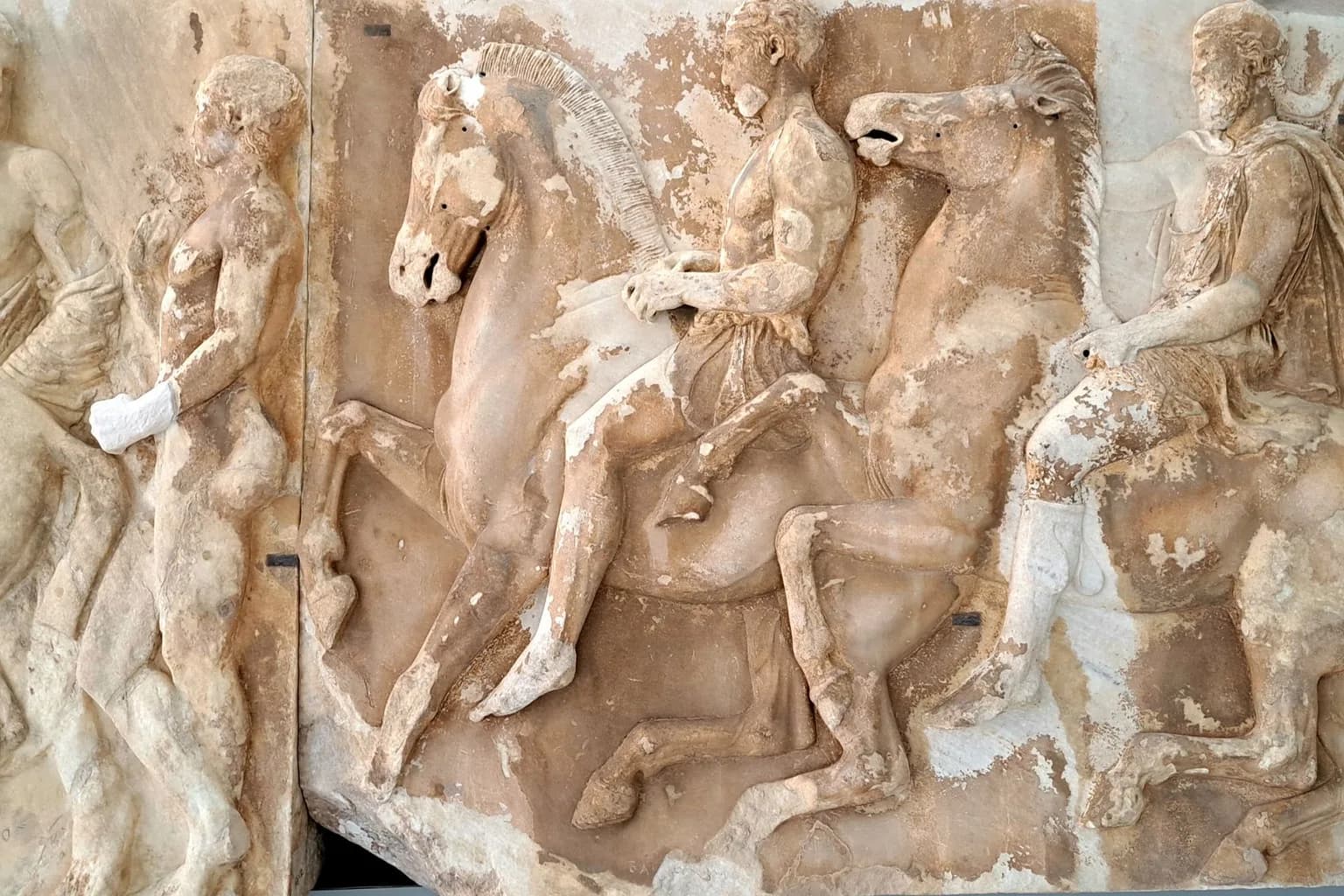
George Osborne, the chairman of the British Museum’s board of trustees, believes the Parthenon Sculptures could still spend part of their time in Athens and part in London. Osborne, who will stay in the role for another three years, says an agreement remains possible and that he has entered discussions “in really good faith”.
His proposed arrangement would see the 5th century BC works displayed alternately in Greece and Britain. “These very valuable and historically significant marbles” should spend time in both Athens and London, he has said.
The proposal comes as direct negotiations have, in practical terms, stopped. Greece and the British Museum are deadlocked over the central question: Greece seeks permanent return, while the museum is prepared to offer a loan only.
For Athens, a loan would concede the British Museum’s claim to ownership. Prime Minister Kyriakos Mitsotakis has said a settlement requires “political will”, while writing that Greece “cannot accept any arrangement that would require it to recognise the British Museum's ownership of the sculptures, or a scheme that would mean we “borrow” parts of our own monument”.
Advertisement
Lina Mendoni, Greece’s culture minister, has made clear that her government will not consider a loan arrangement.
The sculptures, created in the 5th century BC by Phidias, remain divided between the two cities. Half of the Parthenon frieze is in Athens and the other half is held by the British Museum in London.
Greece reopened direct talks with the museum in 2021 in pursuit of the sculptures’ return. The negotiations explored possible exchanges, including a rotating selection of ancient Greek artefacts sent to the UK as an inducement and as “collateral” for the eventual return of the Elgin treasures.
In 2022, Greek officials showed The Telegraph around the Archaeological Museum of Athens as they sought to demonstrate what Greece could send to Britain under a deal. By 2024, reports suggested the parties were close to an agreement and were examining creative ways through the dispute.
Those efforts foundered on the question of a long-term loan. Regular contact between Athens and the British Museum has since stopped, and Athens has signalled that formal discussions are unlikely to restart, although channels of communication have remained open.
Sources close to the talks have challenged the description of a full collapse, while accepting that a large gap remains between the sides. Greek frustration over the lack of progress has left “no talks” taking place, with none planned to resume.
The museum says a legal provision prevents it from gifting objects in its collection. Its director, Nicholas Cullinan, has pointed to France’s 10-month loan of the Bayeux tapestry to the British Museum as a possible model for an agreement over the marbles.
The dispute reaches back to the 19th century, when Lord Elgin, born Thomas Bruce, transported the marbles to Britain and sold them to the British government in 1816. Greece describes Elgin’s actions as outright theft.
In 2024, Turkish representatives at UNESCO supported Greece’s position, arguing that Lord Elgin had never secured a legitimate agreement with the Ottoman Empire to authorise the marbles’ legal transfer.
Osborne has said there is “a deal to be made” and believes the issue could be resolved before his tenure ends. He has also acknowledged the weight of the dispute: it is “obviously a long-standing issue” and “if it were easy to solve, it would have been solved at some point in the last 200 years”.
For Mitsotakis, reunification could provide the basis for a broad and enduring cultural partnership. Whether alternating displays could meet Greece’s demand for permanent return remains unresolved.
Advertisement

Comments (0)