
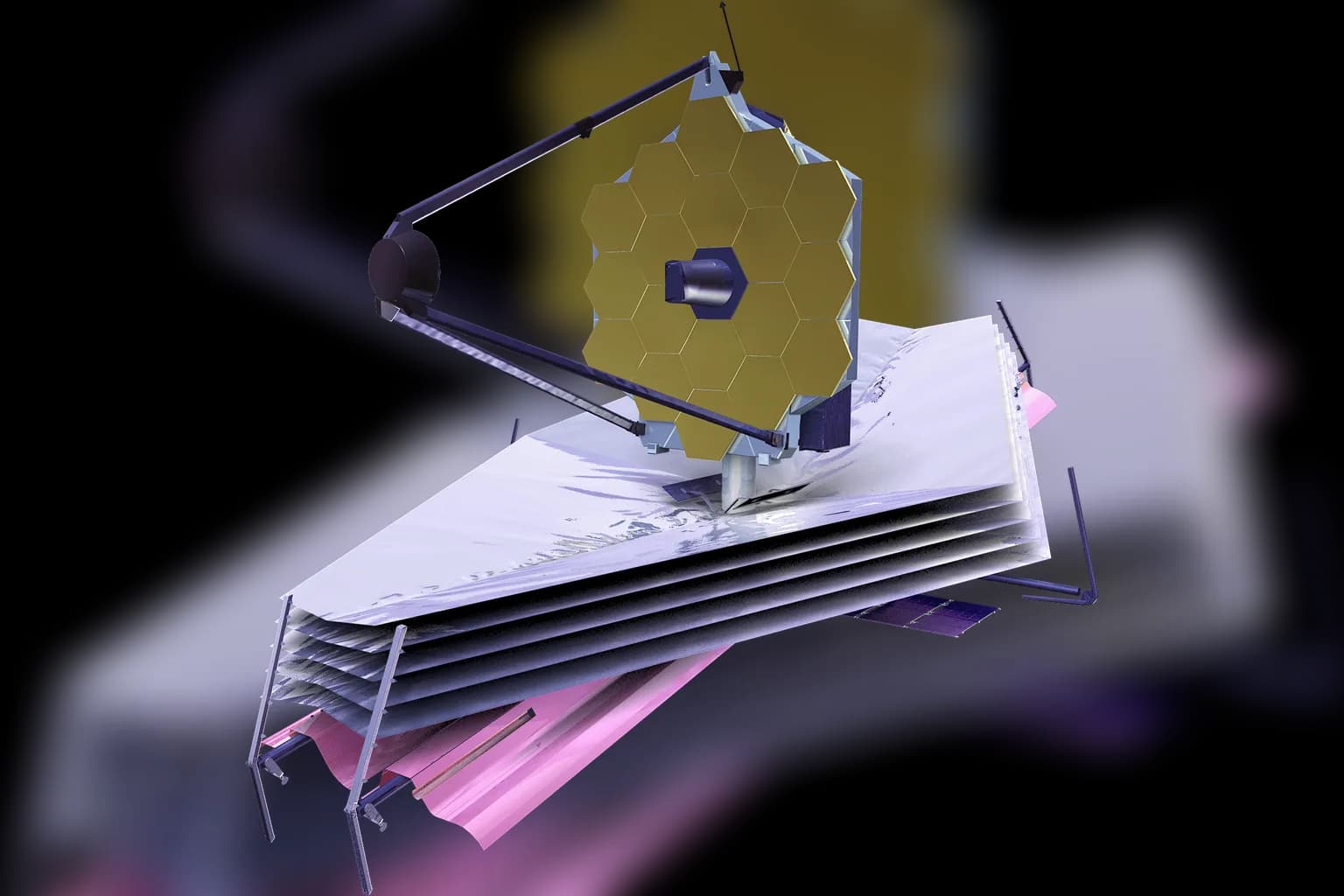
Dr. Lili Alderson and her team used NASA’s James Webb Space Telescope to measure the atmospheric edge of WASP-17b, a highly inflated gas giant 1,300 light-years from Earth that is locked to its host star. Their measurements found an atmosphere shaped as a deformed sphere, with a much more extended evening side around its equator than its morning side.
The result offers the first direct spatial measurement of an exoplanet’s asymmetrical atmosphere, according to a joint study by Cornell University and the University of Bristol published in Nature Astronomy.
For years, astronomers have generally modelled exoplanet atmospheres as perfect spheres with uniform properties. WASP-17b presents a more complicated picture. One hemisphere remains permanently lit by its star while the other is permanently dark.
High-speed winds at the planet’s equator carry superheated material from the illuminated side towards the night side. The atmosphere on the evening side expands, then cools as it travels towards the morning limb, leaving the morning side more compressed.
Advertisement
The researchers used a method called transmission strings, developed by the Bristol astrophysicists Dr. David Grant and Dr. Hannah Wakeford. The algorithm measures the changing distance between a planet’s centre and the outer edge of its atmosphere at several angles across its poles.
Alderson’s team applied the technique to James Webb data and measured the form of WASP-17b’s transmitting limb as it changed across the planet’s poles for the first time.
The findings support theoretical predictions that WASP-17b would have sharp temperature contrasts between its day and night sides, as well as between its morning and evening sides.
Planets are three-dimensional bodies whose thermal structure and atmospheric dynamics shape them, and observations of transiting exoplanets are beginning to reveal that complexity, the researchers said.
The paper, titled ‘A spatial map of the atmospheric limb of a hot Jupiter’, was published in Nature Astronomy on 14 October 2026. It was written by Lili Alderson, Hannah R. Wakeford and Tiffany Kataria, who co-authored the study.
Alderson described the result as a proof of concept for studying exoplanets as complex, three-dimensional worlds rather than uniform spheres. The demonstration could allow three-dimensional weather mapping of many more exoplanets, moving beyond broad day-night averages.
Advertisement



Comments (0)