
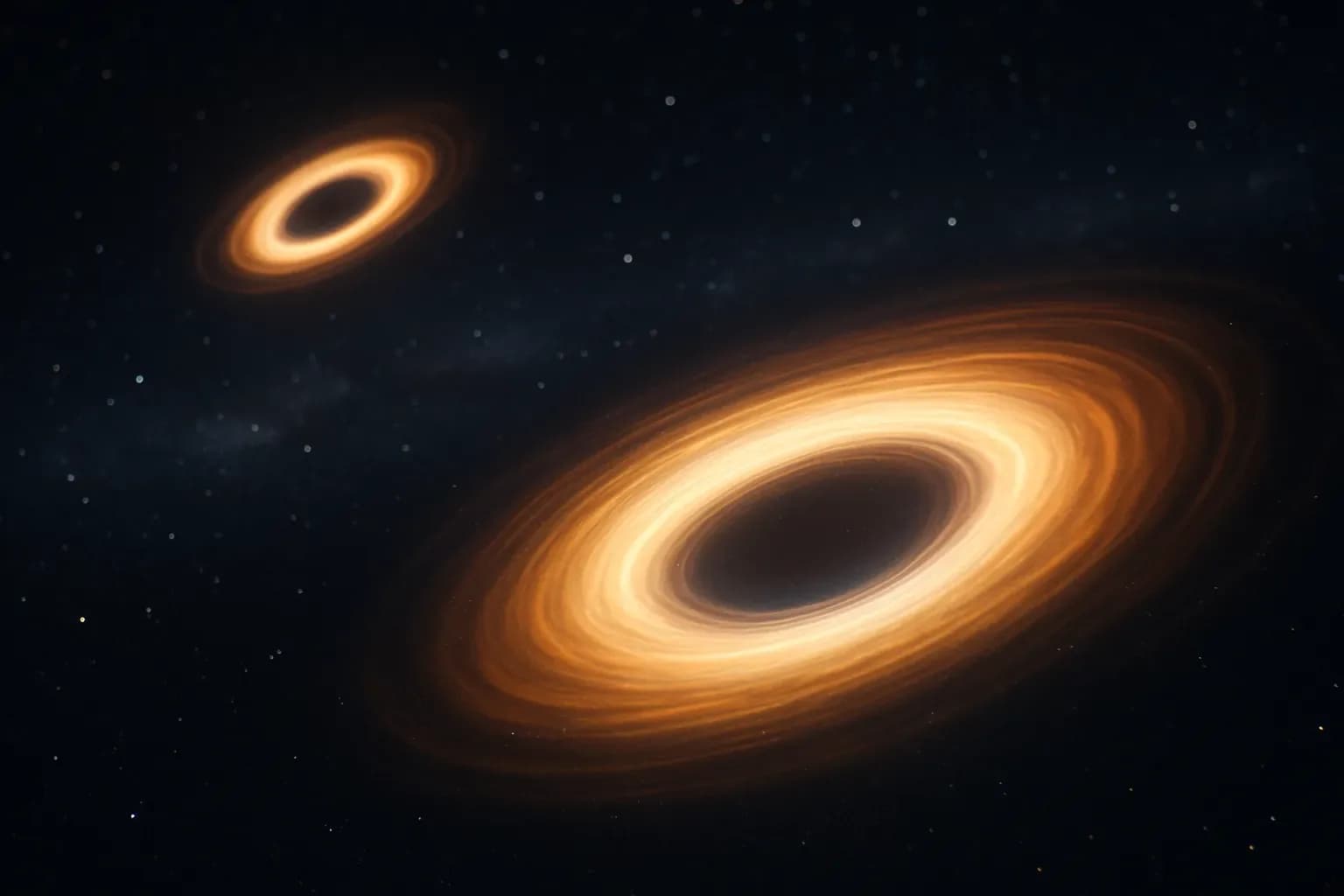
Two supermassive black holes were feeding while separated by 570 light-years in a galaxy seen 2 billion years after the Big Bang. The close pairing is in a system known as MG B2016+112.
The system lies at a redshift of 3.273, meaning its light set out towards Earth when the universe was approximately two billion years old. The separation is 175 parsecs, or roughly 570 light-years.
The investigation was led by Jianghao Huyan and Júlia M. Sisk-Reynés, who studied archival observations gathered in 2018 by the Multi Unit Spectroscopic Explorer, known as MUSE, on the European Southern Observatory's Very Large Telescope.
Gravitational lensing created three visible images of the distant system, labelled A, B and C.
Advertisement
Images A and B produced matching values in an emission-line ratio analysis, while C produced a substantially lower ratio. The researchers examined emission lines from hydrogen, nitrogen, carbon and helium, and found one ratio useful after correcting for absorption linked to the Milky Way and masking absorption near the distant quasar.
The black hole associated with A and B has a mass of at least approximately 20–23 million solar masses. The black hole associated with C has a mass of at least 15 million solar masses.
The Eddington ratios for A and B were approximately 47% and 51%, respectively. C's value was only about 4%.
The findings were set out in a study posted to arXiv, in a preprint dated 25 September 2026.
Supermassive black holes are widespread in the centres of massive galaxies in the local Universe. Astronomers have also found hundreds of luminous quasars at redshift z>6, from a period when the Universe was less than one billion years old.
The James Webb Space Telescope has made it possible to detect fainter and smaller black holes at larger cosmological distances than previously possible.
MG B2016+112 adds a close, active pair to the evidence from the early universe. It bears on efforts to understand how supermassive black holes and their host galaxies grew so rapidly at that time. How the two black holes came to be so close, whether they will merge, and whether similar pairs are common remain unknown.
Advertisement



Comments (0)