
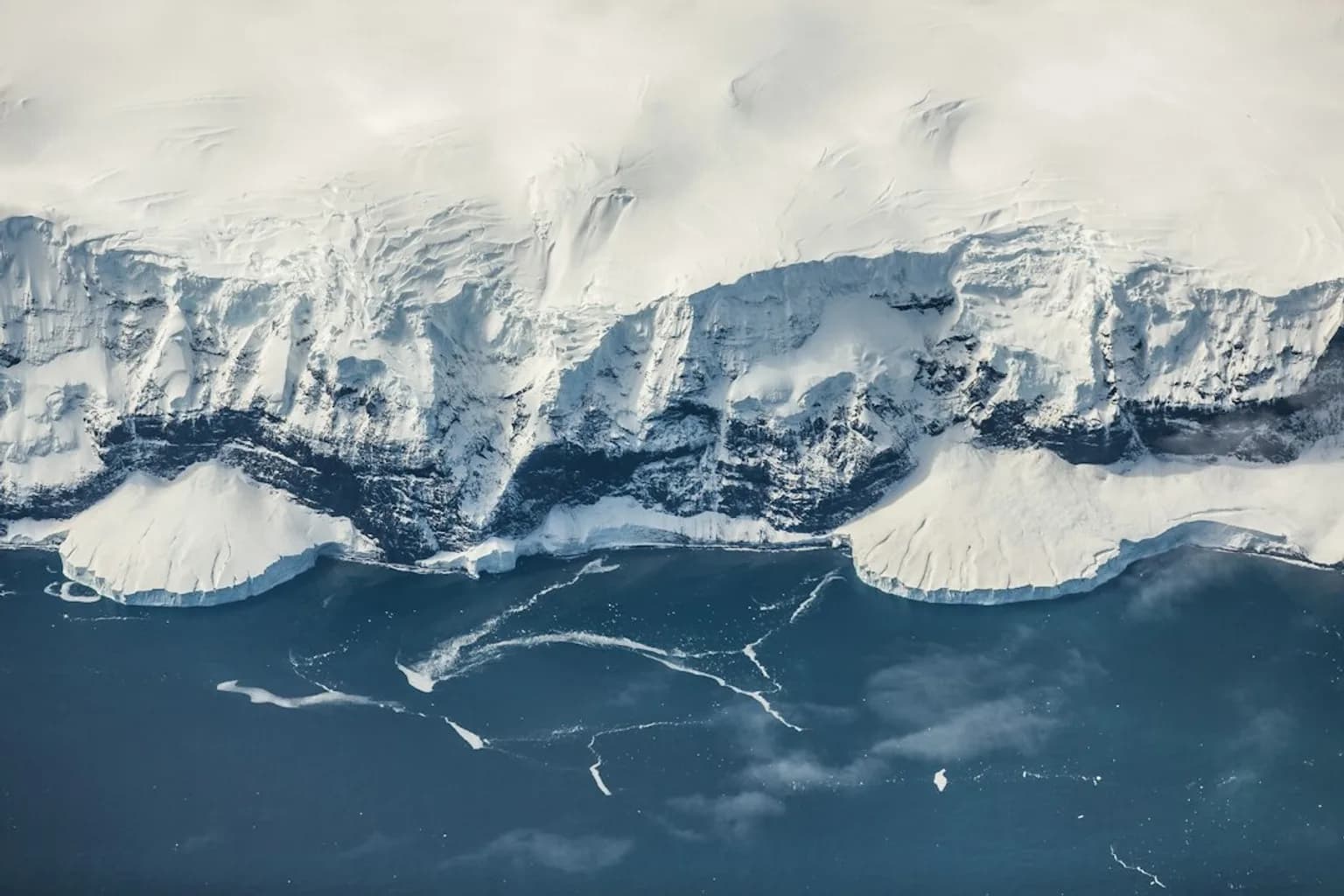
Mattia Poinelli, the lead author of a new ice-sheet model, and co-author Eric Rignot have traced faster-than-expected melting at Antarctica’s Thwaites Glacier to warm seawater moving beneath the ice. Poinelli was a UC Irvine postdoctoral scholar in Earth system science when the study was conducted, while Rignot is a UC Irvine professor of Earth system science.
The findings, published this week in Nature Communications, come from researchers at the University of California and NASA’s Jet Propulsion Laboratory. They found that seawater is reaching deep under the glacier and melting its core through tidal pumping, helping explain why Thwaites is shedding mass more quickly than earlier models indicated.
Scientists first identified rapid melting at Thwaites in the 1980s. The glacier has retreated for decades, and researchers now say its loss of mass is accelerating beyond what they had expected.
Thwaites lies on the Walgreen Coast of Marie Byrd Land, in remote western Antarctica’s Amundsen Sea Embayment sector. It covers around 192,000 sq km (74,130 sq miles), making it roughly the size of Senegal and larger than the US state of Florida.
Advertisement
The team changed how the computer model represented the point where grounded ice meets the ocean. Instead of a narrow “grounding line”, it used a “grounding zone” that can be several kilometres wide. Within that zone, seawater can penetrate several kilometres under grounded ice and lift it with the tides, a process called “tidal pumping”.
The researchers calibrated the model with observations covering more than 20 years, including synthetic aperture radar readings from the Finnish ICEYE satellite constellation. Research on the Eastern Ice Shelf was conducted in 2020.
The resulting projection is that Thwaites could add up to 30 millimeters (1.2 inches) to sea level by 2100 without additional climate warming. That amount is also given as 1.2 inches (30mm), and is twice previous estimates of the glacier’s contribution over the next century.
Attention is also on the glacier’s Eastern Ice Shelf, which research suggests is likely to break up sometime within the next two decades. Simulations using a 4-6-kilometer grounding zone put the probability of unpinning the Mouginot Ridge, which stabilises Thwaites’s main trunk, at 60 percent by the end of the century.
Thwaites currently accounts for around 4% of global sea-level rise. Together with glaciers including Pine Island, it acts as a barrier holding back the West Antarctic ice sheet, which is 14 times the size of Thwaites. The glacier holds enough water to raise sea levels by more than 2 feet if it collapsed, while a collapse could ultimately lead to around 10 feet of sea-level rise.
Its size, vulnerability and potential influence have earned Thwaites the nickname “Doomsday Glacier”.
Advertisement

Comments (0)