
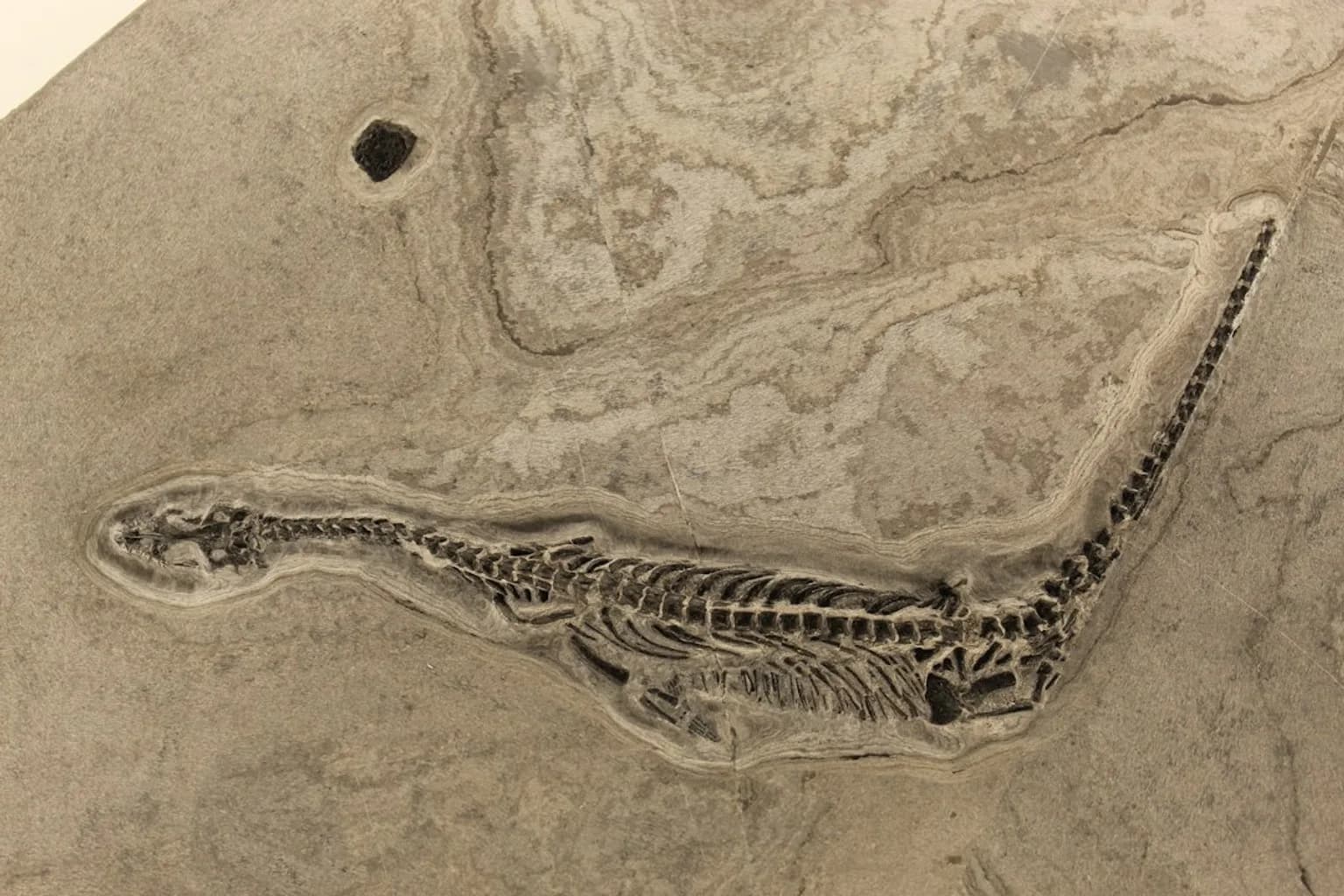
At the Panandhro Lignite Mine in Kutch, Gujarat, paleontologists found 27 fossilised vertebrae, some still arranged in their original anatomical order. Debajit Datta and Sunil Bajpai of the Indian Institute of Technology Roorkee identified the remains as a previously unknown species, Vasuki indicus.
The name honours Vasuki, the mythical serpent associated with the Hindu deity Shiva. Dating placed the animal in the Middle Eocene, roughly 47 million years ago. The discovery was described in the journal Scientific Reports in 2024.
The bones offer an unusual measure of a creature whose full skeleton has yet to be found. Individual vertebrae were between 37.5 and 62.7 millimetres long and between 62.4 and 111.4 millimetres wide, indicating a very thick-bodied snake. Researchers used two methods to reconstruct its size, producing estimates of 10.9 to 12.2 metres (36 to 40 feet) and 14.5 to 15.2 metres (48 to 50 feet).
At the upper end of that range, Vasuki indicus could have reached 15.2 metres (50 feet). That would place it alongside, or potentially beyond, Titanoboa, which inhabited what is now Colombia approximately 60 million years ago and is thought to have reached around 13 metres (43 feet). Titanoboa had previously been considered the largest snake in history.
Advertisement
The comparison remains provisional. Paleontologists say the absence of a complete skeleton limits the accuracy of the size reconstruction. The differing estimates also leave a wide range between the smaller and larger reconstructions.
Vasuki indicus belonged to Madtsoiidae, an extinct snake family that survived for roughly 100 million years, from the Late Cretaceous to the Late Pleistocene. Members of the family occupied India, Africa, Europe, South America and Australia. Vasuki is the largest known member of Madtsoiidae.
Its habitat was tropical. During the Middle Eocene, the region where it lived had average temperatures estimated at approximately 28 degrees Celsius (82 degrees Fahrenheit). The researchers suggest the animal was likely a land or swamp-dwelling hunter that relied on ambush rather than speed or agility.
“Vasuki was a slow-moving ambush predator,” Datta said.
What it hunted, and the full shape of its body, remain unknown. Yet the vertebrae from Gujarat have opened a challenge to Titanoboa’s long-held record, with a snake that may have rivalled the largest known snakes in history.
Advertisement



Comments (0)