
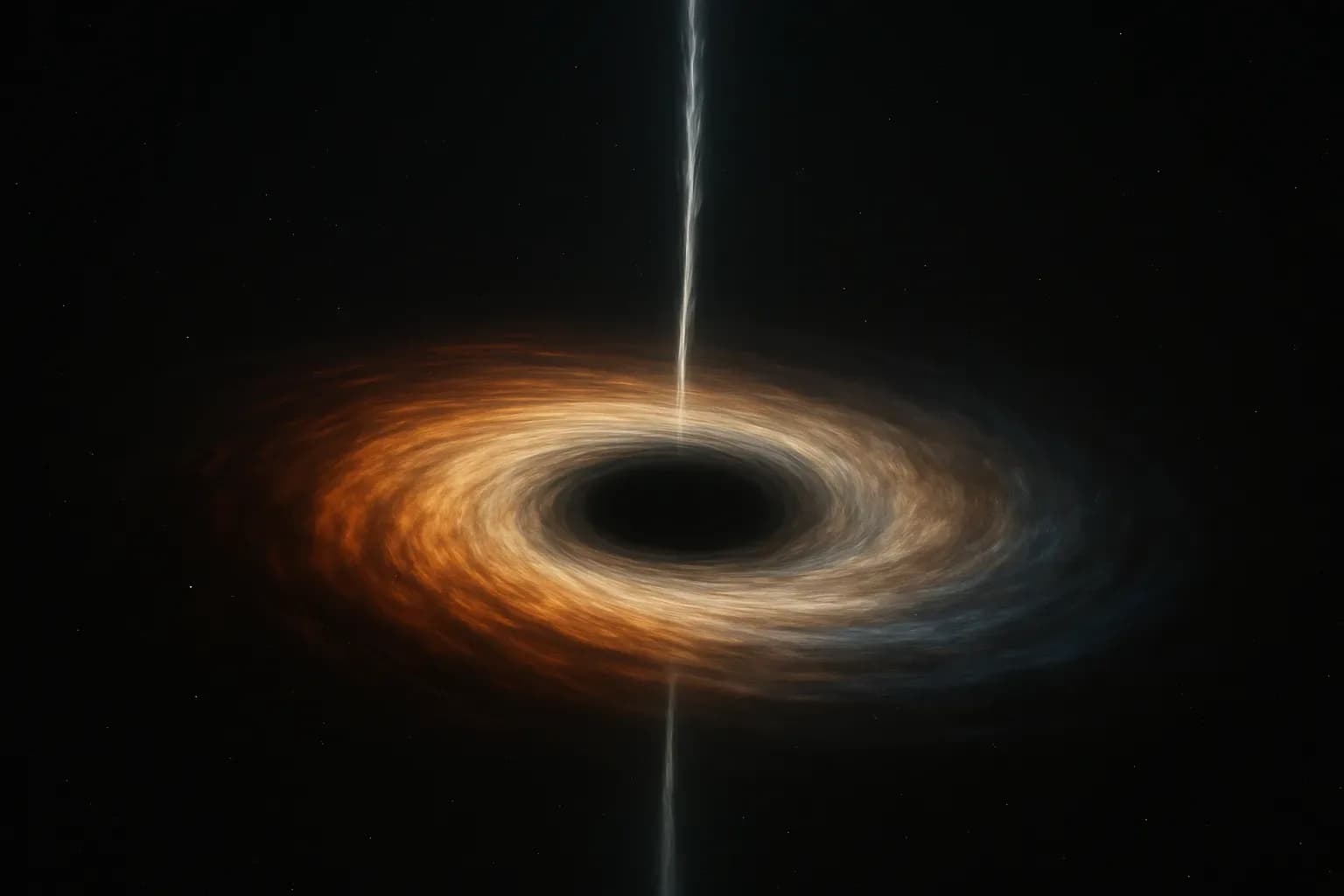
At a scientific conference in Madrid, Adelle Goodwin, a Forrest Research Foundation Fellow at Curtin University’s International Centre of Radio Astronomy Research in Western Australia, discussed an enduring puzzle with Andrew Mummery, a Martin A. and Helen Chooljian Member (2025-30) in the School of Natural Sciences at the Institute for Advanced Study in Princeton. Mummery asked: “Why do some supermassive black holes blast out radio jets right after shredding a star, while others just sit there looking completely dormant, only to suddenly fire up their jets months or even years later?”
Their international team has identified what it describes as a universal rule for when black holes launch powerful jets. The result links black holes about ten times the mass of the sun with supermassive black holes millions of times heavier, finding that the connection between feeding and jet production is scale invariant across seven orders of magnitude in mass.
The researchers focused on tidal disruption events, in which a star passes so close to a supermassive black hole that gravitational forces tear it apart. “When a black hole tears apart a star, it does not swallow everything neatly,” Goodwin said.
They combined observations from telescopes in America, Australia, India, South Africa and space, looking across optical and ultraviolet light, X-rays and radio waves. The team examined twenty tidal disruption events, then narrowed the work to ten high-quality events where it could reliably establish both the black hole’s feeding rate and the timing of its radio outflows.
Advertisement
The data showed two periods in which jets form. One comes early, while the black hole is consuming material at an extremely high rate. The other arrives hundreds to thousands of days after the star was first torn apart.
In that later phase, the feeding rate has fallen to about two percent of the Eddington limit. That threshold is already known to trigger jet formation in much smaller black holes within the galaxy.
The study, published in Nature Astronomy under the title “A universal critical accretion rate for black hole jet formation”, suggests that black holes of very different masses reach the same critical point before launching these later jets. Black hole jets can travel at speeds that can change how galaxies evolve, while astrophysicists devote telescope time to trying to catch such jets in action.
Advertisement



Comments (0)