
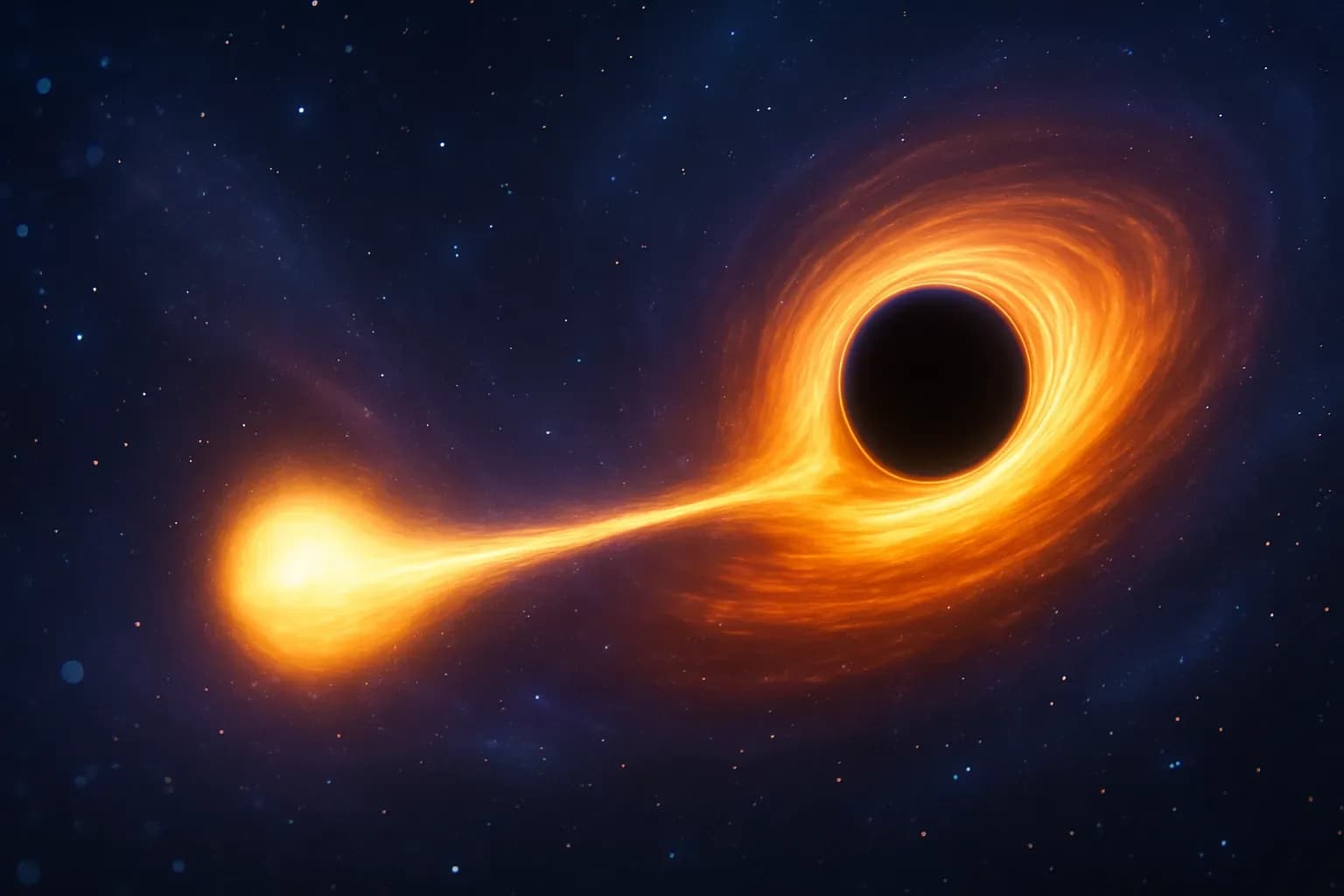
A massive black hole wandering 1.08 ± 0.04 kpc from the centre of its host galaxy tore apart a star, producing the bright flare now known as TDE 2023mfm. A group of astronomers from the USA, China and Sweden discovered the event, which offers a way to find massive black holes far outside galactic centres.
The event is a tidal disruption event, or TDE, caused by a wandering massive black hole. When a star passes too close to a black hole, tidal forces can shred it and create a flash of light that identifies the black hole's location.
The disrupting black hole has a mass of approximately 10^6.2 ± 0.5 solar masses. Its host is a massive galaxy with a mass of approximately 10^11 solar masses, and contains a central low-luminosity active galactic nucleus, or AGN.
Measurements place the flare source 0.66 ± 0.02 arcseconds from the galaxy's centre. That corresponds to a projected distance of 1.08 ± 0.04 kpc, or more than 1,000 parsecs.
Advertisement
The optical flare stayed hot. Its emission temperature remained at approximately 22,000 ± 1,000 K for more than a month after its peak.
In the g-band, the light curve reached (2.24^+0.10_-0.11) × 10^43 erg s^-1 and remained above half its maximum luminosity for 47.8^+3.7_-3.5 days.
A broad hydrogen line gave astronomers a clear classification: TDE-H, a category whose spectra show hydrogen lines only.
Late optical-to-ultraviolet observations with the Hubble Space Telescope, or HST, suggest an unresolved stellar population at the event's position, with a stellar mass of 10^7-10^8 solar masses. That population may be a low-mass dwarf galaxy or the remnant of a galaxy stripped in an earlier minor merger.
Radio emission appeared at least a year after the optical discovery and likely came from a delayed outflow. Researchers found no X-ray radiation from the event itself.
The galaxy's weak active-nucleus emission clearly shows a black hole at its centre. Astronomers therefore rule out both ejection scenarios, because the system contains two black holes.
They consider a collision with a small galaxy the most plausible explanation for the offset black hole. The discovery and analysis drew on observations from ZTF, Lick, Keck, Swift, Chandra, XMM-Newton, HST and VLA.
The black hole's exact history remains unclear, as does the full nature of the unresolved stellar population and the reason for the late radio signal. The event nevertheless shows how a star's destruction can expose massive black holes moving through unexpected parts of a galaxy.
Advertisement



Comments (0)